Uga Ulagalla

Michelin Selected
A Michelin Selected walawwa estate in Sri Lanka's Cultural Triangle, Uga Ulagalla occupies a restored colonial manor house set among paddy fields and ancient reservoirs outside Anuradhapura. The property sits within the orbit of some of the island's oldest Buddhist sites, placing it in a distinct tier of heritage-led luxury that few properties in the north-central province can match.

Pearl is the En Primeur Club membership app, where members save venues, book tables and use the concierge.
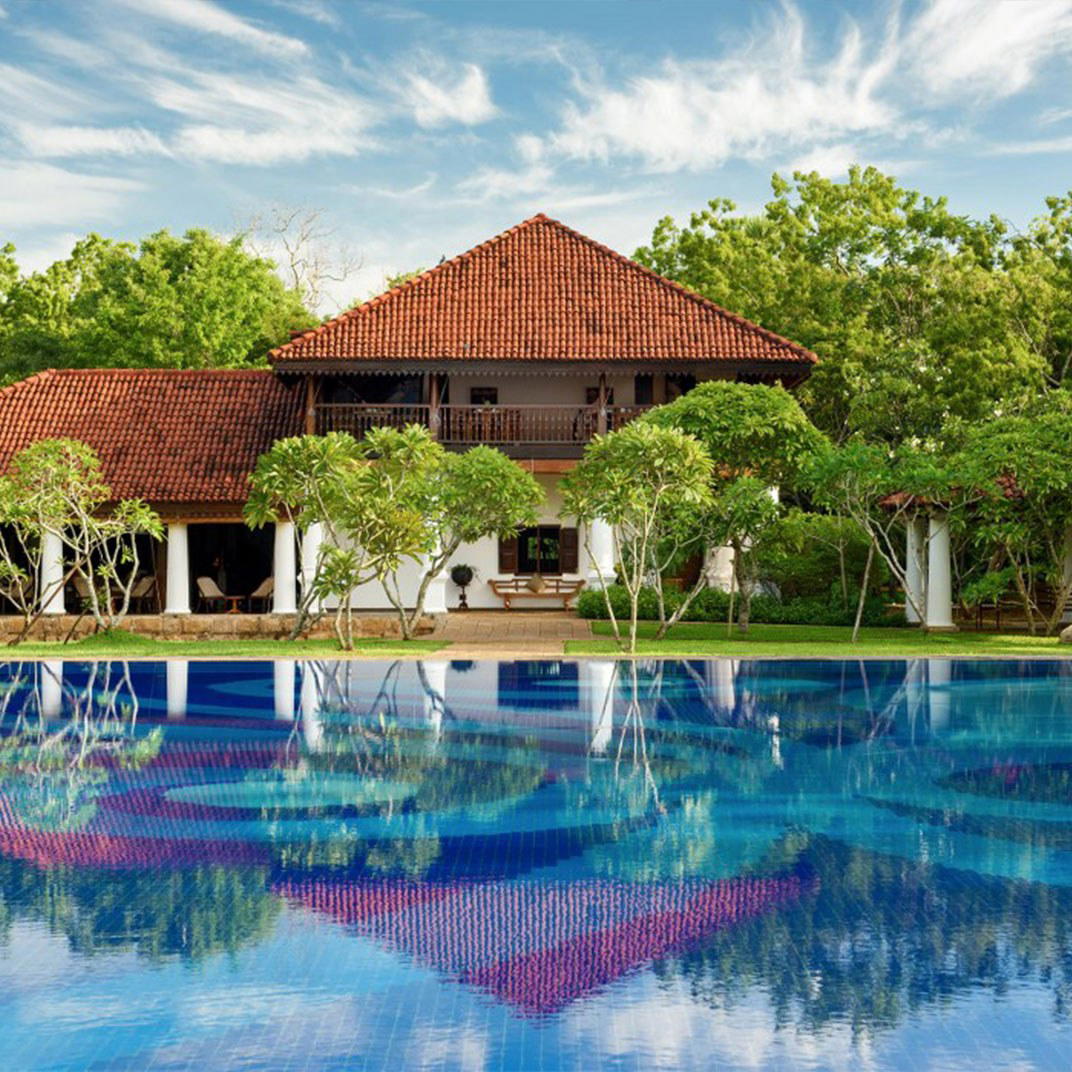
The approach to Uga Ulagalla sets the terms immediately. A single-lane road threads through paddy fields and past seasonal irrigation tanks that have been in use since the pre-Christian era, with Anuradhapura's ancient stupas visible on the horizon at certain angles. By the time the walawwa, the traditional Sri Lankan manor house at the property's centre, comes into view, you have already been inducted into the particular quiet that defines the Cultural Triangle's interior. This is not a resort that competes with coastal spectacle. It operates in a different register entirely.
A Colonial Manor in the Cultural Triangle
Sri Lanka's premium accommodation sector has organised itself along recognisable fault lines over the past decade. Coastal properties, concentrated around Galle, Weligama Bay, and the east-coast beaches, have absorbed the majority of international investment and editorial attention. Amangalla in Galle and Cape Weligama in Weligama Bay represent that coastal canon. The north-central interior, by contrast, has remained comparatively underdeveloped as a luxury destination, despite containing the densest concentration of UNESCO World Heritage Sites on the island. Uga Ulagalla occupies a rare position in this gap: a property with genuine heritage architecture, set against the backdrop of Anuradhapura, one of the world's oldest continuously inhabited cities.
The walawwa building type, the manor houses of Sri Lanka's landed families, carries specific architectural logic. These structures were designed to mediate between formal reception and domestic life, with deep verandas acting as transitional spaces, thick masonry walls providing thermal mass against equatorial heat, and interior courtyards drawing airflow through the building. At Ulagalla, this inherited geometry has been preserved and extended rather than replaced. Where contemporary luxury properties in the region tend toward pavilion-and-pool arrangements that could exist anywhere in tropical Asia, the walawwa's specific proportions and material palette remain legible throughout. The timber columns, the terracotta floor tiles, and the recessed verandas all point to a design tradition rooted in the particular climate and social conditions of the Dry Zone.
Architectural Language and the Logic of Space
Heritage-led hospitality in South Asia has a complicated record. The conversion of traditional structures into luxury accommodation often produces properties caught between two ambitions: preservation and performance. The more successful examples, and there are precedents in Rajasthan's palace hotels and Sri Lanka's own colonial-era properties, resolve this tension by letting the original structure set the spatial rules rather than treating it as decorative overlay. Uga Ulagalla's design approach aligns with that discipline. The manor functions as the social and architectural anchor, with accommodation distributed across the estate in a way that preserves the legibility of the original property's hierarchy of spaces.
In the broader context of north-central Sri Lanka, this matters. Heritance Kandalama in Dambulla, Geoffrey Bawa's late-career commission, established the benchmark for architecture that takes the landscape and historical substrate of the Cultural Triangle seriously. Water Garden Sigiriya in Sigiriya represents a more recent iteration of the same ambition. Ulagalla's walawwa heritage positions it within this tradition of place-specific design, though its distinction comes from the authenticity of the original structure rather than from a single architect's authorial vision.
Setting and Surroundings
The estate sits within the ancient hydraulic civilisation of the Anuradhapura kingdom, a landscape still defined by the wewa, the irrigation reservoirs built and maintained over two millennia by successive dynasties. These tanks are not scenic accessories. They are functioning agricultural infrastructure, and the paddy cultivation they support gives the Ulagalla estate its particular texture across different seasons. During the cultivation periods, the surrounding fields are active working landscapes; during dry months, the tanks and their margins take on a drier, more austere character that aligns with the archaeology of the region.
Anuradhapura itself, the nearest major site, requires early-morning visits to experience before the heat concentrates and coach groups arrive. The sacred city's main complex is most coherent in the first two hours after dawn, when the white-painted dagobas catch the low light and the site remains comparatively uncrowded. A property positioned this close to the complex, with the ability to arrange private vehicle access before standard tourist hours, holds a timing advantage that more distant properties cannot replicate. For those extending into the wider Cultural Triangle, Sigiriya and Polonnaruwa are both reachable as day trips, though Polonnaruwa in particular is more rewarding with a full day and an informed guide.
Uga Bay and the Wider Collection
Within the Uga Hotels portfolio, Ulagalla occupies the heritage position that Uga Bay in Passikudah does not attempt: where the east-coast property is built around beach access and water sports, Ulagalla's value is archaeological and architectural. This internal differentiation matters when planning a multi-property itinerary across Sri Lanka. The two properties serve different moments in a trip rather than competing for the same travel motivation. A sequence that moves from Anuradhapura south to Colombo and then east to the coast creates a coherent geographic and experiential arc, with Ulagalla anchoring the Cultural Triangle portion.
For other regional properties worth holding against Ulagalla when calibrating expectations for heritage-led accommodation in Sri Lanka's interior, Taru Villas Maia in Habarana offers a smaller-scale boutique alternative in the same general zone, while Ceylon Tea Trails in the hill country interior represents the island's other major heritage-conversion success story, though in a completely different climate and landscape. Our full Thirappane guide maps the region's accommodation options against the specific sites and travel patterns that define the Cultural Triangle circuit.
Michelin Selection and What It Signals
Uga Ulagalla carries a MICHELIN Selected distinction in the 2025 Michelin Hotels guide, placing it within the cohort of properties that the guide's hotel inspectors have identified as meeting a standard across accommodation quality, design, and service consistency. In the Sri Lankan context, this selection is meaningful as an external quality marker: the local hotel sector does not yet have the depth of Michelin-starred restaurants that would make the restaurant distinction system directly relevant, but the hotels guide has been extending its coverage of South and Southeast Asian destinations, and selection at this level positions Ulagalla alongside a small number of Sri Lankan properties that have cleared that editorial threshold. Properties such as Kahanda Kanda Galle in Angulugaha and Karpaha Sands in Kalkudah Beach occupy comparable positions in the design-led, limited-key tier of Sri Lankan accommodation.
Planning Your Stay
The north-central province is most hospitably visited between November and April, when the northeast monsoon has cleared and temperatures, while warm, have not reached the extreme heat of the April-to-May period immediately preceding the southwest monsoon. Anuradhapura is approximately 200 kilometres north of Colombo by road, a journey of roughly three to four hours depending on traffic through the city's northern exits. The nearest domestic airport is Sigiriya, which handles light aircraft connections on certain routes, though Colombo's Bandaranaike International Airport remains the primary entry point for international arrivals. Advance booking is advisable for high season months of December through March, when the Cultural Triangle receives its heaviest concentration of visitors and estate properties with limited keys fill quickly. For those building a wider Sri Lanka itinerary, The Last House in Tangalle, Taru Villas Levita in Kandy, and Nine Skies in Demodara represent complementary options across the south, hill country, and tea-growing regions respectively.
How It Stacks Up
Comparable venues nearby, for context on price, style, and recognition.
| Venue | Cuisine | Price | Awards | Notes |
|---|---|---|---|---|
| Uga UlagallaThis venue (the venue you are viewing) | Restored heritage walawwa estate with contemporary eco-luxury villas | Not listed | Michelin Selected | Not listed |
| Tekanda Lodge | Handcrafted eco-lodge blending traditional iluk-thatched architecture with modern luxury on a restored tea and coconut plantation | $200–300 | Michelin Selected | Kathaluwa |
| Maya Tangalle | Restored 19th-century colonial manor with modern comforts | $100–200 | Michelin Selected | Aranwella |
| Wattura Resort and Spa | Upscale boutique beach resort blending Sri Lankan heritage with modern luxury. | $300–500 | Michelin Selected | Waikkal |
| Aarunya Nature Resort | Luxury boutique nature retreat blending Kandyan hospitality with immersive wellness. | $500–750 | Michelin Selected · Condé Nast Johansens Best Countryside Hotel | Kandy |
| Marino Beach Colombo | Urban luxury beachfront hotel blending modernity and elegance | Not listed | Preferred Hotels Member | Bambalapitiya |
Recognition history
Dated appearances from independent guides and award organizations, with the underlying list record or original source where available.
Michelin Selected
Michelin
Continue exploring
More in Thirappane
Hotels in Thirappane
All hotels in Thirappane →
Restaurants in Thirappane
Browse all →
Details
- Quiet
- Elegant
- Scenic
- Rustic
- Sophisticated
- Intimate
- Honeymoon
- Romantic Getaway
- Wellness Retreat
- Weekend Escape
- Private Villa
- Infinity Pool
- Destination Spa
- Garden
- Panoramic View
- Pool
- Spa
- Fitness Center
- Room Service
- Concierge
- Valet Parking
- Wi Fi
- Outdoor Pool
- Garden
- Waterfront
- Wheelchair Accessible
Serene and tranquil atmosphere with natural surroundings, lush greenery, and unhurried luxury enhanced by thoughtful design and polished service.