← Guides
Maison Les Cinq Filles, founded in 2017, now has 2026 Gold and Grand Master medals tied to Yvonne Seier Christensen’s name.
Maison Les Cinq Filles, founded in 2017, now has 2026 Gold and Grand Master medals tied to Yvonne Seier Christensen’s name.
In 2017, Yvonne Seier Christensen entered Champagne without family vineyards, inherited cellars, or a generational estate name; by 2026, according to The Drinks Business, Maison Les Cinq Filles had won Gold for Cuvée Les Chapelles at The Champagne Masters and Grand Master for Rosé de Saignée at The Global Rosé Masters. That is the cleanest answer to what makes the Yvonne Seier Christensen Champagne story different: an outsider with banking discipline, Michelin-star restaurant experience, and a winemaking education at Plumpton College built a house that has begun to collect medals before its tenth anniversary (Thedrinksbusiness1).
Champagne does not usually hurry for newcomers. The region rewards patience, family continuity, access, and an instinct for rules written long before any contemporary entrepreneur arrived with a new label. Seier Christensen's path does not fit that pattern. Her background runs through banking, gastronomy, and luxury businesses; her family story spans Nigerian heritage, an English upbringing, Danish family life, and French terroir. The maison's name, Maison Les Cinq Filles, comes from her five daughters (Thedrinksbusiness1).
The point is not that Champagne needed an outsider to explain itself. It did not. The point is more precise: Seier Christensen came to the region without the usual inheritance, then chose technical study and gastronomic fluency as her route in. For collectors and wine travellers, that makes her house a useful case study in how new Champagne names earn trust when they cannot lean on centuries of cellar dust.
Before Maison Les Cinq Filles, Seier Christensen worked in banking and founded businesses across gastronomy and luxury, according to The Drinks Business. That matters because Champagne is not merely a vineyard story. It is also a patience story, a cash-flow story, a distribution story, and a hospitality story. Bottles may carry romance, but they also carry decisions that begin years before anyone hears the cork.
Banking gives a person a particular relationship with time. Champagne demands one too. The wine has to be made, held, positioned, poured, explained, and judged in a category where the established houses already occupy shelf space, restaurant lists, and collector memory. A new producer cannot rely on reflex recognition. The liquid has to survive the scrutiny of people who already have preferences.
Seier Christensen did not arrive as a hobbyist looking for a label to place beside a family crest. The Drinks Business frames her as an entrepreneur with a record in banking, gastronomy, and luxury. That combination gives the Yvonne Seier Christensen Champagne profile a different centre of gravity from the familiar grower succession narrative. She was not stepping into a family press house. She was building a name that had to make sense to sommeliers, buyers, and guests who know Champagne's old addresses.
There is also a certain tension in this path. Banking teaches risk control; Champagne asks for faith in long timelines. Gastronomy teaches immediacy; Champagne often reveals itself after patience. Luxury teaches detail; winemaking punishes superficial detail. Seier Christensen's move into Champagne sits at the intersection of those disciplines, and Maison Les Cinq Filles gives the intersection a bottle.
Maison Les Cinq Filles carries a personal name before it carries a commercial one. Seier Christensen has five daughters, and the source material identifies that family legacy as the foundation for the maison's name. In a region where lineage often appears on labels, hers is not ancestral Champagne lineage. It is maternal lineage.
That distinction gives the house its emotional architecture. The five daughters are not a decorative backstory; they explain why the maison's name feels domestic rather than dynastic. Maison Les Cinq Filles does not ask you to imagine a château handed down through centuries. It asks you to consider what a first-generation founder chooses to build when she wants the next generation to inherit more than a business plan.
The outsider status matters because Champagne can be difficult terrain for anyone without inherited access. The source describes Seier Christensen as coming into the industry without a generational wine estate, and her own public reflection names that absence directly. She did not have the automatic legitimacy that comes from a family domaine. She had to construct her authority through education, technical seriousness, gastronomic credibility, and the wines themselves.
That is where Maison Les Cinq Filles becomes more than a new label. A house founded in 2017 and now approaching its tenth anniversary has entered the period when early choices begin to show more clearly. Champagne rewards consistency, but consistency cannot be claimed in the abstract. It is tested in cuvées, in competitions, in restaurant settings, and in the patience of repeat drinkers.
For collectors, the absence of a long estate history is not automatically a weakness. It changes the questions. Instead of asking which ancestor first planted which slope, you ask how the founder thinks, what she has chosen to learn, where the wines have been judged, and whether the house can keep its direction as visibility grows. In this case, the available facts point to a founder who has chosen study over theatre and gastronomic application over decorative branding.
Among the more useful details in the source is not a medal. It is a classroom. Seier Christensen studied winemaking at Plumpton College, and in her own public reflection she places herself there in 2018, sitting in a lecture hall as a student and recognising that her route into wine would not look conventional.
“I didn't come from a generational wine estate. But I had a clear vision: I didn't want to just build a brand, I was determined to understand every technical, dirt-under-the-fingernails decision that goes into a bottle.”
That sentence carries the hinge of the profile. Plenty of people enter wine through capital, taste, or social access. Fewer make technical comprehension the visible centre of the project. Seier Christensen's phrase, “dirt-under-the-fingernails decision”, matters because it rejects the glossy shortcut. It also gives readers a way to judge the maison: not by the founder's biography alone, but by the discipline she claims for the bottle.
Plumpton College is a telling part of the route. The honest move is not to embroider. What we can say is that Seier Christensen chose formal winemaking study before building her Champagne project. For an outsider entering a region with strict codes and high expectations, that choice reads as a refusal to outsource understanding.
This is where the Yvonne Seier Christensen Champagne profile becomes particularly relevant to serious drinkers. Champagne buyers often receive a finished object: label, dosage, disgorgement, blend, price, allocation. Behind that object sits a chain of decisions. Seier Christensen's stated ambition was to understand those decisions rather than merely commission them.
That does not mean tradition disappears. Champagne is not conquered by willpower. It has appellation rules, cellar customs, house styles, and market expectations that cannot be wished away. But an outsider who has studied the craft can ask different questions. Why this cuvée for this table? Why this profile for this moment in a meal? Why should a young house ask for space beside names that have been poured for generations?
Seier Christensen's Champagne story cannot be separated from Copenhagen. The Drinks Business reports that she co-owns Geranium and Alchemist, both in Copenhagen; Geranium has three Michelin stars, and Alchemist has two. Those credentials matter because they place her palate in dining rooms where Champagne is judged against food, service rhythm, glassware, temperature, and the expectations of guests who notice small failures.
A Champagne house connected to restaurants of that calibre is not automatically better. It is, however, trained by proximity to the table. Sommeliers in such rooms do not think about Champagne as a standalone trophy. They think about opening texture, salt, acidity, fat, sequence, and the way a wine behaves after the first sip. A blanc poured as an aperitif does different work from a rosé placed deep in a menu. A cuvée has to move with the kitchen rather than simply announce itself.
The source says Seier Christensen has a sharp focus on gastronomic potential and refined winemaking. That phrase should be read practically. Champagne with gastronomic intent needs more than immediate charm. It needs the structure to meet food, the precision to stay clean through a pairing, and the poise to hold attention without exhausting the palate. The article does not provide tasting notes, grape composition, dosage, disgorgement dates, or lees-ageing details for the cuvées, so we should not pretend to taste what has not been described. The gastronomic signal comes instead from her restaurant world: Geranium, Alchemist, and the operational discipline of Michelin-star dining.
For wine travellers, this connection adds a useful map. Copenhagen is not Champagne, but in Seier Christensen's case it is part of the origin story of the palate. Geranium and Alchemist provide the dining context behind the founder's idea of Champagne as a food wine, while Maison Les Cinq Filles gives that idea a French terroir address. You do not need to collapse those places into one experience. You can understand the tension between them: Copenhagen's tasting-menu precision on one side, Champagne's traditional codes on the other.
This may be the clearest insider access point for readers who already follow restaurants as closely as cellars. The Michelin connection is not garnish here. It is a clue to how she thinks about Champagne's job at the table.
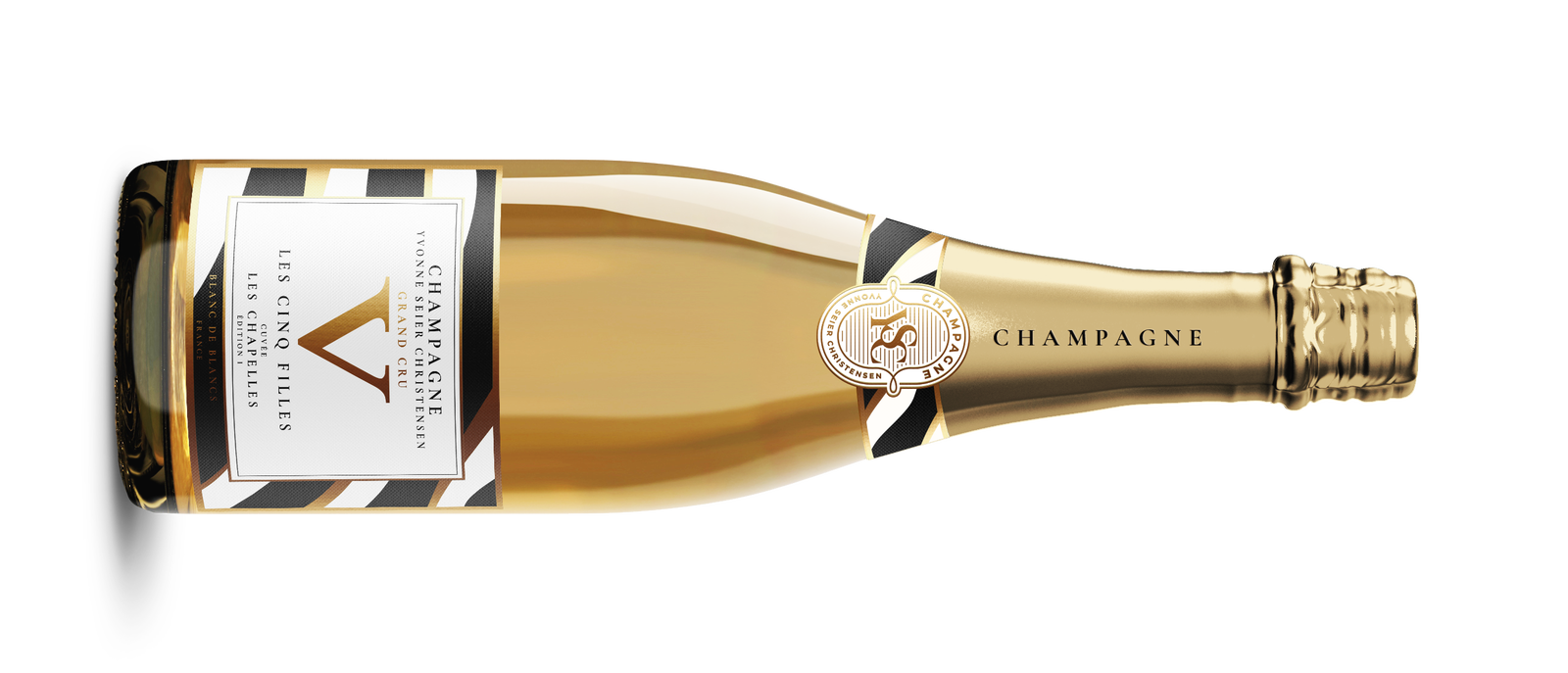
The award facts are direct. According to The Drinks Business, Cuvée Les Chapelles won Gold at The Champagne Masters 2026, while Rosé de Saignée won Grand Master at The Global Rosé Masters 2026. For a maison founded in 2017, those results give Maison Les Cinq Filles a visible credential in its first decade (Thedrinksbusiness1).
Collectors should read the medals carefully. A medal is not the same as a long secondary-market record, and it does not replace tasting, bottle condition, or knowledge of a cuvée's release history. But awards do matter for a young Champagne house because they offer third-party validation at the moment when name recognition may still lag behind ambition. In a category crowded with familiar labels, a Gold and a Grand Master give sommeliers and buyers a reason to pause.
Cuvée Les Chapelles and Rosé de Saignée also tell us something about range, though the source does not provide technical sheets. The names alone point to two different propositions within the house. One is positioned as a cuvée bearing the Les Chapelles name; the other is a rosé de saignée, a format that carries its own stylistic expectations in Champagne. Without source-backed details on grape varieties, maceration, dosage, or ageing, we should stop there. The medals are the fact. The specifications remain to be requested from the producer or merchant before any serious buying decision.
Still, the timing is difficult to ignore. Maison Les Cinq Filles was founded in 2017. The Drinks Business notes that Champagne depends on patience, and the house is nearing its tenth anniversary. A young maison receiving recognition in 2026 gives the founder's early choices a public test. The story moves from biography to bottle.
That movement matters because outsider narratives can become sentimental if the wine does not carry them. Seier Christensen's own comment, “let the liquid speak for itself”, sets a high bar. Awards do not speak with the intimacy of a bottle opened over dinner, but they do give the liquid a microphone. In this case, The Champagne Masters and The Global Rosé Masters supplied two named stages.
The Yvonne Seier Christensen Champagne story offers three signals for collectors. First, there is scarcity of biography: a first-generation Champagne founder without a generational estate behind her is still unusual in this category. Second, there is credential: Gold at The Champagne Masters 2026 for Cuvée Les Chapelles and Grand Master at The Global Rosé Masters 2026 for Rosé de Saignée. Third, there is table logic: co-ownership of Geranium and Alchemist places the founder close to the demands of Michelin-star dining.
None of those signals should be confused with a drinking window, a score history, or an allocation guarantee. The source does not provide bottle counts, prices, import markets, disgorgement dates, vineyard sources, or cellar methods. A collector should treat those omissions as the next layer of due diligence rather than an inconvenience. If a bottle appears on a list or through a merchant, ask for the technical sheet. If a sommelier pours it, ask where it sat in the meal and why. If a merchant offers a limited parcel, ask what makes that parcel distinct beyond the medal.
For travellers, the route is more cultural than logistical. What it does give is a set of coordinates: Champagne as the terroir, Plumpton College as a formative educational site, and Copenhagen as the gastronomic frame through Geranium and Alchemist. Follow those coordinates and the profile becomes richer than a producer note.
There is a broader lesson here for how new Champagne houses earn their place. The old route remains powerful: land, family, cellar memory, and accumulated trust. Seier Christensen's route is different: technical study, entrepreneurial stamina, restaurant intelligence, and a family name built forward rather than backward. It is not a replacement for tradition. It is another way of entering a region that rarely makes entry easy.
The house now faces the harder part. Early recognition can open doors; sustained quality has to keep them open. As Maison Les Cinq Filles moves closer to its tenth anniversary, the next questions will be the ones collectors always ask once curiosity turns serious: how the cuvées develop, where the bottles appear, which restaurants pour them with conviction, and whether Seier Christensen's dirt-under-the-fingernails promise continues to show in the glass.
Get the App
Take the shortlist into the En Primeur Club app for concierge access, saved places, and the next step after discovery.
Get Exclusive AccessMore from the editors