← Guides
Tony and Youmna Asseily bought Château Biac in 2006 with no plan to make wine. Two decades later, the estate has a new pulse.
Tony and Youmna Asseily bought Château Biac in 2006 with no plan to make wine. Two decades later, the estate has a new pulse.
Tony and Youmna Asseily bought Château Biac in 2006 after falling for a private property outside Bordeaux, not for a wine label. Château Biac Bordeaux is the Entre-deux-Mers estate the Lebanese couple restored over two decades with counsel from Denis Dubourdieu, Patrick Léon, and Christine Sourdès. The line Youmna gave Decanter still has the clean shock of truth: “We never wanted to make wine.” That is what makes the story useful. Biac did not begin, for the Asseilys, as an acquisition thesis or a vanity cuvée. It began as a search for quiet, a view over the Garonne, and a house no one could see from the road (Decanter1).
Two decades later, the accident has become a lineage. Not the five-generation Burgundian version, with old barrels carrying family initials and cousins debating pruning in the courtyard, but a first-generation Bordeaux lineage built in public: one couple, one neglected château, 9.7 hectares, and enough humility to call the people who knew the ground better than they did.
The Asseilys’ route to Biac began well before the contract. Decanter reports that Tony and Youmna, both originally from Lebanon, had lived between Beirut and London for 25 years. Tony had spent his career in finance in London. Youmna had lived in Switzerland and Lebanon before the couple settled in London to raise their children. Their relationship with the Bordeaux countryside came through interruption rather than design: in 1990, after repeated flight delays, the family chose to holiday in Entre-deux-Mers, four kilometres from Château Biac (Decanter1).
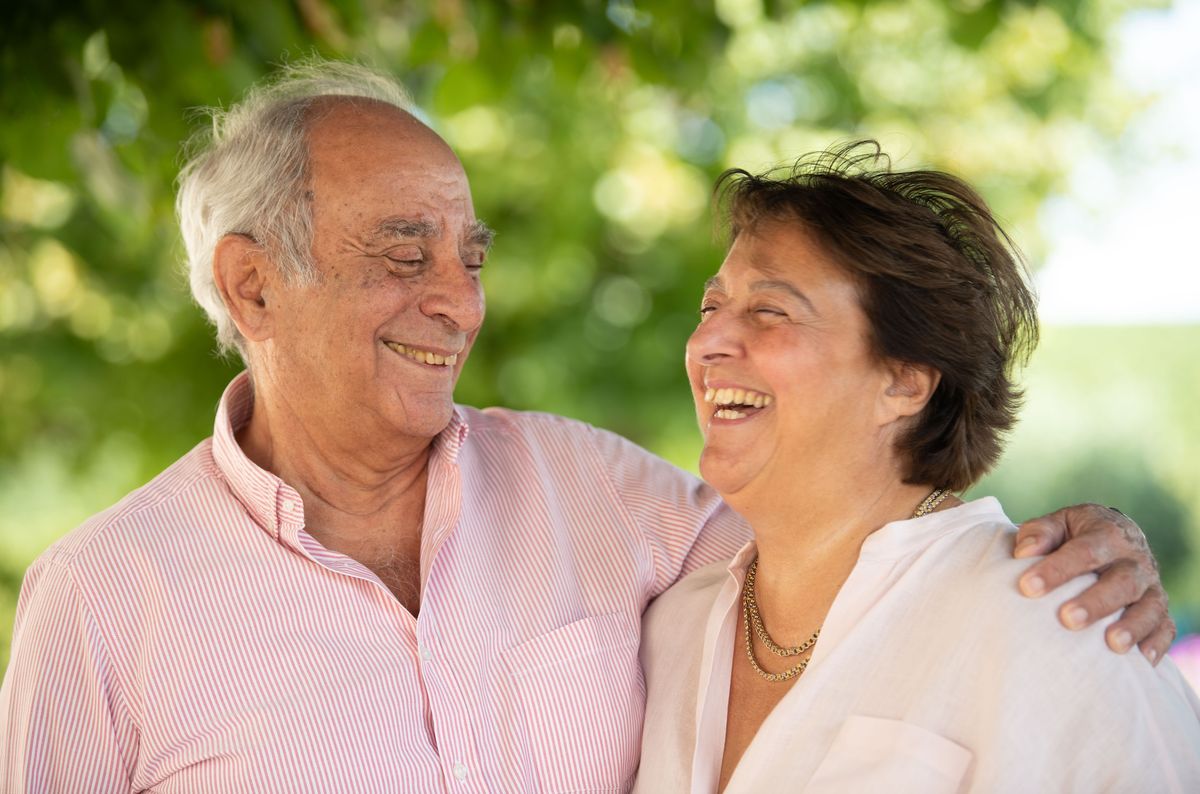
That detail matters because Biac was not an instant purchase made on the momentum of a tasting. The family returned to Entre-deux-Mers each summer for a decade. In 2000, they rented the guesthouse at Biac and fell in love with the place. That same year, Tony dissolved his wealth management company. The next chapter, by the couple’s own account, was meant to be quieter: Youmna wanted to paint, Tony wanted to write. Wine did not make the list (Decanter1).
The list itself was precise. They wanted to be half an hour from Bordeaux, 35 minutes from the airport, close to a motorway, near a town with daily necessities, with a view over the Garonne, and private enough not to be visible from the road. Château Biac met those points. For anyone who travels through Bordeaux by appointment, those criteria read less like romance and more like logistics. The airport matters. The motorway matters. Langoiran and the river matter. Privacy matters most when a house becomes both family life and working estate (Decanter1).
The purchase still took time. The previous owners, according to Decanter, wanted to sell the main house while keeping the vineyards and holiday homes. Negotiations stalled over that division, and the contract was finally signed in 2006. By then, the Asseilys had already learned the first rule of Bordeaux property: the view from the terrace is only the surface. The vineyard, even neglected, carries the long argument.
Château Biac Bordeaux sits in the orbit of Entre-deux-Mers, near Langoiran, in the part of the region that often asks visitors to slow down after the polished theatre of the Left Bank. The Asseilys first encountered the area not as collectors or estate owners, but as a family looking for summer ground. That distinction gives Biac its particular texture. The house came before the cuvée. The place came before the plan.
For wine travellers, the geography is part of the appeal. Entre-deux-Mers places you between Bordeaux’s rivers, within reach of the city, but away from the procession of classified-growth gates. The Asseilys’ own search criteria tell you how the estate functions in real time: close enough to Bordeaux for dinner, close enough to the airport for visiting family or trade guests, close enough to a town for the plain requirements of daily life. It is not a remote retreat. It is a working Bordeaux property positioned for people to come and go.
That practical siting also shaped the restoration. A château not visible from the road has privacy, but it does not have automatic traffic. A family arriving without a winemaking background has to build credibility bottle by bottle and decision by decision. Biac’s story, then, is not the familiar one of a famous appellation carrying a new owner. It is the reverse: the owner had to learn what the property could say, then find the people able to translate it.
Decanter’s account makes clear that the vineyard was not the initial object of desire. That is the pivot. Many estates begin with ambition and acquire architecture as a stage set. At Biac, architecture and privacy drew the Asseilys in; the vineyard then demanded seriousness from them. The moment they accepted that demand, the project changed from property ownership into stewardship.
Biac had history before the Asseilys arrived. Decanter reports that Cocks & Féret’s second edition guide to Bordeaux in 1868 rated Biac among the leading in the region. For a neglected estate, that kind of archival trace is not decoration. It is a provocation. If a site once carried such a reputation, the question becomes whether neglect erased the possibility or merely obscured it.
Denis Dubourdieu gave the Asseilys the answer they needed to hear, though not necessarily the one that made life easier. The Bordeaux enologist, nicknamed the pope of white wine, had consulted at Biac before. According to Decanter, he told the family that the terroir itself was notable regardless of its condition. That sentence is the hinge of the whole Biac restoration: the property did not require invention. It required recovery.
There is a useful distinction here for collectors. Some estates sell narrative when the vineyard cannot carry the weight. Biac’s early case rested on the opposite sequence: an old Cocks & Féret reference, a neglected property, then a Bordeaux enologist telling new owners that the ground still mattered. The Asseilys did not have the technical fluency to test that claim alone. Their first intelligent move was to recognise the limit of enthusiasm.
Dubourdieu’s role also places Biac in a specific Bordeaux tradition: the consultant as interpreter of site. In a region where families, investors, consultants, cellar teams, and vineyard managers often overlap, technical counsel can become the difference between inherited potential and bottled clarity. The Asseilys’ lack of prior winemaking experience could have become a liability. Instead, they treated it as a reason to listen.
The 1868 reference should not be overplayed as a guarantee of modern quality. Bordeaux is full of properties with handsome histories and uneven present tense. But paired with Dubourdieu’s assessment, it gave Biac something more useful than nostalgia: a reason to commit money, time, and attention to the land under the house.
Patrick Léon did not say yes immediately. Decanter reports that the Château Mouton Rothschild retiree waited five or six months before agreeing to take on the vineyard, wanting to be sure the Asseilys were serious. That pause tells you as much about Biac as the eventual appointment. Léon had tried and failed to buy Biac himself years earlier, according to Decanter, so he knew the property was not an ordinary consulting file. He also knew that new owners without wine experience can tire quickly when restoration becomes pruning, drainage, replanting, sorting, and invoices.
The five- or six-month delay gave the relationship its first test. The Asseilys had to show that they were not passing through. Léon had to decide whether their attachment to the place could survive the work required by the vineyard. When he agreed, Biac gained a technical figure whose previous address at Mouton Rothschild carried immediate weight in Bordeaux circles. The name did not make the wine. It made the seriousness legible.
Christine Sourdès joined the following year to oversee the sweet wine, Decanter reports. Her credentials are precise: consultant to Château Guiraud and Château de Myrat, and the first woman to open her own laboratory in the Sauternes-Graves area. That is not a decorative résumé line. Sweet wine asks for nerve, timing, and close reading of fruit condition. Bringing Sourdès into that part of the estate shows that the Asseilys were not treating Biac as a single red-wine project with peripheral bottlings attached.
This is where the Asseily lineage begins to differ from inherited family narratives. Tony and Youmna did not receive a cellar manual from a parent. They assembled one through people. Dubourdieu framed the site. Léon tested the owners before touching the vineyard. Sourdès brought Sauternes-Graves laboratory experience to the sweet-wine side. The inheritance at Biac is therefore not a recipe passed down through generations, but a discipline acquired from Bordeaux practitioners who agreed that the site justified the effort.
For readers who follow Bordeaux allocations, consultant names can become shorthand. Here, the more revealing detail is the sequence. The Asseilys did not start with a grand project and then attach names for polish. They arrived by accident, learned that the vineyard had dormant value, and then built a team around the parts of the estate they did not yet understand. That is a different kind of luxury: patience before expertise, expertise before claims.
The scale of Château Biac is one of its strongest signals. The estate’s own materials describe 9.7 hectares and say that, from 2006 to 2014, important changes were made to the vineyard after deep soil analysis by agricultural consultant Gilles Rey. The same materials point to diversity within that small surface. In Bordeaux terms, 9.7 hectares is not a vast holding. It is a size that forces attention.
The parcel notes from the estate give the story its texture. Les Graves LG1 covers 1.3747 hectares. Its top part is listed as 100% gravel; the bottom part is clay with high-density gravel. The grape variety is Cabernet Sauvignon, planted in 2008, at 9,100 vines per hectare, pruned Guyot double. Les Graves LG2 covers 1.07 hectares, with clay and high-density gravel in a leading part and silty-clay with high-density gravel below. Its variety is Sémillon, planted in 1960, with a density of 5,000 vines per hectare and pruning listed as Cot.
Those two parcels alone show why generic talk about Bordeaux terroir fails at Biac. One block carries Cabernet Sauvignon on gravel and clay; another carries Sémillon planted decades earlier on clay, gravel, and silty-clay. The differences are not theoretical. They govern drainage, vigour, picking decisions, and the way a team reads the year.
The smaller parcels sharpen the picture. Chiquette 1 covers 0.2459 hectares, with clay, silt, and sand, and no gravel. The estate lists Petit Verdot from selection massale, rootstock 101-14, planted in 2008, at 9,100 vines per hectare, with Guyot double pruning. Romeo covers 0.217 hectares, also clay, silt, and sand with no gravel, planted to Petit Verdot in 2022 at 9,100 vines per hectare. Juliette, another 0.217-hectare parcel planted in 2022, is listed with silt, clay, sand, and medium-density gravel, and planted to Merlot at 9,100 vines per hectare.
Read together, the parcels make Biac feel less like a single vineyard and more like a set of small arguments within one estate boundary. Cabernet Sauvignon, Sémillon, Petit Verdot, Merlot; gravel, clay, silt, sand; plantings from 1960, 2008, and 2022; densities of 5,000 and 9,100 vines per hectare. For collectors, those details matter because they reveal the restoration as physical work rather than brand repair. From 2006 to 2014, according to the estate, the vineyard changed after analysis. The current Biac story rests in those changes.
Scarcity enters quietly here. A 9.7-hectare vineyard divided into parcels of 1.3747 hectares, 1.07 hectares, 0.2459 hectares, and 0.217 hectares does not behave like an estate built on broad anonymity. Even without production figures, the surface area tells you that decisions at Biac happen at close range. A small block of Petit Verdot planted by selection massale is not a marketing phrase. It is a pruning and picking commitment.
For collectors, Château Biac Bordeaux belongs in a different mental folder from the classified-growth chase. The more useful signal is structural: an estate bought in 2006 by owners with no plan to make wine, restored with the counsel of Dubourdieu, Léon, Sourdès, and Gilles Rey, on 9.7 hectares whose parcel detail is unusually transparent in the estate materials.
That combination rewards the kind of buyer who reads back labels, estate histories, and technical sheets before chasing status. The name Patrick Léon gives an immediate Bordeaux credential. Christine Sourdès gives the sweet-wine side its own technical anchor. Denis Dubourdieu’s assessment gives the site its early validation. Gilles Rey’s soil work gives the vineyard restoration a practical base. None of those names should replace tasting the wines, but they explain why Biac keeps appearing in conversations among drinkers who like Bordeaux slightly off the main road.
There is also a travel angle that matters. If you are building a Bordeaux itinerary around more than the Médoc and Saint-Émilion, Entre-deux-Mers offers a different rhythm. Biac’s proximity to Bordeaux, the airport, motorway access, Langoiran, and the Garonne view all appear in the Asseilys’ original property criteria. Those details give visiting collectors a sense of the estate’s position before a glass is poured. The family chose the place because it could sustain daily life. That makes the wine feel connected to habitation rather than display.
Which vintages are currently available? How are the estate’s reds and sweet wines allocated? How does the team present parcels such as Les Graves LG1, Les Graves LG2, Chiquette 1, Romeo, and Juliette in tastings or technical notes? What changed after the 2006-to-2014 vineyard work? These are the questions that separate collecting from label acquisition.
For restaurants and private cellars, Biac’s appeal lies in the conversation it opens at the table. Pouring a 2019 Pauillac declares one kind of Bordeaux confidence. Pouring Château Biac asks the table to listen differently: to Lebanon and London, to a guesthouse rented in 2000, to a contract signed in 2006, to a Mouton Rothschild retiree waiting months before saying yes, to Sémillon planted in 1960 on a 1.07-hectare block. That is not a lesser Bordeaux story. It is a more specific one.
Lineage usually looks backward. At Château Biac, it looks sideways first: from Beirut to London, from delayed flights to Entre-deux-Mers, from a guesthouse rental to a purchase that took years to complete. Tony and Youmna Asseily did not inherit Biac. They inherited, as many displaced families do, the habit of looking for a place that could hold them. The vineyard made the request larger.
That makes the Asseily stewardship feel timely after 20 years. The estate’s old reputation in the 1868 Cocks & Féret guide could have remained a footnote. The neglected property could have become a private house with vines leased away or left peripheral. Instead, the family accepted the technical burden of restoration and surrounded itself with people who knew Bordeaux at the level of soil, sweet-wine laboratories, and classified-growth discipline.
The current generation in residence remains Tony and Youmna. No successor has been named, which gives this anniversary its own tension. A first-generation restoration is never only about what has been repaired; it is about what can now be passed on. At Biac, the inheritance is already more concrete than sentiment: parcel records, replanting dates, soil distinctions, consultant decisions, and the habit of asking the vineyard to justify each move.
Watch the next chapter through those specifics. The 2022 plantings of Romeo and Juliette, the older Sémillon in Les Graves LG2, the Cabernet Sauvignon of Les Graves LG1, and the post-2006 vineyard changes will say more about Biac’s future than any anniversary language can. The Asseilys arrived looking for peace and privacy; two decades later, Château Biac’s most persuasive claim is that the quiet place they chose still has more to give through the vines.
Get the App
Take the shortlist into the En Primeur Club app for concierge access, saved places, and the next step after discovery.
Get Exclusive AccessMore from the editors