← Guides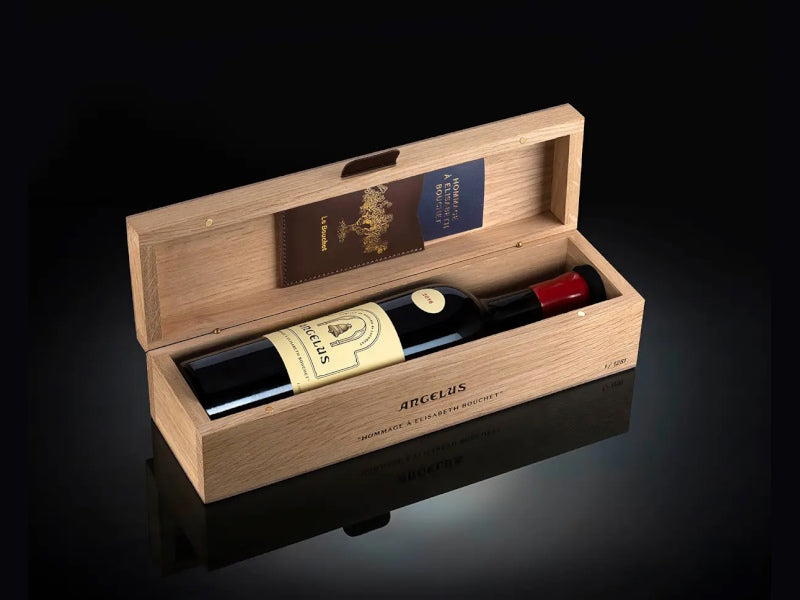
Angelus and Acker bring the estate’s largest auction offering to October 17, 2026, with Grand Vin Blanc and 1955 library depth.
Angelus and Acker bring the estate’s largest auction offering to October 17, 2026, with Grand Vin Blanc and 1955 library depth.
On October 17, 2026, bidders at Marea in New York City will watch Acker livestream a Delaware sale built from Château Angelus ’s own cellar, including a 1955 magnum, a 1959 bottle and the first sale of Grand Vin Blanc. The château angelus acker auction will bring the largest Château Angelus offering ever to auction, with the Saint-Émilion estate opening library stock, large formats and a private estate experience that have a different weight when they arrive direct from the château.
For collectors, the draw is provenance first. Angelus brings the cellar; Acker brings the market. Founded in 1820, Acker accounts for 42% of the global fine wine auction market, and its October sale places one of the Right Bank’s most closely followed names in front of American bidders with a depth that ordinary allocations cannot supply.
The château angelus acker auction is built around a collector advantage that cannot be recreated after bottling: the wines come direct from Château Angelus. In Bordeaux buying, provenance carries its own premium when a bottle has moved from château cellar to auction house rather than passing through private hands, storage units, restaurant lists, or a chain of secondary-market consignors.
Château Angelus was founded in 1782 and has remained under the stewardship of the de Boüard de Laforest family for eight generations. Stéphanie de Boüard-Rivoal has led the estate since 2012, the third woman to head Angelus in its nearly 250-year history. Her tenure gives the sale a clear family signature rather than the feel of a deaccession from a distant archive (Eurocave3).
"We have never opened the cellar in this way before. Many of these bottles have been kept at the château for generations, so sharing them now is about more than offering a collection of vintages."
Stéphanie de Boüard-Rivoal, President and CEO, Château Angelus
The phrase to hold is “kept at the château for generations.” It is the practical detail behind the glamour. A six-bottle case of 1990 Angelus with estate provenance belongs in a different conversation from a bottle whose history begins at a prior auction label. The sale also carries the institutional weight of Acker, America’s oldest wine merchant, led for three generations by the Kapon family, with John Kapon joining forces with Irv and Jay Goldman in 2017.
Irv Goldman, Acker’s Chief Executive Officer, framed the sale through Bordeaux’s place in collecting, saying that Bordeaux remains the backbone of every great fine wine collection. That view will be familiar to anyone who has built a cellar around ageable claret, especially from Saint-Émilion, where Merlot and Cabernet Franc can deliver long-lived structure without the profile of the Médoc.
The headline bottle is not red. Lot 42 includes a three-bottle case of Château Angelus Grand Vin Blanc 2020 with a magnum of the 2022 vintage, in original wooden case. Until this auction, Grand Vin Blanc had never been offered for sale and had been poured only at the château for a small circle of family and friends. October 17 marks its first release of any kind.
For a collector who already owns the grand vin across multiple vintages, that changes the logic of the sale. The Grand Vin Blanc is not a back-vintage fill-in or a format upgrade. It is a first commercial opportunity, tied to a named lot and an estate experience, rather than a bottle likely to appear in quantity through normal retail channels.
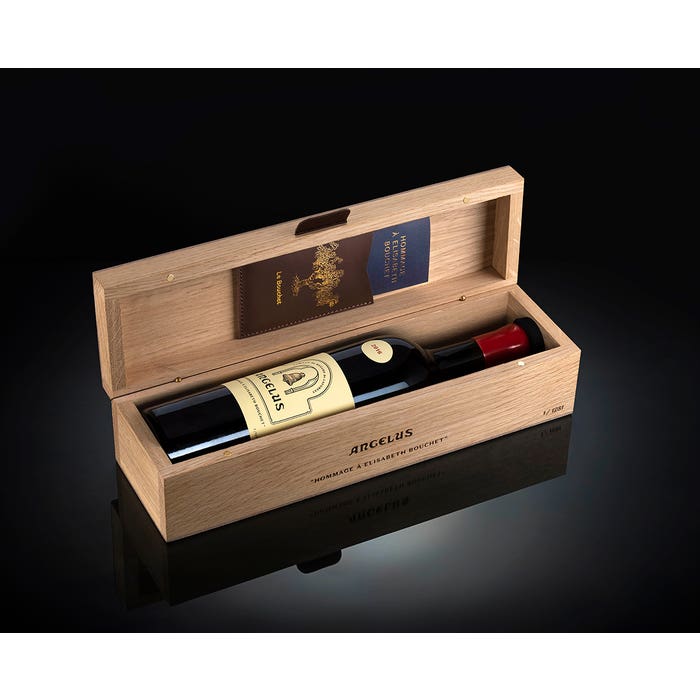
The red-wine center of the consignment is Hommage à Élisabeth Bouchet, a 100% Cabernet Franc cuvée produced from a single half-hectare parcel in the historic heart of the property. The vines are more than 70 years old and grow in clay-scree-limestone soils. Eight lots feature the cuvée, including bottles from the 2018, 2019, 2020 and 2022 vintages, plus a five-vintage vertical spanning 2016 to 2022 in original wooden case.
The name matters. Élisabeth Bouchet married Maurice de Boüard de Laforest in 1921 and brought Clos de L’Angelus into the family. Maurice later replanted a parcel with Cabernet Franc, locally known as Bouchet, in her name. After his death, Élisabeth led the estate and later passed it on to their children. In a sale led today by Stéphanie de Boüard-Rivoal, the cuvée carries a matriarchal line that is unusually explicit for Bordeaux.
The formats should sharpen bidding. Hommage à Élisabeth Bouchet appears as a 2020 magnum, a double magnum of the first 2016 vintage, and a 2016 Imperial offered commercially for the first time. That 2016 Imperial is the kind of object that changes the room’s tempo: a named cuvée, a first vintage, a large format, a first commercial appearance. Large-format Bordeaux also carries a different drinking calendar from standard bottles, particularly for collectors who plan dinners around a single estate or a single Right Bank theme.
Then come the library vintages. The consignment spans seven decades of Château Angelus, with a 1955 magnum and a 1959 bottle at the early end, and six-bottle cases of 1983, 1985, 1986, 1989, 1990, 1995, 1999, 2000, 2003 and 2005. Large formats include double magnums of 1990, 1995, 1998, 2000, 2001 and 2003, a 2003 Jeroboam, a 2012 Imperial and an 18-liter 2015 Melchior. Magnums and double magnums of Carillon d’Angelus complete the offering.
That is the kind of list that rewards advance discipline. The 1950s bottles carry the romance of age and château storage. The 1989, 1990, 2000 and 2005 cases will draw collectors looking for mature or maturing vintages with enough bottle depth for future dinners. The 2012 Imperial has classification-era context, while the 2015 Melchior brings theater to a cellar, a service team and a long table.
The charitable lot binds the rarest white wine in the sale to time at the estate. Lot 42 includes the Grand Vin Blanc bottles, a private tour of Château Angelus, a guided tasting of Château Angelus vintages, and a five-course lunch or dinner with members of the estate and winemaking team. Chef Thibaut Gamba will prepare the meal at Le Logis de la Cadène, the Angelus-owned Michelin-starred restaurant in Saint-Émilion, and the experience includes a one-night suite stay with breakfast.
All proceeds from this lot benefit the Eva Longoria Foundation, which supports economic opportunity, civic participation and cultural influence for Latinas. Longoria is an admirer of Château Angelus Blanc, and her connection to the wine gives the lot a personal edge rather than a simple charity add-on. In her words, "Pairing it with a private day at the château: the tour, the tasting, dinner with the winemaking team, a night at Le Logis de la Cadène makes this among the more special wine experiences you could imagine."2
For wine travelers, the estate experience is the piece that cannot be replicated by buying bottles alone. Saint-Émilion rewards slow pacing: the approach to a château, a cellar visit, a guided tasting with the people responsible for the wine, then dinner in the village after the day’s formalities have softened. Le Logis de la Cadène brings the hospitality into the Angelus orbit, with a meal prepared by Gamba and a suite upstairs instead of a taxi back to Bordeaux.
The sensory promise here is documented in the format rather than tasting notes. A vertical tasting at the property, a five-course meal with the winemaking team, breakfast after a night in Saint-Émilion, and Grand Vin Blanc bottles that had previously stayed inside the château’s circle. For bidders who collect experiences with the same seriousness as bottles, Lot 42 will likely become especially personal contest among the sale.
Angelus sits at a complex point in modern Saint-Émilion history. The estate was upgraded in the official 2012 Saint-Émilion classification, then announced in January 2022 that it would withdraw its application for the 2022 ranking and renounce Premier Grand Cru Classé A status. For collectors, those dates do not replace the wine in the glass, but they do frame how bottles are cataloged, discussed and compared across vintages (Janeanson4).
The estate’s modern identity also reaches beyond classification language. Château Angelus moved to 100% organic farming in 2018. Its core production of Château Angelus comes from 27 hectares, while the remaining 12 hectares of vines are used for Le Carillon de l’Angelus and No. 3. Average production is 8,500 cases per vintage, a scale large enough for global recognition yet small enough that deep library parcels remain finite (Thewinecellarinsider5).
Carillon d’Angelus, first released in the 1987 vintage, gives the consignment a second-wine dimension for bidders who follow the estate across labels rather than chasing the grand vin alone. No. 3 d’Angelus can benefit from being kept for five to eight years, a shorter cellar horizon than a leading wine and a useful marker for collectors who separate near-term drinking from long-hold inventory (Angelus6).
Hommage à Élisabeth Bouchet adds another register entirely. A 100% Cabernet Franc cuvée from a half-hectare parcel with vines over 70 years old is not a standard Right Bank acquisition. The Cabernet Franc focus speaks to Angelus’s identity in Saint-Émilion, while the parcel scale and family dedication give the wine a narrow collecting audience: buyers who want the estate’s most personal bottlings, not simply the label most often seen on auction screens.
The château angelus acker auction also arrives at a time when collectors increasingly separate provenance from scarcity. Scarcity alone can be manufactured by small release volume or marketing control. Cellar-direct provenance cannot be added later. A 1955 magnum, a 1959 bottle, a commercially first-offered 2016 Imperial of Hommage à Élisabeth Bouchet, and the first release of Grand Vin Blanc all draw their power from where they have been and why they are appearing now.
The sale takes place on October 17, 2026. Acker will conduct the auction in Delaware, with the proceedings livestreamed to a live bidding room at Marea in New York City. Catalog and bidding information are available through Acker at ackerwines.com.
For bidders attending at Marea, the room itself matters because high-value wine auctions still carry social information. You see which lots slow the room, where telephone bids enter, how large formats change tempo, and whether the charitable estate experience draws a different buyer than the library cases. None of that replaces a maximum bid set in advance, but it helps you read the sale as it unfolds.
For remote bidders, the catalog should be read in layers. Start with provenance, then format, then vintage, then lot composition. A six-bottle case of 1989 or 2000 speaks to a different purpose than an 18-liter 2015 Melchior. A 1955 magnum requires a different service plan than a 2022 Hommage à Élisabeth Bouchet bottle. Lot 42 sits outside those categories because it ties wine, travel and philanthropy into one bidding decision.
The château angelus acker auction gives American collectors a concentrated view of Angelus across family history, library stock, large formats and a white wine that had stayed at the property until now. The next signal will come from the catalog room on October 17, when bidders decide how much value they place on a Saint-Émilion cellar opening its doors for the first time at this scale.
The wines come directly from Château Angelus's own cellar, providing provenance that cannot be replicated through secondary-market purchases. This is the first time the estate has opened its library stock in this way, with bottles kept at the château for generations rather than passing through private hands or storage units.
The auction will be held on October 17, 2026, with bidders gathering at Marea in New York City to watch Acker livestream the Delaware sale. The event brings the largest Château Angelus offering ever to auction.
Grand Vin Blanc is Château Angelus's white wine that has never been commercially released before this auction. Until now, it has only been poured at the château for family and friends, making Lot 42's three-bottle case of 2020 with a 2022 magnum the first sale of any kind.
Hommage à Élisabeth Bouchet is a 100% Cabernet Franc cuvée produced from a single half-hectare parcel with vines over 70 years old. Eight lots feature this cuvée at the auction, including bottles from 2018-2022 vintages and a five-vintage vertical spanning 2016 to 2022.
The auction includes library vintages dating back to 1955 (in magnum format) and 1959 (in bottle). These older vintages represent rare opportunities to acquire aged Château Angelus with direct estate provenance.
Get the App
Take the shortlist into the En Primeur Club app for concierge access, saved places, and the next step after discovery.
Get Exclusive AccessMore from the editors