
Our verdict
Mauvaise herbe brings a French frame to Okinawan produce in Uruma, a city better known for coastal drives and local cooking than formal French dining. The draw is not ceremony for its own sake, but the way regional ingredients can carry a French restaurant without losing their Okinawan identity.

Pearl is the En Primeur Club membership app, where members save venues, book tables and use the concierge.
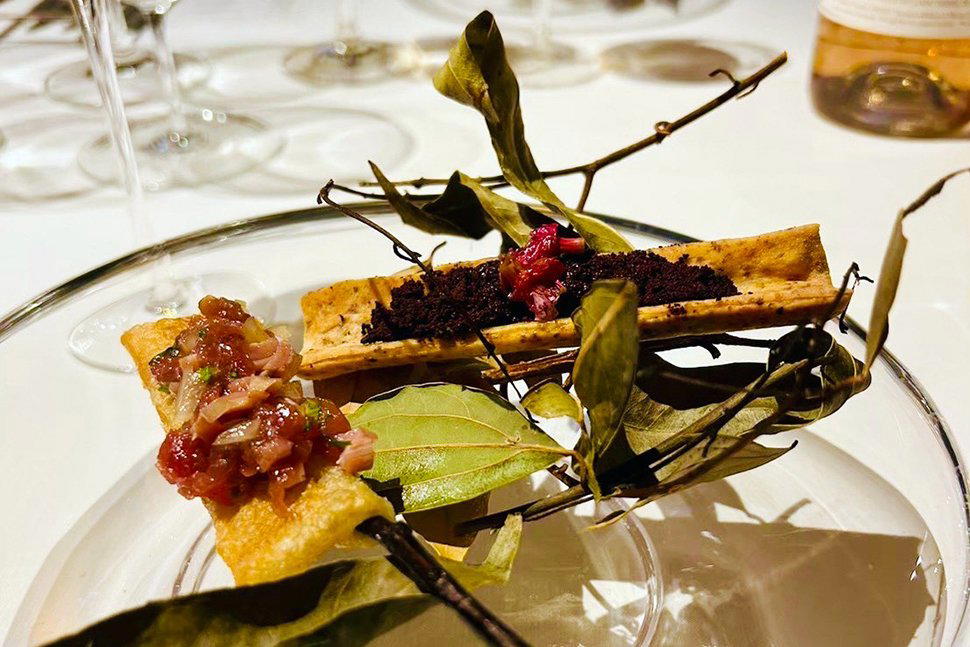
The menu
What to order
- Goat tartare
- Crow meat preparation using local game
Approaching French food in Uruma starts with a different set of expectations than it does in Japan’s larger restaurant capitals. The city places Mauvaise herbe outside the most familiar circuits for destination dining, which is part of its interest. Rather than treating the restaurant as a Tokyo- or Kyoto-style import, it is more useful to read it as a French-food address whose context is Okinawa Prefecture and whose appeal rests on how that setting frames the meal.
French technique, Okinawan ground
Uruma gives this restaurant its editorial reason to exist. French food is often discussed through technique, pacing, sauce, texture, and restraint, but location changes how those ideas are received. A restaurant in Uruma is not simply another formal dining room on a national checklist; it asks diners to consider how a French category can sit within Okinawa Prefecture without losing sight of where it is.
That is the useful way to read Mauvaise herbe. Its listed category is French food, but the stronger signal is placement. In Uruma, the restaurant belongs to a different travel pattern from the metropolitan rooms that dominate many fine-dining itineraries. The result is a venue that sits apart from the casual dining many visitors plan around, while still being anchored by the city rather than floating above it as an interchangeable destination.
The recognition attached to the restaurant is narrow but meaningful: Mauvaise herbe appears in the Japan Times Destination Restaurants 2024 selection, ranked No. 10 for French food in Okinawa Prefecture. That matters more than a vague accolade would. It places the restaurant within a specific national dining list and gives travelers a clearer reason to pay attention when building an Uruma itinerary.
Why Uruma changes the French conversation
Uruma is not a default stop for travelers chasing formal dining in Japan, and that relative distance from the country’s restaurant capitals changes the stakes. A French-food restaurant here has less reason to perform the familiar rituals of luxury for an international audience. The more persuasive move is contextual specificity: a meal whose meaning is tied to Uruma rather than to a generic hotel-district template.
That does not make the restaurant casual by default, and it does not mean the experience should be judged by mainland French dining templates alone. Okinawa Prefecture has its own travel rhythm, and Uruma asks for a slower reading than a quick checklist stop. When a French-food address is placed in that frame, the interest lies in proportion: enough polish to justify the category, enough local grounding that the restaurant still feels connected to the city. The middle ground is where this address has its point.
For travelers building a wider Uruma itinerary, the restaurant makes sense as part of a slower look at the city rather than a quick dining trophy. Start with the full Uruma restaurants guide, then place meals against the rest of the trip through the full Uruma hotels guide, the full Uruma bars guide, the full Uruma wineries guide, and Our full Uruma experiences guide. Readers comparing Japanese restaurant formats more broadly can also think about other dining rooms across Japan in general terms, from urban counters and casual cafés to regional hotel restaurants, grill-focused venues, and French-food addresses in other prefectures.
Who should put it on the itinerary
Mauvaise herbe is strongest for diners who care about context and regional identity more than trophy metrics alone. The appeal is not a long list of public-facing numbers; it is the clearer proposition of French food in Uruma, supported by its Japan Times Destination Restaurants 2024 recognition. In a city where many visitors may default to easier meals, this is the more deliberate choice.
The decision comes down to mood. If the trip needs a polished pause from Okinawa’s more relaxed dining cadence, this is the right kind of contrast. If the goal is a quick family meal, a walk-in snack, or a price-led choice, Uruma has easier answers. For a traveler tracing how French food appears outside Japan’s major restaurant centers, Mauvaise herbe offers a focused case study: a French-food restaurant whose strongest claim is not imported prestige, but its place in Uruma and its 2024 recognition.
Frequently asked questions
Does Mauvaise herbe work for a family meal?
Yes, if the family is comfortable with French food in a restaurant setting in Uruma. For a time-sensitive visit, checking the venue’s current guidance is sensible.
What's the overall feel of Mauvaise herbe?
The feel is French food in Uruma, with the restaurant best understood through its city context rather than through classic metropolitan formality alone.
What distinctions does Mauvaise herbe have?
Mauvaise herbe is listed in the Japan Times Destination Restaurants 2024 selection, ranked No. 10 for French food in Okinawa Prefecture.
What cuisine category does Mauvaise herbe fall under?
Mauvaise herbe serves FRENCH FOOD cuisine.
How do I find Mauvaise herbe?
Uruma.
Do I need a reservation for Mauvaise herbe?
No reservation policy is listed in the public record, so the booking situation cannot be stated with confidence. For a French-food restaurant in Uruma, checking ahead is sensible, especially if the visit is time-sensitive. Check the venue's official channels for the latest details.
Comparable venues nearby, for context on price, style, and recognition.
| Venue | Cuisine | Price | Awards | Notes |
|---|---|---|---|---|
| Mauvaise herbeThis venue (the venue you are viewing) | Okinawan Terroir-Driven French Omakase | $200–300 | Not listed | Not listed |
| Embellir | Modern French Fine Dining | $100–150 | Not listed | Higashiyama |
| サンス・エ・サヴール | Modern French Fine Dining | $200–300 | We're Smart World 3 Radishes | Chiyoda |
| ドロワ | Michelin-Star French Fine Dining | Not listed | Not listed | 左京区 |
| アントル ヌー | Innovative French-Japanese Fusion | $150–200 | Tabelog Bronze #64 | Chūō |
| ESPICE | Modern Japanese-influenced French (Seafood-focused) | $150–200 | Tabelog 100 #51 | Chūō |
Recognition history
Dated appearances from independent guides and award organizations, with the underlying list record or original source where available.
The Japan Times Destination Restaurants Destination Restaurants Selection #10
The Japan Times Destination Restaurants
Details
- Intimate
- Rustic
- Cozy
- Sophisticated
- Date Night
- Special Occasion
- Celebration
- Solo
- Chefs Counter
- Design Destination
- Standalone
- Extensive Wine List
- Local Sourcing
- Sustainable Seafood
- Farm To Table
- Tasting Menu
- Omakase
- Counter Dining
- Wine
A tiny, secretive counter-only space with just a handful of seats, creating a hushed, almost speakeasy-like atmosphere where guests sit inches from the chef; the mood is refined but unpretentious, focused on the theater of cooking and the aromas of Okinawan ingredients.