
Tabelog 100 #39
Our verdict
Kaida Ya puts Nankoku’s unagi culture in a rural Kochi frame: fish-led cooking, tatami-room comfort, and a reputation strong enough for repeated Tabelog Unagi 100 selections. The appeal is not metropolitan ceremony, but a focused eel meal where sourcing and format matter more than polish.

Pearl is the En Primeur Club membership app, where members save venues, book tables and use the concierge.
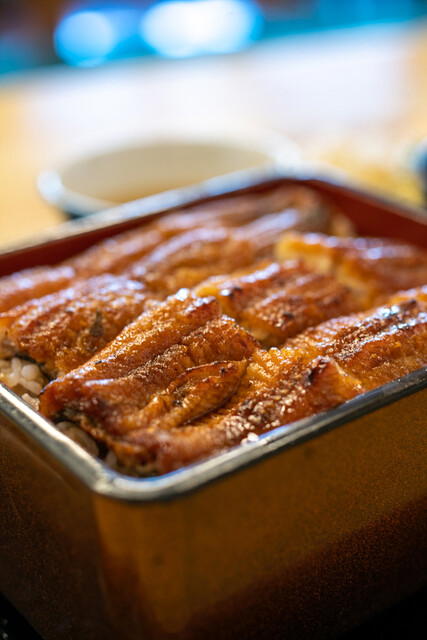
Approaching an eel house in Nankoku changes the tempo of a meal before the first order is placed. Nankoku is not a city of grand dining entrances; its stronger tables often sit closer to everyday routines than to nightlife districts. That setting matters for unagi. Eel in Japan carries ceremony, but outside the major capitals the ceremony is often practical: a room built for regulars, smoke discipline, rice timing, and fish handled with enough confidence that the meal does not need theatrical framing.
Kaida Ya belongs to that provincial Japanese category where the dining room, the ingredient, and the local habit all point in the same direction. It is listed for unagi rather than for a broad washoku menu, and that specificity is the signal. In an era when many destination restaurants broaden their appeal through tasting formats and imported luxury cues, a regional eel specialist has a narrower job: cook consistently and make the rice-and-eel proposition feel complete without decoration.
Unagi in Nankoku rewards focus over ceremony
Nankoku’s food identity is often understood through everyday local dining rather than through grand destination-restaurant signaling, but eel has its own place in that landscape. The ingredient asks for control at every stage. Handling, fat level, grilling decisions, sauce balance, and rice texture all decide whether the meal lands with depth or turns heavy. That is why specialist houses matter. They reduce choice so the kitchen can repeat a demanding craft with less distraction.
The Tabelog Unagi 100 selection in 2024 gives Kaida Ya a clear external credential in a category where national recognition is difficult for restaurants outside larger dining circuits. For Nankoku, that matters. The city is better understood as part of everyday food geography than as a conventional restaurant destination, so category recognition carries more weight than a generic popularity claim.
The ingredient angle is not decorative here. Eel restaurants rise or fall on consistency, because the diner is not protected by a long menu. When a house is identified with unagi, the claim has practical consequences: the kitchen’s reputation depends on how the central ingredient behaves over rice, not on seasonal novelty or plated complexity. This is why regional unagi can be more revealing than luxury dining. There is less to hide behind.
A focused restaurant with specialist logic
Format reads as a focused local restaurant rather than a high-gloss destination counter. That distinction changes the meal’s social register. Kaida Ya feels closer to local gathering culture than to the urban omakase model, and its appeal rests less on scarcity than on a focused specialty. The restaurant’s scale is best understood through that everyday lens: built for people who have come for eel, not for a theatrical tasting progression.
That does not make the meal casual in the weak sense. In Japan, unagi is often priced and treated as a deliberate lunch or early dinner rather than a throwaway everyday stop. The discipline sits in the repetition: eel, rice, sauce, heat, pacing. A stronger unagi house does not need to announce ambition through luxury ingredients from outside the category. It proves the point by making a single protein carry the whole table.
Compared with Takokuseki Shokudo Sabi to Susu, another Nankoku restaurant, Kaida Ya occupies a more ingredient-specific lane. The comparison is useful because it shows how compact the city’s dining range can be: one address can serve broader local eating, while an eel specialist asks the diner to commit to a single tradition. Travellers mapping the area should treat those as different decisions, not substitutes.
The same logic applies when looking beyond Nankoku. Japan’s restaurant culture gives equal legitimacy to narrow specialists and broad menus, but unagi houses are especially unforgiving because the main act is known before arrival. There is no surprise format to rescue weak execution. For readers building a wider itinerary, the contrast with other dining rooms across Japan is instructive: the country rewards precision in wildly different formats, from single-dish devotion to urban casual specialization.
Who should put this on a Nankoku itinerary
Kaida Ya makes sense for travellers who plan around ingredients rather than spectacle. It is a strong fit when Nankoku travel includes local food traditions beyond more general eating and drinking circuits, and it works especially well for readers who value regional specialists with independent recognition. The 2024 Tabelog Unagi 100 listing is the trust signal; the local-restaurant setting is the editorial clue. Expect the experience to feel anchored in Nankoku rather than translated for a visitor’s checklist.
The practical decision is timing and appetite. Eel is a focused meal, and the restaurant is not framed around late-night grazing or bar-hopping energy. Budget planning also matters in this category: Kaida Ya is listed at JPY 3,000 - JPY 3,999 for both lunch and dinner. The room itself is part of the point, giving the food a local social context rather than a destination-dining stage set.
For a wider local map, use our full Nankoku restaurants guide alongside our full Nankoku hotels guide, our full Nankoku bars guide, our full Nankoku wineries guide, and our full Nankoku experiences guide. For readers comparing Japanese food culture abroad, overseas Japanese dining shows a different kind of translation: Japanese formats adapted to other dining rhythms rather than rooted in a Nankoku setting.
Frequently asked questions
Would Kaida Ya be comfortable with kids?
Kaida Ya is an eel-focused restaurant in Nankoku. Its JPY 3,000 - JPY 3,999 listed budget for lunch and dinner keeps it in a relatively accessible bracket for a meal built around unagi.
Is Kaida Ya better for a quiet night or a lively one?
Kaida Ya fits a quieter meal rather than a lively night out, especially given its focus on unagi in Nankoku. The experience is more about the eel-and-rice meal than any social scene.
What does dinner at Kaida Ya typically cost?
Pricing at Kaida Ya is listed as JPY 3,000 - JPY 3,999 JPY 3,000 - JPY 3,999 View spending breakdown.
What are the operating hours at Kaida Ya?
Specific operating hours are not provided here; confirm directly with Kaida Ya before visiting.
What part of town is Kaida Ya in?
Nankoku.
Side-by-Side Snapshot
Comparable venues by cuisine and price in the same metro.
| Venue | Cuisine | Price | Awards | Notes |
|---|---|---|---|---|
| Kaida YaThis venue (the venue you are viewing) | Traditional Unagi (eel) Restaurant | $20–30 | Tabelog 100 #39 | Not listed |
| Takokuseki Shokudo Sabi to Susu | South Indian–inspired multiethnic curry house & cafe | $20–30 | Tabelog 100 #33 | Tateda, Nankoku |
| 伊達翁 | Traditional Soba Noodles | Not listed | Not listed | Natsukumachi |
| 1000mヒュッテ 1000m Hut | Mountain Café - Japanese & Western | Not listed | Not listed | Niseko Grand Hirafu |
| 餃子歩兵 | Kyoto-style Gyoza | $10–20 | Not listed | Ginza |
| Coffee Shop Poronno | Traditional Ainu Cuisine | Not listed | Not listed | Akan Onsen |
Recognition history
Dated appearances from independent guides and award organizations, with the underlying list record or original source where available.
Tabelog 100 #39 · No. 39
Tabelog · Tabelog 100 - Unagi - 2024
Continue exploring
More in Nankoku
Restaurants in Nankoku
All restaurants in Nankoku →
Hotels in Nankoku
Browse all →
Details
- Classic
- Cozy
- Family
- Group Dining
- Casual Hangout
- Solo
- Standalone
- Sustainable Seafood
- A La Carte
- Pescatarian Friendly
Current opening hours
- Monday
- Closed
- Tuesday
- Closed
- Wednesday
- 11 AM–2:30 PM
- Thursday
- 11 AM–2:30 PM
- Friday
- 11 AM–2:30 PM
- Saturday
- 11 AM–7 PM
- Sunday
- 11 AM–3 PM
Hours can change for holidays and private events. Last verified .
Traditional, low-key atmosphere with tatami rooms and a focus on grilled eel, drawing steady crowds but remaining relaxed and comfortable rather than formal.