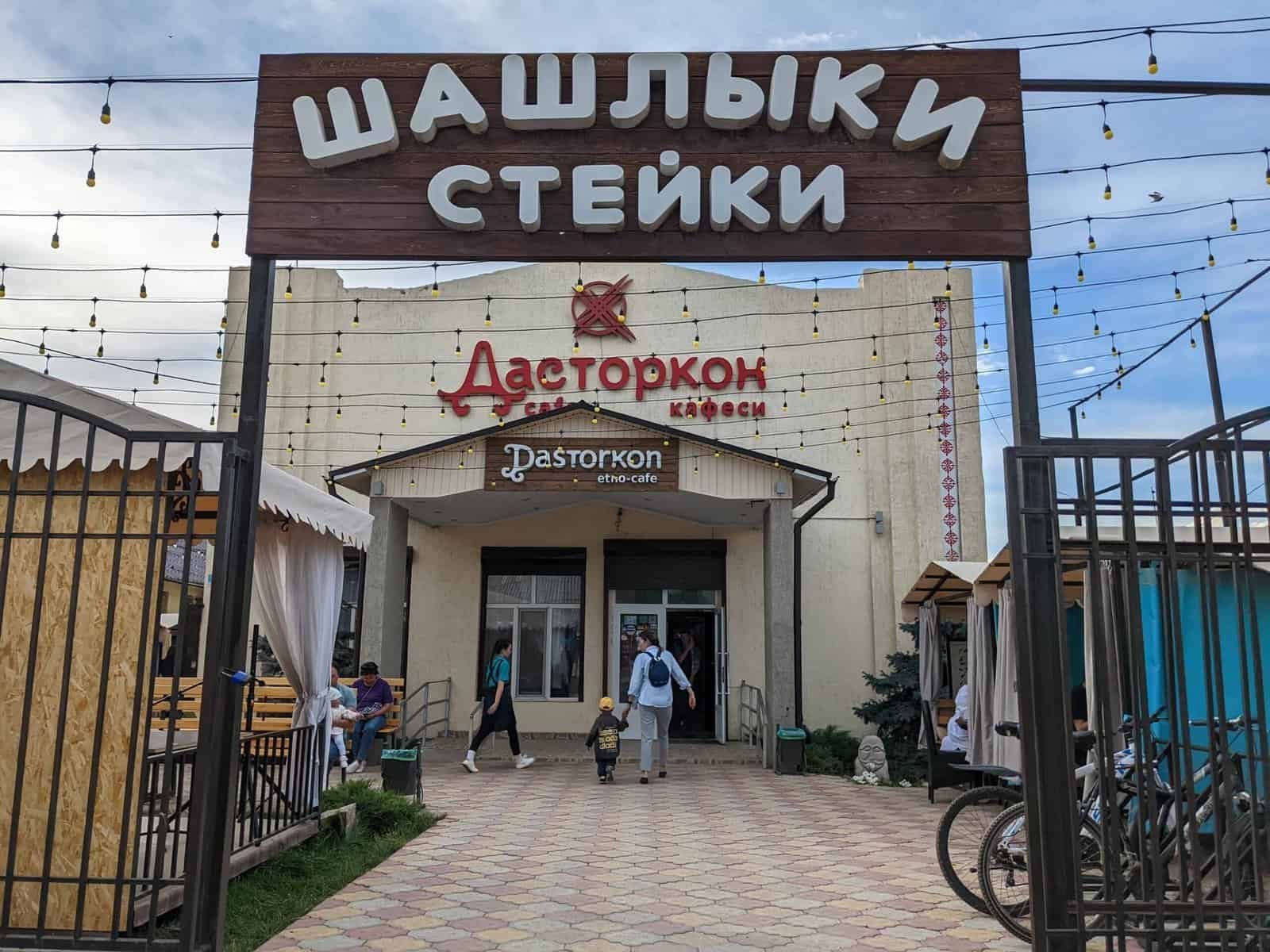
Cafe Dastorkon
Our verdict
In Karakol, where the Tian Shan foothills shape both the climate and the table, Cafe Dastorkon draws on the ingredient traditions of Kyrgyzstan's eastern heartland. The restaurant sits within a dining culture built around lamb, dairy, and grain sourced from nomadic and semi-nomadic supply chains that have changed little in generations. For travellers moving through this corner of Central Asia, it offers a grounded entry point into the region's food.

Pearl is the En Primeur Club membership app, where members save venues, book tables and use the concierge.
The menu
What to order
- Beshbarmak
- Lamb Steak
- Beef Kurrdak
- Shashlik
Where the Tian Shan Meets the Table
Karakol sits at roughly 1,700 metres above sea level at the eastern end of Lake Issyk-Kul, a position that does more to shape local cooking than any restaurant decision could. The altitude compresses the growing season, the surrounding pastures dictate what animals are raised and how, and the relative isolation from Bishkek's increasingly cosmopolitan restaurant scene means the food here has remained closer to its source. Cafe Dastorkon operates inside that context. Before considering what arrives on the plate, it helps to understand the supply geography: this is a region where lamb is slaughtered locally, fermented mare's milk (kumis) is produced within kilometres of where it is served, and grain products are milled from wheat grown in the Issyk-Kul basin rather than imported from Russia or Kazakhstan.
That ingredient proximity is not a marketing position in Karakol; it is simply the structure of the local economy. Small towns in Kyrgyzstan's eastern provinces have always relied on short supply chains by necessity, and restaurants like Cafe Dastorkon are the downstream expression of that reality. The name itself signals the intent: "dastorkon" refers to the traditional Kyrgyz cloth spread on the ground or a low table to receive food and guests, a hospitality framework that places generosity and abundance at the centre of the meal before a single dish is named.
The Ingredient Architecture of Kyrgyz Cooking
Kyrgyz cuisine is pastoral in its foundation. The dominant proteins are lamb and mutton, raised on high-altitude pasture that produces leaner, more mineral-forward meat than lowland alternatives. Beef appears, but occupies a secondary position. Horse meat, particularly in sausage form (chuchuk), is a seasonal and ceremonial ingredient that signals a kitchen's connection to nomadic tradition rather than urban adaptation. Dairy runs through the cuisine at every point: kaymak (a thick cream), kurut (dried sour milk balls), and kumis all appear in different registers, from condiment to digestif.
The grain work centres on wheat-based doughs, with beshbarmak (wide boiled noodles layered with meat and onion broth) sitting at the apex of the formal meal structure. Samsa (baked pastries filled with meat and onion) and manti (steamed dumplings) represent the everyday end of the same tradition. What distinguishes a kitchen operating in Karakol from one in Bishkek is the directness of the sourcing: the lamb has not travelled far, the dairy has not been aggregated through a distribution network, and the cook is likely to know the producer. That compression of distance between farm and kitchen is something that restaurants in more centralised cities, from Bishkek's Kim's Ramen to globally recognised kitchens like Arpège in Paris (whose sourcing model is built on named producers and tight geography), have to construct deliberately. In Karakol, it is simply the default.
Karakol's Place in Kyrgyzstan's Dining Tier
Kyrgyzstan's restaurant scene is concentrated in Bishkek, where a growing middle class and an expanding expat population have produced a range of dining formats, from casual Korean and Russian-influenced cafes to newer venues like Кростини / Crostini in Bishkek that reflect broader Central Asian urbanisation trends. Karakol operates in a different register entirely. It is a trekking and adventure tourism hub, not a culinary destination, and the restaurants here are evaluated on different terms: reliability, local authenticity, and the ability to feed travellers who have spent days on the Ala-Kul or Jety-Oguz trails.
Within that context, a cafe that maintains a connection to regional ingredients and traditional formats occupies a specific and functional niche. The comparison set is not Bishkek's emerging dining scene, and certainly not the Michelin-tracked kitchens of Le Bernardin in New York or Alain Ducasse at Louis XV in Monte Carlo. The relevant peer group is the network of family-run cafes and small restaurants across Karakol that serve the town's permanent population and its seasonal visitors.
Planning Your Visit
Karakol is most accessible between June and September, when the mountain passes are open and the trekking season draws the bulk of the town's visitors. The town is reachable from Bishkek by shared taxi (marshrutka) in approximately eight hours, or by overnight train to Balykchy followed by onward transport along the lake's northern shore. Accommodation options in Karakol remain modest by regional standards, oriented toward guesthouses and small hotels rather than branded properties. Dining hours across the town generally align with the local rhythm: earlier dinners, limited late-night options, and menus that may shift based on what is available from local suppliers on a given day. Visitors should approach with that flexibility rather than with expectations calibrated to urban dining environments. No booking infrastructure has been confirmed for Cafe Dastorkon; walk-in visits are the standard approach for this category of establishment in Karakol.
What the Food Tells You About the Place
Eating in Karakol is, at a structural level, an exercise in reading a landscape through its food. The prominence of lamb in the local diet reflects the herding economy of the surrounding valleys. The importance of preserved and fermented dairy products reflects the historical need to extend perishables across seasons without refrigeration. The communal format of dishes like beshbarmak, designed to be eaten together from a shared plate, reflects a hospitality culture built around collective consumption rather than individual portions.
Restaurants that maintain these formats, rather than adapting toward more individually plated, tourism-facing presentations, preserve something that is increasingly difficult to find as Kyrgyzstan's urban centres converge with international dining conventions. That is not a trivial observation for the traveller who has come this far east. The distance from the controlled-sourcing theatrics of kitchens like Aponiente in El Puerto de Santa María or the tasting-menu precision of Atomix in New York is not just geographical. It is a difference in what the meal is asked to do, and for whom it is constructed. In Karakol, the food is not a curated statement; it is the everyday output of a pastoral economy served with the generosity implied by the word dastorkon.
For broader orientation across the town's dining options, see our full Karakol restaurants guide.
Frequently asked questions
Is Cafe Dastorkon a family-friendly restaurant?
Karakol's dining culture is broadly communal, and places like Cafe Dastorkon reflect that orientation. Traditional Kyrgyz meals are structured around shared dishes, plov, shurpa, beshbarmak, which lend themselves naturally to group and family settings. The restaurant is based in Karakol, a town where tourism is tied largely to trekking families and multi-generational groups, so the format generally accommodates that audience.
How would you describe the vibe at Cafe Dastorkon?
Cafe Dastorkon sits in Karakol, a small high-altitude town at the eastern end of Lake Issyk-Kul rather than in Bishkek's more polished restaurant corridor. The atmosphere here follows the local register: functional, unhurried, and oriented toward the food rather than the setting. Expect a room that prioritises the meal over decor, with a clientele drawn from trekkers, local residents, and travellers passing through before or after the Tian Shan passes.
Is Cafe Dastorkon a good option for visitors arriving in Karakol specifically for trekking or outdoor travel?
Karakol functions as the primary staging town for Tian Shan trekking routes, and Cafe Dastorkon's location in the city puts it squarely in the path of that traveller flow. Traditional Kyrgyz food is calorie-dense and protein-forward, lamb broth, meat-heavy mains, bread staples, which aligns practically with pre- or post-trek needs. For visitors with limited time in the city, a restaurant grounded in local Kyrgyz cuisine gives a more direct read on regional food culture than the handful of international alternatives in town.
What should I eat at Cafe Dastorkon?
Kyrgyz cooking in Karakol centres on lamb and mutton raised on high-altitude pasture, which produces leaner meat than lowland equivalents. Beshbarmak, the national dish of boiled meat over flat noodles, and shurpa, a clear meat broth, represent the core of what a traditional Kyrgyz restaurant in this region would offer. Samsa, baked pastries filled with lamb and onion, are a reliable order at the lighter end of the menu.
Comparison Snapshot
| Venue | Cuisine | Price |
|---|---|---|
| Cafe DastorkonThis venue (the venue you are viewing) | Authentic Kyrgyz and Central Asian | Not listed |
| Кростини / Crostini | Mediterranean with Italian Influences | $10–20 |
Continue exploring
More in Karakol
Hotels in Karakol
All hotels in Karakol →
Details
- Rustic
- Cozy
- Well Known
- Family
- Group Dining
- Casual Hangout
- Open Kitchen
- Terrace
- A La Carte
- Vegetarian Friendly
- Vegan Options
- Gluten Free Options
Cozy ethnic interior with handmade carpets, paintings of ancestral life, and a yurt-inspired dome ceiling, creating an immersive nomadic atmosphere praised for its beauty and comfort.