





World's 50 Best #81 · Tabelog Bronze #505 · We're Smart World 5 Radishes
Our verdict
An auberge-format Italian restaurant set among its own working fields in Wakayama's Iwade, Villa Aida holds a Tabelog score of 4.26 and consecutive annual awards from 2020 through 2026. Chef Kanji Kobayashi grows more than 100 vegetable varieties on the surrounding land and sources seafood from within 12 kilometres, positioning the restaurant among Japan's most seriously produce-rooted Italian tables.

Pearl is the En Primeur Club membership app — saves, bookings, and concierge access live there. Same editors, same standards.
- Address
- 71-5 Kawashiri, Iwade, Wakayama 649-6231, Japan
- Phone
- +81736632227
- Hours
- Daily 12–8 PM
- Website
- villa-aida.jp
- Directions
- Get directions
- Booking
- Book on the venue's website
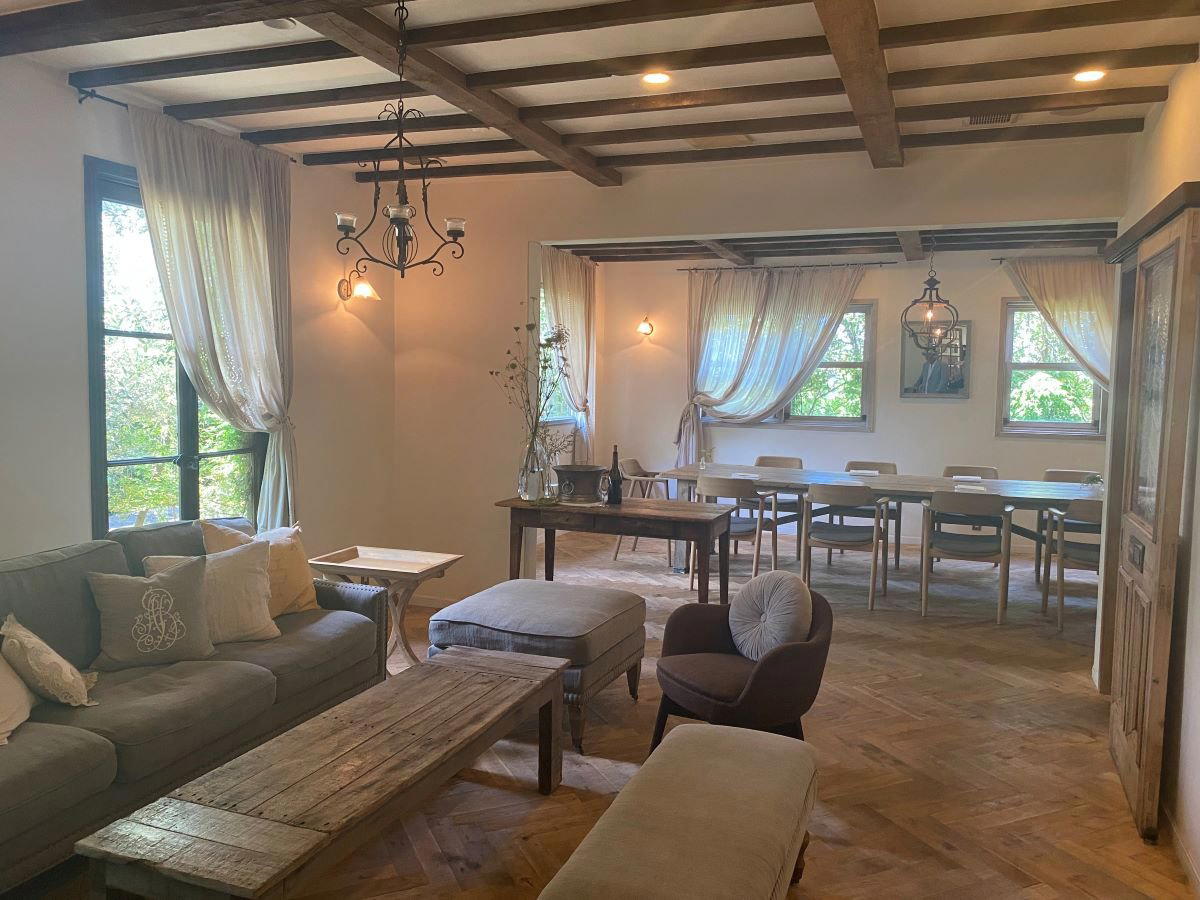
A Field, Then a Restaurant
The approach to Villa Aida tells you something about how Italian cooking has been reinterpreted in provincial Japan. Where Italy's most celebrated farm-to-table restaurants — think Piemonte's agriturismo belt or Tuscany's estate-winery tables — typically pair a working property with deep regional meat and grain traditions, the Wakayama version pivots hard toward vegetables and the sea. The kitchen sits inside a house-restaurant format in Iwade, a small city in Wakayama Prefecture roughly an hour south of Osaka, and the fields surrounding the building are part of the dining proposition. More than 100 vegetable varieties are cultivated on that land. Rice comes from the same property. The Pacific coast is approximately 12 kilometres away, close enough that the daily seafood supply operates on the same hyper-local logic as the produce.
This is not a metropolitan Italian table adjusted for Japanese ingredients. It is something more specifically regional: a Wakayama restaurant that happens to use Italian technique as its organising grammar. That distinction matters when you are placing it in context alongside Japan's broader fine-dining map.
Where Villa Aida Sits in Japan's Award Hierarchy
Japan's Italian restaurant scene divides, broadly, between city-centre addresses in Tokyo and Osaka competing on technique and international pedigree, and a smaller cohort of rural or semi-rural tables where the argument is about produce provenance and immersion in place. Villa Aida belongs firmly to the second group, and within that group it has built a sustained award record that is difficult to dismiss.
Tabelog, Japan's most-used restaurant review platform, has recognised Villa Aida with annual Bronze or Silver awards every year from 2020 through 2026, including a Silver in 2022. The venue's current Tabelog score is 4.26, which places it in the upper tier of the platform's Italian rankings for western Japan: it has been selected for the Tabelog Italian WEST "100" list in 2021, 2023, and 2025. On the Opinionated About Dining list, a separate, critic-sourced ranking, the restaurant placed 97th in Japan in 2023, 60th in 2024, and 36th in 2025, a trajectory that indicates sustained upward momentum rather than a single breakout year. That 2025 OAD ranking of 36th across all of Japan, across all cuisine categories, is the most telling single data point here.
For comparison, the upper tier of Japan's Italian scene includes addresses like cenci in Kyoto and the globally recognised 8 1/2 Otto e Mezzo Bombana in Hong Kong. Villa Aida operates at a different register, its argument is not one of classical Italian lineage deployed in Asia, but of Italian structure applied to the agricultural specifics of a single Japanese prefecture.
The Locavore Logic: Italian Form, Wakayama Content
Italy's regional cooking traditions are, at their root, expressions of geography: Roman anchovy-and-offal cooking reflects what was available around the Tiber; Ligurian food is shaped by the narrow coastal strip between mountains and sea; Sicilian cuisine carries centuries of maritime trade. The logic at Villa Aida is structurally parallel, Italian form applied to what the specific land and sea around Iwade actually produce.
Chef Kanji Kobayashi developed what is now described as a locavore approach after time spent in Italy, where proximity of kitchen to source was not a marketing positioning but a practical default in the country's more agricultural regions. Back in Wakayama, the application of that principle required building supply chains from scratch, cultivating the vegetables directly rather than relying on existing distribution networks. The result is a kitchen with more than 100 vegetable varieties in rotation across the growing calendar and a seafood supply drawn from the Kii coast to the south. The wine program takes the same considered approach, with the restaurant noted for particular attention to its wine list.
Vegetarian and vegetable-forward options are explicitly part of the menu structure, which is consistent with a kitchen whose primary investment is in its produce rather than its protein. This orientation earned Villa Aida recognition as Leading Vegetable Restaurant of Japan in 2019, a designation that pre-dates much of the current critical momentum but signals how early the vegetable-forward identity was established.
The Format: Auberge Scale, Counter-Adjacent Intimacy
The auberge designation in Villa Aida's listing places it in a category that Japanese dining culture has absorbed from the French tradition but inflects distinctly. An auberge format implies overnight accommodation attached to or associated with a restaurant, where the dining experience and the landscape context are inseparable. Villa Aida's 16-seat capacity is consistent with this framework: it is small enough that every service is a complete, intentional event rather than a segment of a high-volume operation.
Sixteen seats is a meaningful constraint. For context, Japan's high-end omakase counters, the sushi and kaiseki formats that attract the most international attention, often operate at 8 to 12 seats. At 16, Villa Aida is slightly larger than those intimate counter formats but remains in the low-capacity tier where reservation pressure is significant. Reservations open two months ahead and close when capacity is reached, meaning that last-minute access is essentially unavailable. The restaurant is reservation-only, and the practical advice applies year-round: plan the visit two months in advance, not two weeks.
Dinner is priced in the JPY 20,000 to JPY 29,999 range per person based on review data, with some spending breakdown entries indicating JPY 40,000 to JPY 49,999 at the higher end. Credit cards are accepted (Visa, Mastercard, JCB, Amex, Diners). QR code payments and electronic money are not. The restaurant is entirely non-smoking, and school-age children are welcome, though children below elementary school age are not admitted.
Getting There from Osaka or Kyoto
Villa Aida's address, 71-5 Kawashiri, Iwade, Wakayama, places it in a residential-agricultural area that requires deliberate navigation. Iwade Station is the nearest rail hub, and a taxi from the station costs approximately JPY 1,000. The alternative is the Wakayama Bus Naka express service toward Tarui Station, alighting at the Ikemoto stop for a three-minute walk of around 191 metres. Buses run approximately once an hour, so timing matters. Driving is the most practical option for parties arriving from Osaka or Nara: the route follows National Route 24 to the Bizen intersection, heading north, with the restaurant sign appearing on the left after a JA cooperative building. Parking is available on site.
Business hours shift seasonally: lunch service begins at 12:30 in summer and 13:00 in winter. Closed days are not fixed, so confirming directly with the restaurant before travel is essential. The website is villa-aida.jp. Phone is +81-736-63-2227.
Villa Aida in the Broader Kansai Context
Wakayama's premium dining scene is small compared to the Kansai triangle of Osaka, Kyoto, and Nara. The region's restaurant recognition tends to cluster around traditional Japanese formats, which makes Villa Aida's Italian positioning and its OAD top-40 national ranking all the more notable as a regional anomaly. For visitors building a Kansai itinerary, the logical anchor points include HAJIME in Osaka, Gion Sasaki in Kyoto, and akordu in Nara. Villa Aida sits at a deliberate remove from that circuit, not a detour from a city itinerary but a destination in its own right, one that rewards the additional logistics with a dining context that no urban table in the region replicates.
For those extending further, Goh in Fukuoka, 1000 in Yokohama, Harutaka in Tokyo, 6 in Okinawa, Abon in Ashiya, affetto akita in Akita, Aji Arai in Oita, and Ajidocoro in Yubari District represent the range of Japan's regional fine dining across formats and geographies. Explore, along with guides to Iwade hotels, Iwade bars, Iwade wineries, and Iwade experiences for broader trip planning in the area.
Frequently asked questions
What dish is Villa Aida famous for?
No single signature dish is documented in published sources, but Villa Aida's defining focus is vegetable-forward Italian cooking drawn almost entirely from ingredients grown or sourced within the immediate area. The restaurant was named Best Vegetable Restaurant of Japan 2019, and its Tabelog profile notes a particular focus on vegetables and vegetarian options. The menu changes in line with what chef Kanji Kobayashi's fields and local farmers produce.
Comparable Venues
Comparable venues nearby, for context on price, style, and recognition.
| Venue | Cuisine | Price | Awards | Notes |
|---|---|---|---|---|
| Villa AidaThis venue — the venue you are viewing | Italian Vegetable Omakase | $150–200 | World's 50 Best #81 · Tabelog Bronze #505 | Not listed |
| ヴィラ アイーダ | Italian Vegetable Omakase | $150–200 | World's 50 Best #81 · Tabelog Bronze #505 | Iwade |
| Kiyama | Traditional Kaiseki Washoku | $200–300 | 1 Michelin Star · Tabelog Silver #61 | Nakagyō |
| Da terra | Farm-to-Table Italian Omakase | $50–100 | 1 Michelin Star · We're Smart World 4 Radishes | Asuka |
| Kashiwaya Osaka Kitashinchi | Traditional Kaiseki | $200–300 | 1 Michelin Star | Kita |
| DODICI | Modern Italian with Kyoto Influences | $200–300 | 1 Michelin Star · Tabelog 100 #73 | Nakagyō |
Recognition history
Dated appearances from independent guides and award organizations, with the underlying list record or original source where available.
World's 50 Best Asia's Best Restaurants #81
World's 50 Best
Opinionated About Dining Top Restaurants in Japan Ranked #28
Opinionated About Dining
Tabelog Bronze #505
Tabelog
The Best Chef Two Knives
The Best Chef
We're Smart World 5 Radishes
We're Smart World
Full recognition history (11 entries)
Opinionated About Dining Top Restaurants in Japan Ranked #36
Opinionated About Dining
Tabelog 100 #65 · No. 65
Tabelog · Tabelog 100 - Italian - WEST - 2025
We're Smart World Top 100 #7
We're Smart World
Opinionated About Dining Top Restaurants in Japan Ranked #60
Opinionated About Dining
Opinionated About Dining Top Restaurants in Japan Ranked #97
Opinionated About Dining
The Japan Times Destination Restaurants Destination Restaurants Selection #8
The Japan Times Destination Restaurants
Continue exploring
More in Iwade
Restaurants in Iwade
Browse all →


Bars in Iwade
Browse all →
Hotels in Iwade
Browse all →

Wineries in Iwade
Browse all →
Details
- Elegant
- Cozy
- Intimate
- Rustic
- Scenic
- Date Night
- Special Occasion
- Garden
- Extensive Wine List
- Local Sourcing
- Farm To Table
- Garden
- Omakase
- Tasting Menu
- Vegetarian Friendly
Current opening hours
- Monday
- 12–8 PM
- Tuesday
- 12–8 PM
- Wednesday
- 12–8 PM
- Thursday
- 12–8 PM
- Friday
- 12–8 PM
- Saturday
- 12–8 PM
- Sunday
- 12–8 PM
Hours can change for holidays and private events. Last verified .
Warm Italian villa-style house with relaxing, stylish atmosphere evoking Italian countryside, surrounded by gardens.