
A Michelin-starred sushi counter in Nishitenma, Osaka, where Edomae tradition meets Kansai sensibility. The chef deploys two types of shari, rice vinegar for white-fleshed fish, red vinegar for fatty cuts, to calibrate every piece precisely.
Pearl is the En Primeur Club membership app — saves, bookings, and concierge access live there. Same editors, same standards.
- Address
- 4 Chome-12-22 Nishitenma, Kita Ward, Osaka, 530-0047, Japan
- Phone
- +81 6-6367-5040
- Website
- sushi-roku.com
- Directions
- Get directions
 Saves & bookings on Pearl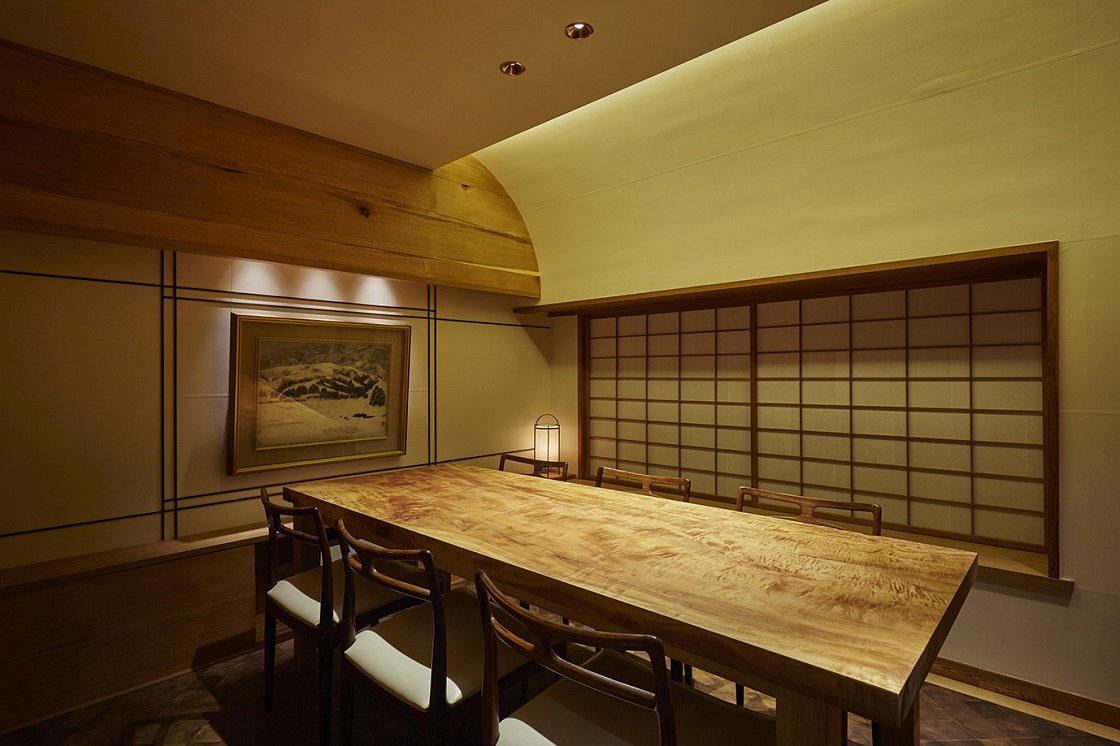
A Counter in Nishitenma
Nishitenma sits in Kita Ward, north of the Nakanoshima business island, and has accumulated a concentration of serious counter restaurants over the past decade. It is the kind of neighbourhood where the storefronts are understated and the clientele knows exactly where it is going. Sushiroku is a one-Michelin-star restaurant in Osaka serving Edomae-Style Omakase Sushi at about $150 per person. It occupies that register: a room built around a hinoki cypress counter, the pale timber grain catching whatever light there is, and a chef working in near silence. The atmosphere is purposeful rather than theatrical, no spoken drama, no tableside performance, just the sound of rice being pressed and fish being cut. For a visitor oriented around Osaka's louder, more gregarious dining culture, that restraint registers immediately as a signal.
Where Edomae Meets Kansai
The foundational tension in high-end Osaka sushi is the same one that shapes the city's relationship with Tokyo cooking more broadly. Edomae, the tradition that developed in Edo-period Tokyo around quick-curing, marinating, and soy-glazing fish to extend its life, arrived in Osaka carrying its own vocabulary. Kansai cooking, by contrast, has historically preferred softer rice, lighter seasoning, and a directness with ingredient quality over technique-as-transformation. The counters that matter in this city tend to position themselves somewhere along that axis.
Sushiroku holds a considered position in that argument. The chef uses Edomae method as a structural framework, the soy-marinated tuna wrapped in nori after forming, tekkamaki-style, is a direct reference to the old Tokyo tradition, but the underlying approach acknowledges Kansai sensibility rather than overriding it. This is not a Tokyo counter that happens to be in Osaka. The result is a reading of sushi that earns its Michelin star through synthesis rather than replication. For context on what that star means in a city with fierce competition across price brackets, consider that the ¥¥¥¥ tier in Osaka sits alongside addresses like Kashiwaya and Taian at the kaiseki end, and that earning recognition at this price point requires consistent precision rather than spectacle.
The Rice Logic
The technical commitment that defines the counter is the two-shari system. Most omakase counters use a single seasoned rice throughout service, adjusting portion and temperature by hand. Here, the chef maintains two distinct preparations: rice vinegar for white-fleshed fish, red vinegar for fatty cuts. Red vinegar, made from sake lees, carries more umami and a darker hue; it has a longer history in Edomae tradition than the lighter rice vinegar that became standard through much of the twentieth century. The decision to run both through the same service is logistically demanding and signals a specific calibration philosophy, that the harmony between rice and topping should be engineered per piece rather than approximated across the whole. Among Osaka sushi counters, that dual-shari discipline is not the norm. It places Sushiroku in a smaller comparable set that includes counters like Sushi Harasho and Matsuzushi, where rice is treated as a variable rather than a constant.
The Lunch Case
Across Japan's omakase tier, lunch service has become a strategically important booking. Demand at starred counters has shifted the economics: dinner remains the primary sitting, but lunch often delivers the same chef, the same sourcing, and the same sequence at a lower price point, with more accessible reservation windows. At Sushiroku, the ¥¥¥ pricing already positions it below the ¥¥¥¥ bracket occupied by Osaka's French and innovative-cuisine leaders like Hajime and Fujiya 1935. A lunch booking compresses that further while retaining the full dual-shari experience.
There is also a perceptual argument for lunch at a counter this quiet. The room, described as cosy in the Michelin notes, will feel different at midday than late evening. Natural light through the interior changes how the hinoki counter reads. The chef's concentration, unchanged by the hour, is easier to observe without the accumulated energy of a full dinner sitting. Serious sushi counters in Japan have long understood that lunch is not a lesser version of dinner, it is a different angle on the same craft. Comparable starred counters in Tokyo, such as Harutaka, have built strong lunch followings on exactly this premise. In Osaka, the same logic applies.
How Sushiroku Sits Among Osaka's Sushi Counters
The Michelin 1 Star awarded in 2024, followed by the Plate recognition in 2025, places Sushiroku in a defined peer tier within Osaka sushi. The city's counter scene spans from neighbourhood kaiten operations through mid-range omakase to a smaller cohort of starred addresses. Within that starred cohort, Sushiroku's ¥¥¥ positioning distinguishes it from counters that push into higher price brackets for premium sourcing alone.
For a broader map of where Sushiroku sits, the comparison set within Osaka sushi includes Sushi Hoshiyama, Sushi Murakami Jiro, and Sushi Sanshin. Each brings its own technical emphasis; Sushiroku's dual-shari discipline and Edomae-Kansai synthesis mark its position clearly within that field. Beyond Osaka, the regional comparison reaches to Gion Sasaki in Kyoto for a sense of how Kansai culinary identity operates at starred level across disciplines, and internationally to counters like Sushi Shikon in Hong Kong and Shoukouwa in Singapore, which export Edomae tradition to different markets with different constraints.
For visitors building a broader Kansai itinerary, akordu in Nara and Goh in Fukuoka round out a regional circuit that moves between Japan's distinct culinary registers. The full Osaka restaurants guide covers the wider scene across categories and price points.
Planning Your Visit
Location: 4 Chome-12-22 Nishitenma, Kita Ward, Osaka 530-0047. Reservations: The counter format and Michelin recognition mean advance booking is advisable; no online booking details are publicly listed, so approach via telephone or through your hotel concierge. Budget: ¥¥¥ tier, mid-to-upper range for Osaka omakase, below the upper-tier ¥¥¥¥ bracket. Dress: No formal dress code is documented, but the counter atmosphere reads as smart-casual at minimum. Timing: Lunch service, where available, offers the same technical programme with potentially more accessible reservations than dinner.
Same-City Peers
Comparable venues nearby, for context on price, style, and recognition.
| Venue | Cuisine | Price | Notes |
|---|---|---|---|
| SushirokuThis venue — the venue you are viewing | Edomae-Style Omakase Sushi | $$$$ | Not listed |
| Nishitemma Ichigaya | Modern Kappo | $$$$ | Kita |
| Sushi Murakami Jiro | Michelin 1-Star Omakase Sushi | $$$$ | Kita |
| Katamachi Kawaguchi | Refined Japanese Kaiseki | $$$$ | Miyakojima |
| Sushi Yuden | Michelin-Starred Omakase Sushi | $$$$ | Tennōji |
| Masuda | Michelin-Starred Seasonal Kaiseki Omakase | $$$$ | Chūō |
Recognition history
Dated appearances from independent guides and award organizations, with the underlying list record or original source where available.
Michelin Plate
Michelin
Michelin Plate
Michelin
Michelin 1 Star
Michelin
Continue exploring
More in Osaka
Restaurants in Osaka
Browse all →




Bars in Osaka
Browse all →




Hotels in Osaka
Browse all →




Wineries in Osaka
Browse all →
At a Glance
- Intimate
- Quiet
- Elegant
- Cozy
- Date Night
- Special Occasion
- Solo
- Chefs Counter
- Sake Program
- Sustainable Seafood
Current opening hours
- Monday
- 5:30–10 PM
- Tuesday
- 5:30–10 PM
- Wednesday
- 5:30–10 PM
- Thursday
- 5:30–10 PM
- Friday
- 5:30–10 PM
- Saturday
- 5:30–10 PM
- Sunday
- 5:30–10 PM
Hours can change for holidays and private events. Last verified .
Cozy hinoki cypress counter in a simple, quiet space offering a private and refined atmosphere.