Mercado Central

Michelin Plate
Our verdict
A Spanish restaurant on Green Street, a short walk from Trinity College, Mercado Central holds a Michelin Plate for 2024 and 2025. The menu draws heavily from northern Spain, with Galicia and the Basque Country shaping most of the cooking. Open-flame preparation is visible on the ground floor; a quieter dining room sits upstairs.

Pearl is the En Primeur Club membership app — saves, bookings, and concierge access live there. Same editors, same standards.
- Address
- 24 Green St, Cambridge CB2 3JX, United Kingdom
- Phone
- +44 7904 195165
- Hours
- Mon ClosedTue–Thu 12–2:30 PM, 6–9:30 PMFri–Sat 12–2:30 PM, 5:30–9:30 PMSun 12–2:30 PM
- Website
- mercadocentral.co.uk
- Directions
- Get directions
- Booking
- Book on ResDiary
The menu
What to order
- Croquetas
- Iberico pork
- Black rice
- Tortilla
Green Street, the University Quarter, and the Logic of Eating Spanish in Cambridge
Cambridge's restaurant geography follows a familiar pattern in historic university cities: the streets closest to the colleges attract the most passing trade, which tends to reward versatility over specialism. Green Street, tucked between the market square and Trinity College, is dense with that kind of foot traffic. What makes Mercado Central worth noting is that it pushes against that logic. A Spanish kitchen with a northern-Iberian focus, operating out of a brightly decorated townhouse a short distance from Trinity's gates, is a deliberate choice of identity rather than an attempt to please everyone at once.
That specificity matters in the context of Cambridge dining more broadly. The city's strongest restaurants — among them Midsummer House and Restaurant Twenty-Two, both operating at the ££££ tier — tend toward contemporary British or modern European formats. Mercado Central sits at £££, occupying a middle price point and a clearly defined regional identity that neither of those venues attempts. It is also a different proposition from the American-influenced cooking at Alden & Harlow or the more casual registers of Darling and Fallow Kin. Within Cambridge's dining scene, a committed northern-Spanish programme is genuinely uncommon.
Northern Spain on a Cambridge Menu
The Basque Country and Galicia represent two of Spain's most produce-driven culinary traditions. Galicia is built around the Atlantic: seafood pulled from cold, mineral-rich waters, white wines with high acidity, and a cooking culture that treats quality of ingredient as the primary argument. The Basque Country operates on similar principles but with a distinct identity shaped by pintxos culture, wood-fired cooking, and a tradition of male-dominated gastronomic societies that have long made the region's food scene one of the most discussed in Europe. Together, these two regions represent a northern axis that is emphatically different from the olive-oil-and-tomato vocabulary of Andalusia or the rice-centred cooking of Valencia.
Mercado Central's menu draws on both. The Michelin Plate recognition it has held for both 2024 and 2025, a designation awarded by Michelin inspectors to restaurants serving food of good quality that falls below star level, confirms that the sourcing and execution are taken seriously. The Michelin Plate is not a starred accolade, but it is a considered signal: inspectors visited, assessed, and found the kitchen worth flagging. In a city where Michelin recognition at any tier is not guaranteed, it is a meaningful data point.
The presa Ibérica noted in Michelin's own citation is instructive. Presa is a cut from the shoulder-end of the Iberian pig, prized for its fat marbling and its capacity to carry char from open-flame cooking without drying out. The fact that the Michelin entry specifically calls out the marbling suggests the sourcing is from higher-welfare, acorn-fed stock rather than commodity Ibérico. Tarta de Santiago, the almond cake from Galicia traditionally marked with the cross of Saint James, represents a different kind of northern-Spanish classicism: it is one of the region's most historically documented desserts, and its presence on the menu signals a commitment to the source culture rather than a pan-Iberian greatest-hits approach.
Two Rooms, Two Temperatures
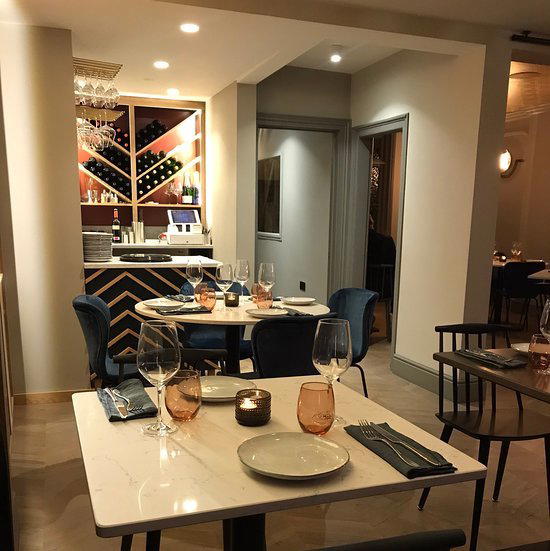
The physical layout of Mercado Central creates a genuine choice for the visitor. The ground floor, where open-flame cooking is visible, operates at a higher sensory register: the smell of charring fat, the sound of a working kitchen close at hand, the visual drama of fire as a cooking medium. Open-flame cooking is a defining technique in northern-Spanish tradition, from the asadores of the Basque interior to the stone-grilled fish of the Galician coast, so the ground-floor setting makes the connection between method and culture legible.
Upstairs dining room is quieter. In a townhouse conversion near a busy Cambridge street, that separation of registers is a practical asset: the same kitchen serves both rooms, but the experience of eating shifts depending on which floor you choose. For groups wanting a more focused conversation, the upper room offers it. For solo diners or pairs who want proximity to the cooking, the ground floor is the more interesting choice.
Townhouse format itself, a residential building repurposed for hospitality, is common enough in Cambridge that it registers as a vernacular rather than a novelty. What matters here is that the bright decoration creates a domestic warmth rather than a corporate-restaurant anonymity, which suits the regional specificity of the menu: northern-Spanish food is social and generous in its proportions, and it reads better in spaces that feel inhabited.
Where Mercado Central Sits in a Broader Iberian Context
Across the UK, the Basque and Galician traditions have moved from curiosity to establishment status over the past decade. London has a well-developed Basque-inflected dining scene; cities like Edinburgh and Manchester have seen serious Spanish kitchens open and consolidate. Cambridge, with its smaller dining economy and a visitor base weighted toward academic tourism, has been slower to develop depth in any single regional cuisine. Mercado Central operates in a thin competitive field locally, which means it draws comparison less with other Cambridge restaurants and more with the broader tier of regional-Spanish kitchens operating outside London.
For readers tracking Michelin-recognised Spanish cooking across other cities and countries, the tradition Mercado Central draws from is also represented at ZURRIOLA in Tokyo, which applies Basque technique in a Japanese context, and Arco by Paco Pérez in Gdańsk, which exports a starred Catalan sensibility to northern Poland. These are different expressions, but they share a reference culture.
Among the UK's broader roster of destination restaurants, the fire-forward, produce-led ethos that defines northern-Spanish cooking has clear analogues in British fine dining: L'Enclume in Cartmel and Moor Hall in Aughton both operate with a similar premium-produce logic, and Hand and Flowers in Marlow demonstrates that Michelin recognition outside London is sustained by sourcing discipline and technical consistency rather than by location. Mercado Central occupies a different price point and scale than any of those venues, but the underlying argument, that quality of produce carries a menu, is the same.
Planning a Visit
Mercado Central is at 24 Green Street, Cambridge CB2 3JX, a short walk from the city centre and within easy distance of Trinity College and the market square. The £££ price tier places it in the mid-to-upper range for Cambridge dining, below the ££££ tier of Midsummer House and Restaurant Twenty-Two but above the casual end of the market. Booking in advance is advisable, particularly for the ground-floor seats near the open flame, which are likely to be requested most often.
For a fuller picture of what Cambridge offers across restaurants, hotels, bars, and experiences, and our full Cambridge experiences guide.
What should I eat at Mercado Central?
The menu is anchored in northern-Spanish traditions, specifically Galicia and the Basque Country, with a strong emphasis on sourced produce. The Michelin citation highlights presa Ibérica, a marbled shoulder cut of Iberian pig suited to open-flame cooking, as a representative dish. The tarta de Santiago, a Galician almond cake, is specifically noted as a recommended way to close the meal. Beyond those reference points, the menu shifts with season and sourcing, so the most reliable approach is to follow the kitchen's current recommendations on arrival rather than planning around a fixed dish list.
Frequently asked questions
What should I eat at Mercado Central?
The menu is rooted in Galician and Basque traditions, with sourced produce doing most of the work. The presa Ibérica, a well-marbled cut from the shoulder of the Iberian pig, is the kind of dish the kitchen builds its identity around. Finish with the tarta de Santiago, the almond cake from Galicia that appears on the menu as a deliberate regional statement. The Michelin Plate recognition in both 2024 and 2025 reflects consistent kitchen output rather than a single showpiece dish.
How much does it cost to eat at Mercado Central?
Pricing at Mercado Central is listed as £££.
Booking and Cost Snapshot
| Venue | Cuisine | Price | Awards | Notes |
|---|---|---|---|---|
| Mercado CentralThis venue — the venue you are viewing | Modern Spanish Tapas | $50–100 | Michelin Plate | Not listed |
| Midsummer House | Modern British Fine Dining | $150–200 | 2 Michelin Stars · La Liste Top Restaurants | Contemporary British, Creative |
| Restaurant Twenty-Two | Modern British Fine Dining | $100–150 | 1 Michelin Star · National Restaurant Awards Top 100 #22 | Modern Cuisine |
| Langdon Hall | Canadian | Not listed | Not listed | Not listed |
Recognition history
Dated appearances from independent guides and award organizations, with the underlying list record or original source where available.
Michelin Plate
Michelin
Full recognition history (3 entries)
Michelin Plate
Michelin
Michelin Plate
Michelin
Continue exploring
More in Cambridge
Restaurants in Cambridge
Browse all →
Bars in Cambridge
Browse all →
Details
- Lively
- Cozy
- Trendy
- Date Night
- Special Occasion
- Casual Hangout
- Open Kitchen
- Extensive Wine List
- Small Plates
- A La Carte
- Vegetarian Friendly
Current opening hours
- Monday
- Closed
- Tuesday
- 12–2:30 PM, 6–9:30 PM
- Wednesday
- 12–2:30 PM, 6–9:30 PM
- Thursday
- 12–2:30 PM, 6–9:30 PM
- Friday
- 12–2:30 PM, 5:30–9:30 PM
- Saturday
- 12–2:30 PM, 5:30–9:30 PM
- Sunday
- 12–2:30 PM
Hours can change for holidays and private events. Last verified .
Warm, buzzy atmosphere with nice decor, atmospheric setting, and an open kitchen.