Boulder Dam Hotel
Boulder Dam Hotel occupies one of the most architecturally coherent buildings in the American Southwest's small-town heritage circuit. Built in 1933 at 1305 Arizona St in Boulder City, Nevada, the property sits in a federally planned town conceived alongside the construction of Hoover Dam, giving the hotel a civic identity that few period properties can match. For travellers passing through the Lake Mead corridor, it functions as a primary historical reference point.

Pearl is the En Primeur Club membership app, where members save venues, book tables and use the concierge.
A Federally Planned Town and the Hotel Built to Anchor It
Boulder City occupies a strange and specific position in American urban history. It was designed from scratch by the federal government in the early 1930s to house the workforce constructing Hoover Dam, one of the largest infrastructure projects in United States history. Unlike Las Vegas, 26 miles to the northwest, it was laid out on a grid with civic intent: orderly streets, a town centre, and a prohibition on gambling that remains in force today. Within that planned context, Boulder Dam Hotel was not an afterthought. It was part of the original civic architecture, completed in 1933 to accommodate government officials, engineers, and press covering what was then considered a wonder of the modern engineering world.
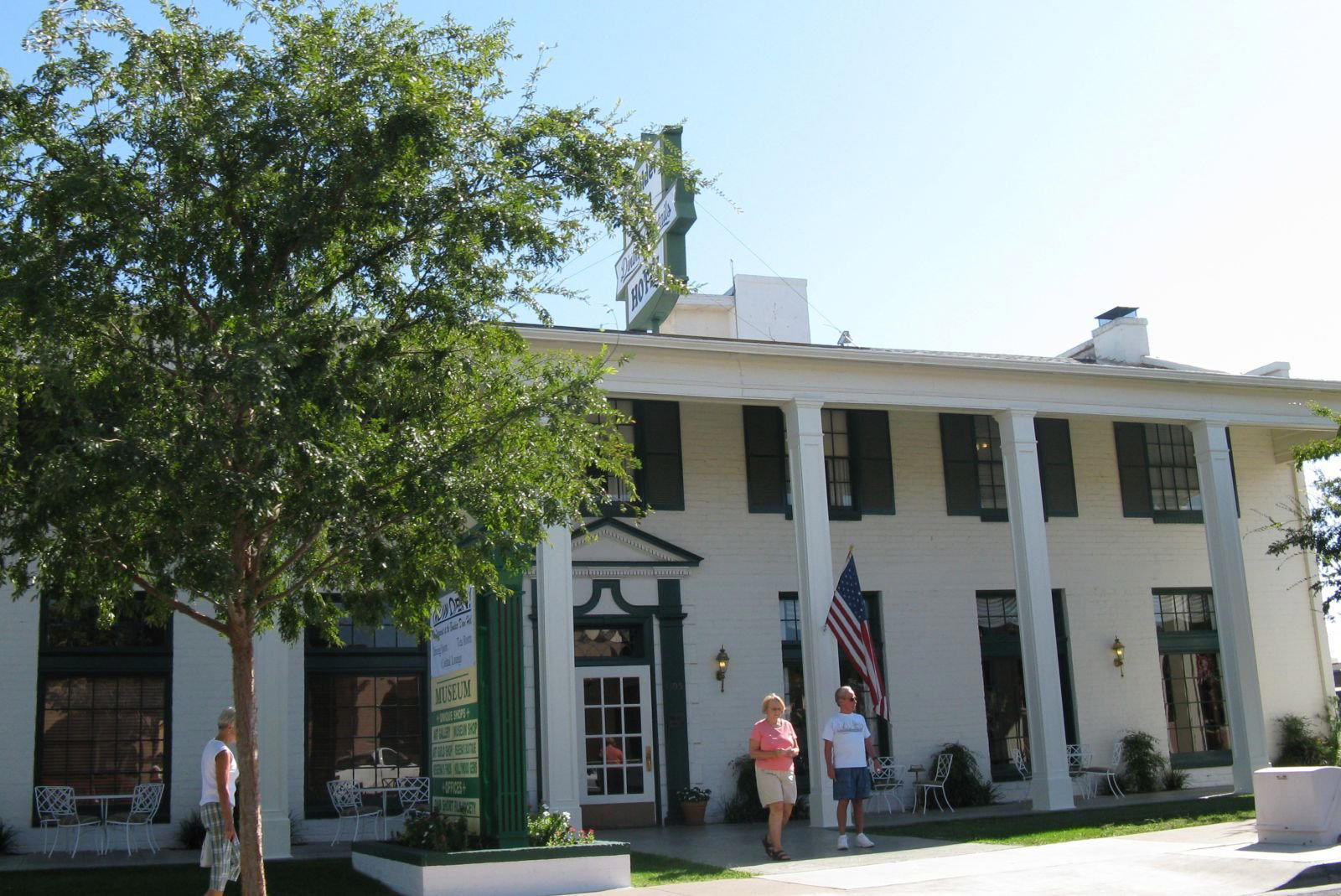
That origin story is not merely historical colour. It defines the building's physical scale, its relationship to the street grid, and the reason its Colonial Revival facade reads with an authority that distinguishes it from the vernacular motels and roadside accommodation that dominate the region's mid-century lodging stock. The hotel's two-storey white frame construction, with its covered verandas and symmetrical front elevation, belongs to a tradition of civic-institutional architecture that the federal government used throughout the New Deal era to signal permanence and legitimacy in projects that might otherwise have seemed temporary. The design choice was deliberate: a building that looked like it intended to stay.
Colonial Revival in the Mojave: What the Architecture Actually Says
Colonial Revival was an unusual choice for a desert property built in the shadow of a concrete dam. The style had been the dominant vocabulary of American civic and institutional buildings since the late nineteenth century, and its application here placed Boulder Dam Hotel in a legible tradition rather than attempting regional exoticism. Where later Southwestern resort architecture would reach for adobe forms, terracotta palettes, and landscape metaphors, the Boulder Dam Hotel insisted on a different register: white-painted clapboard, black shutters, a pitched roof, and a formal entry sequence that would not look out of place in a Virginia county seat.
That architectural contrast matters when reading the building against the landscape it occupies. The Mojave Desert at the Nevada-Arizona state line is not a sympathetic backdrop for New England formalism, and yet the hotel's insistence on its own vocabulary gives it a quality that more contextually sensitive buildings often lack. It does not dissolve into its setting. It holds a position. For travellers arriving from Las Vegas along US-93, this is the first building in Boulder City that reads as a civic statement rather than a commercial convenience.
Heritage properties in this price tier across the American Southwest tend to split between two approaches: adaptive reuse that prioritises modern amenity while preserving shell architecture, and preservation-first operations that accept operational constraints in exchange for period authenticity. The Boulder Dam Hotel's proposition is historical legibility, and the architecture is its primary evidence.
Boulder City as Context: What the Town Adds
Understanding the hotel requires understanding Boulder City, which functions unlike any other municipality in Clark County. The federally mandated gambling prohibition, still in effect, means the town operates on a different economic logic from the rest of the Las Vegas metropolitan area. There are no casinos. Commerce clusters around outdoor recreation access, Lake Mead National Recreation Area, and the heritage tourism generated by Hoover Dam itself, which attracts roughly one million visitors annually. This gives Boulder City a daytime tourism economy that dissipates by evening, leaving the town unusually quiet for a Nevada settlement this close to Las Vegas.
That quietness is a feature for a specific kind of traveller. Visitors using Boulder Dam Hotel as a base for Lake Mead, the historic dam tour, or the surrounding desert trails get the recreational access of the region without the noise and commercial density of the Las Vegas Strip. The hotel's position on Arizona Street, within walking distance of the original town centre, means access to local restaurants and the Nevada State Railroad Museum without requiring a car for every movement. For those comparing Southwest heritage lodging options, this is a materially different experience from the resort scale of Canyon Ranch Tucson or the wilderness positioning of Sage Lodge in Pray.
For travellers exploring the broader American heritage lodging circuit, the comparison set is worth examining. Properties like Chicago Athletic Association in Chicago and The Fifth Avenue Hotel in New York City operate in the same general tradition of institutionally significant buildings repurposed as hotels, though at a very different scale and price point. What Boulder Dam Hotel offers is a version of that proposition sized to a small desert town: period architecture with civic provenance, in a setting where the historical context is immediately and physically present rather than abstracted into urban amenity.
Planning a Stay: What to Know Before You Arrive
Boulder City sits approximately 26 miles southeast of the Las Vegas Strip via US-93, making it a 30-to-40-minute drive depending on traffic, and a practical day-trip anchor for Las Vegas visitors who want Hoover Dam and Lake Mead access without the commute from the Strip. The hotel's address at 1305 Arizona St places it in the original town centre grid, walkable to the main commercial strip. Phone and website details were not available at time of publication; prospective guests should verify current booking channels and room availability directly. Given the hotel's scale and the volume of Hoover Dam tourism in peak season (spring and autumn are the primary windows, with summer temperatures in the valley regularly exceeding 100°F), early planning is advisable.
For travellers building a Southwest itinerary that combines heritage lodging with landscape access, Boulder Dam Hotel pairs logically with properties further along the Colorado River corridor. Amangiri in Canyon Point sits roughly three hours northeast in Utah's canyon country, representing the high-end design-led end of the regional spectrum. Post Ranch Inn in Big Sur and Auberge du Soleil in Napa anchor the California end of a Western circuit for travellers covering more ground. See our full Boulder City restaurants guide for dining options within the town.
Side-by-Side Snapshot
| Venue | Price | Awards |
|---|---|---|
| Boulder Dam HotelThis venue (the venue you are viewing) | $1–100 | Not listed |
| Aman New York | Not listed | 3 Michelin Keys · World's 50 Best #87 |
| Amangiri | $1,000–1,500 | 3 Michelin Keys · World's 50 Best #45 |
| Hotel Bel-Air | $750–1,000 | 3 Michelin Keys · World's 50 Best #57 |
| The Beverly Hills Hotel | Not listed | 3 Michelin Keys · World's 50 Best #65 |
| The Carlyle, A Rosewood Hotel | $1,500–2,500 | 2 Michelin Keys · World's 50 Best #64 |
Continue exploring
More in Boulder City
Hotels in Boulder City
All hotels in Boulder City →
Details
- Classic
- Historic
- Cozy
- Well Known
- Weekend Escape
- Family Vacation
- Historic Building
- Wi Fi
- Restaurant
- Bar
- Air Conditioning
Cozy historic atmosphere with restored woodwork, blending old-world charm and modern comforts in compact, individually appointed rooms.