Explore the enchanting Alsace Wine Route in 2026 with a visit to renowned wineries Trimbach, Zind-Humbrecht, and Hugel. Discover their distinctive offerings and immerse yourself in the region's rich winemaking heritage.
Yes, you can visit all three, but the experience you get depends almost entirely on whether you've contacted them in advance. Walk-in tastings at Trimbach in Ribeauvillé or Zind-Humbrecht in Turckheim are not reliably available; Hugel in Riquewihr has a retail shop that welcomes drop-ins, but the serious tasting requires an appointment. The single best route for most readers: email each estate directly, well ahead of your trip, and be specific about what you want to taste.
Why the Route des Vins Punishes the Unprepared
Alsace's wine route threads roughly 170 kilometres from Marlenheim in the north to Thann in the south, through particularly intensely farmed grand cru land in France. Trimbach, Zind-Humbrecht, and Hugel are not boutique operations running cellar-door sessions for curious tourists. They are working négociant and domaine businesses with export markets spanning dozens of countries. Their winemakers are not stationed at a tasting counter waiting for you.
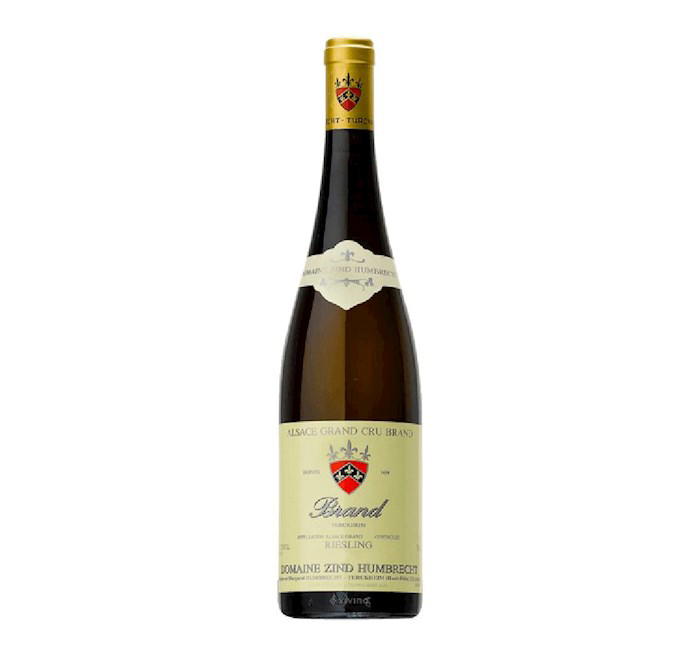
Zind-Humbrecht farms around 40 hectares biodynamically across grand cru sites including Rangen de Thann, Brand, Goldert, and Hengst, producing parcel-specific wines, a single-vineyard Riesling from Clos Windsbuhl, a Pinot Gris from Clos Saint Urbain on the volcanic Rangen, that are allocated to importers and private clients before they reach retail. Annual production runs between 12,000 and 16,000 cases,1 with wines aged on their lees for at least six months, bottled between 12 and 24 months after harvest.1 Demand for appointments from trade buyers, journalists, and collectors competes directly with leisure visitors. Confirm availability directly before planning around a specific date.
Trimbach's reputation rests on two wines above almost everything else: Clos Sainte Hune, a 1.67-hectare Riesling parcel from the Rosacker grand cru, and Cuvée Frédéric Émile. Production of Clos Sainte Hune runs to approximately 700 to 900 cases, around 9,000 bottles, per year,2 and the wine is aged for a minimum of six years in bottle before leaving the winery.2 Secondary market prices reflect that scarcity: the 2019 retails at around $750 per bottle.3 The tasting room is not a public amenity.
Hugel, especially visitor-oriented among the three, operates from 3, rue de la première Armée in Riquewihr,4 and their shop on the main street genuinely welcomes walk-ins during business hours. Production averages 100,000 cases per year, with around 90% exported to more than 100 countries,5 which means the shop tasting of Hugel Gentil or their Tradition Riesling is easy to arrange, but a sit-down session with the Jubilee or S range requires advance contact.
When Appointments Actually Become Available
None of the three estates publishes a public booking calendar; confirm availability directly with each estate before planning travel around a specific date.
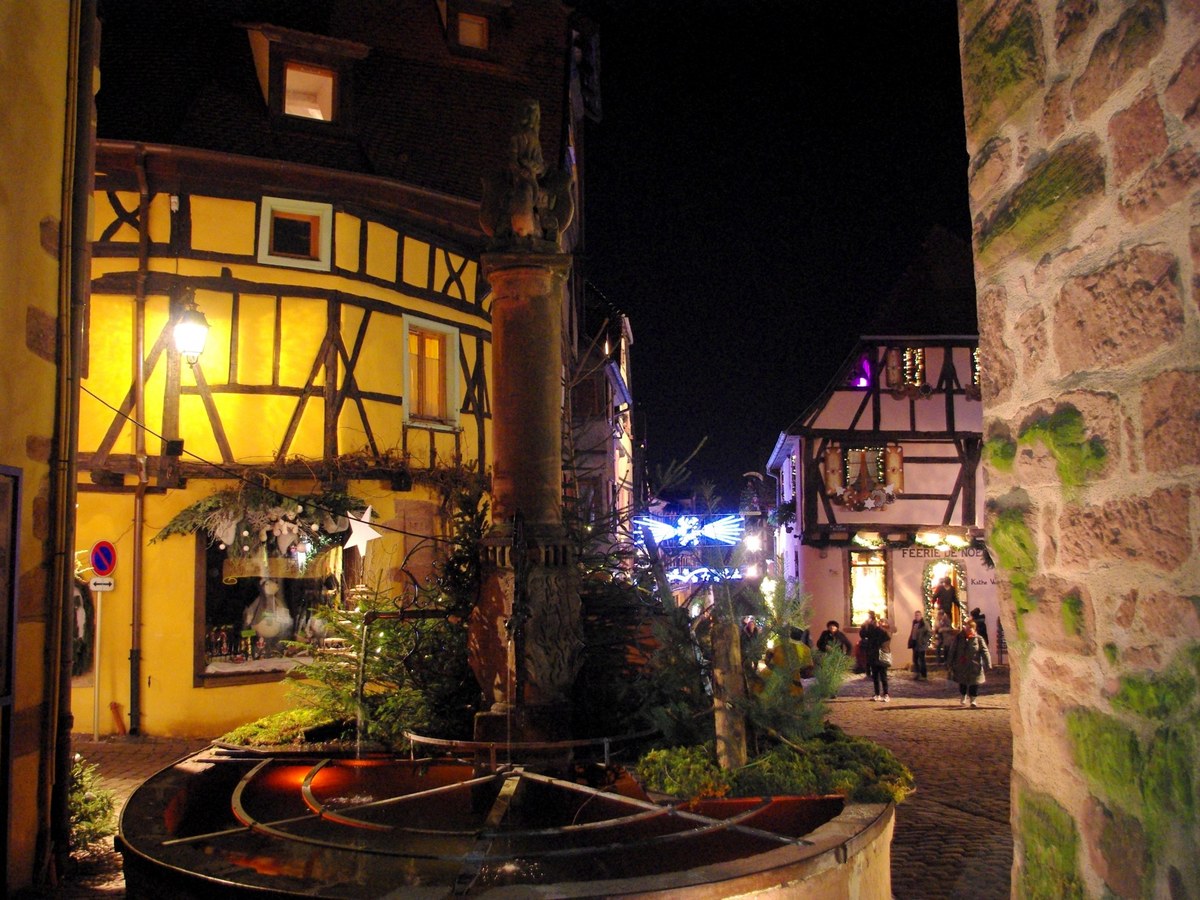
Riquewihr's Christmas market fills the half-timbered old town in December.
What is consistent across all three: email is the correct first contact. Phone calls to a winery during harvest are rarely answered. The estates' contact details are on their respective websites, Trimbach, Zind-Humbrecht, and Hugel, and a direct, specific email (your dates, your group size, the wines you want to discuss) will get a faster response than a generic enquiry.
Lead times vary by season. Harvest, roughly late September through October, is the worst time to request a winemaker appointment; the team is in the vineyard and the cellar simultaneously. The quieter windows are November through February and again in May and June, before the summer tourist peak hits the route in July and August.
The Channels That Actually Work
Three routes, ranked by reliability:
Direct email to the estate. For all three, this is the primary channel. Be specific: name the wines you want to taste, mention any trade or press affiliation if relevant, and propose two or three date options. Zind-Humbrecht in particular receives a high volume of requests; a well-framed email from a serious collector or trade buyer will be prioritised over a generic tourism enquiry.
Through your importer or merchant. If you buy Trimbach or Zind-Humbrecht through a UK or US importer, Enotria&Coe handles Trimbach in the UK, for instance, a word from your account manager can open a door that a cold email cannot. Importers have standing relationships with the estates and can vouch for a client's seriousness in a way that a self-introduction cannot.
Through a specialist wine tour operator. Companies running dedicated Alsace itineraries, Arblaster & Clarke, Cellar Tours, and similar, have pre-arranged access at estates that don't take individual bookings from the public. If your goal is a single trip that covers all three in depth, a structured tour removes the logistics entirely. The trade-off is cost and a fixed itinerary.
What Insiders Do Differently, and the Mistakes That Cost Access
What insiders do: Serious collectors build a purchase history before requesting a visit. Buying Trimbach Cuvée Frédéric Émile or Zind-Humbrecht Rangen de Thann Clos Saint Urbain through a merchant who has a direct relationship with the estate signals intent. When the visit request arrives, it arrives with context. Insiders also time their visits to coincide with the estate's own calendar, the Fête des Vins de Colmar in August, or the Marché de Noël season in December, when the estates are already in a hospitality mode, rather than demanding access during harvest.
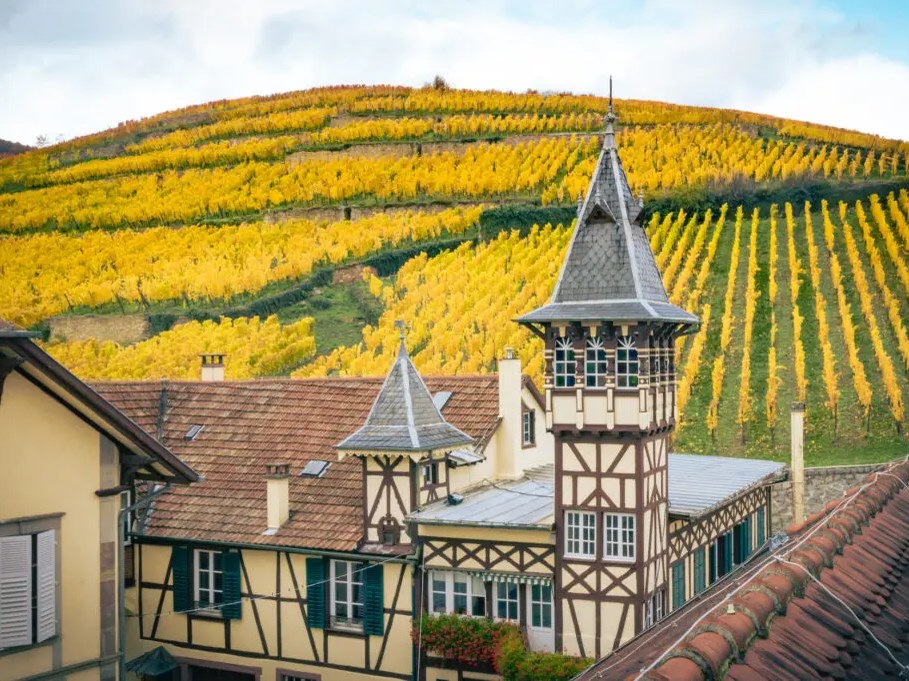
Alsatian village with half-timbered houses and autumn vineyards
A second insider move: ask to taste the current release alongside one back vintage. Estates respond well to visitors who want to understand the wine's development, not just tick a box. Requesting a short vertical of Clos Sainte Hune signals the kind of engagement that earns a longer appointment.
Mistakes that cost access:
Arriving without an appointment at Zind-Humbrecht or Trimbach and expecting a tasting. The cellar door is not staffed for walk-ins at either estate.
Emailing during harvest (late September, October) and expecting a prompt reply. The team is not at a desk.
Requesting a tasting for a group of eight or more without flagging it upfront. Large groups require different logistics and may be declined or redirected to a tour operator.
Asking to taste wines the estate doesn't offer at the cellar door. Clos Sainte Hune is not always poured at standard appointments, ask specifically, and accept that the answer may be no.
Seasonal Access Calendar
The Route des Vins has a pronounced seasonal rhythm that directly affects your odds:
November, February: The quietest window. Estates are bottling, racking, and preparing for spring tastings. Appointment availability is highest. The villages are cold and largely tourist-free, Riquewihr without the summer crowds is a different place entirely.
March, May: Trade tasting season begins. ProWein in Düsseldorf (typically March) pulls key personnel away; avoid the week of the fair. May is otherwise a strong window.
June, August: Tourist peak on the route. Hugel's shop is busy; Trimbach and Zind-Humbrecht are harder to access for individual appointments as trade visitors also increase. Book further ahead.
September, October: Harvest. Do not plan winemaker appointments. You can visit the villages and buy from shops, but the estates are not available for serious tastings.
December: The Alsace Christmas markets draw large crowds to Colmar, Strasbourg, and Riquewihr. Hugel's shop is open and festive; serious tasting appointments are harder to arrange amid the retail rush.
Alternatives When the Appointments Don't Come Through
Alsace Estate Visits: Access Difficulty and Channel Comparison
Estate / Venue
Walk-in Possible?
Appointment Lead Time
Best Channel
Visitor Orientation
Trimbach (Ribeauvillé)
No
Unconfirmed, verify directly with estate
Direct email / importer
Low, trade-focused
Zind-Humbrecht (Turckheim)
No
Unconfirmed, verify directly with estate
Direct email / importer
Low, allocation-focused
Hugel (Riquewihr)
Shop only
Unconfirmed, verify directly with estate
Direct email / shop visit
Medium, retail shop open
Domaine Weinbach (Kaysersberg)
Limited
Unconfirmed, verify directly with estate
Direct email
Medium
Maison Josmeyer (Wintzenheim)
Sometimes
Short notice often possible
Direct / walk-in
Higher, welcoming to visitors
Domaine Marcel Deiss (Bergheim)
No
Unconfirmed, verify directly with estate
Direct email
Low, tastings led personally by the estate's principal
Domaine Weinbach in Kaysersberg is especially natural substitute for Zind-Humbrecht if biodynamic, terroir-driven Alsace is what you're after. The Faller family farms around 30 hectares, and the Clos des Capucins, a walled vineyard directly behind the house, produces Riesling and Gewurztraminer of comparable intensity to Zind-Humbrecht's grand cru parcels.
Maison Josmeyer in Wintzenheim is more accessible than any of the three main estates and produces Riesling from the Brand grand cru that sits comfortably alongside Zind-Humbrecht's Brand bottling. The domaine is run with a genuine openness to visitors that the larger négociant houses can't always match.
Domaine Marcel Deiss in Bergheim is the appointment to chase if you want a philosophical counterpoint to Trimbach's variety-driven approach. The estate makes field-blend wines from grand cru sites, Altenberg de Bergheim, Schoenenbourg, that argue for place over grape variety. The tasting, when you get it, is among the more intellectually engaging on the route.
Inside the Cellars: What a Serious Appointment at Each Estate Actually Involves
At Trimbach, a confirmed appointment typically takes place in the family's tasting room in Ribeauvillé. The focus is the wine, not the theatre, no vineyard walk, no barrel hall tour as a matter of course. You'll taste through the current releases of the Riesling range: Trimbach Riesling, Cuvée Frédéric Émile, and, if the appointment warrants it, Clos Sainte Hune. The wines are made in a reductive, age-worthy style, high acidity, minimal residual sugar, long élevage in large old foudres, and tasting them young requires patience. The family may pour a back vintage to illustrate the point. Sessions are focused and purposeful; this is not a leisurely three-course lunch with pours between courses.
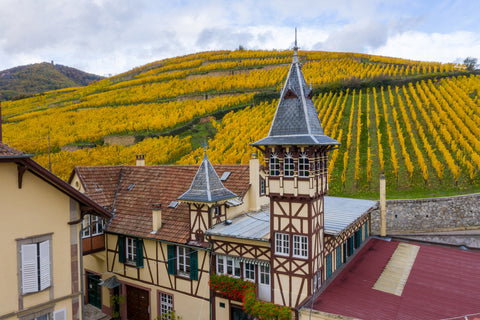
The Alsatian landscape features a half-timbered building with a tower set against golden autumn vineyard hillsides.
At Zind-Humbrecht, the appointment is more likely to involve a senior member of the team, and the conversation will range across biodynamic viticulture, the estate's parcel-by-parcel approach, and the vintage in question. Wines kept on lees for 16 to 18 months in the larger cellar emerge with more depth and intensity,6 and you'll taste that difference across the lineup. Expect to work through varieties in terroir order: lighter soils first, volcanic Rangen last. The wines carry significant residual sugar in some vintages, and the tasting requires engagement, not just sipping.
At Hugel, the shop on Riquewihr's main street is the entry point. The retail range, Gentil, Tradition, Classic, is available to taste and buy without formality. A booked appointment moves you into a back room or the cellar, where the Jubilee and S range wines are poured. Hugel releases its top wines when judged ready for sale, meaning different vintages may be in distribution simultaneously across grape varieties,7 so what's open on the day of your visit depends on the estate's own readiness assessment, not a fixed release calendar. Tasting the S wines in the village where the family has worked for centuries carries a weight that a merchant tasting in London cannot replicate.
Who Should Make the Effort, and When It's Worth It
If you already drink Trimbach Cuvée Frédéric Émile or Zind-Humbrecht Rangen at home, a visit to the source is worth the planning. You'll taste the wines in a context that changes how you understand them, the elevation of the Vosges foothills, the transition from granite to limestone to volcanic basalt across a few kilometres of slope, the way the same Riesling grape produces something austere and mineral at Trimbach and something almost tropical at Zind-Humbrecht's Goldert site.
If you're new to Alsace and want an introduction to the region, Hugel's shop and the village of Riquewihr are a perfectly good starting point, but the serious appointments at Trimbach and Zind-Humbrecht will be wasted without some prior familiarity with the wines. Do the homework first: drink a bottle of Cuvée Frédéric Émile and a bottle of Zind-Humbrecht Riesling Turckheim before you go.
The route is also worth building around a specific vintage release. When a new vintage of Clos Sainte Hune comes to market, typically at least six years after harvest, given Trimbach's extended bottle ageing,2 the window around the release is a natural moment to visit. Your importer will know.
Worth the Chase?
The Route des Vins d'Alsace rewards the prepared visitor and frustrates the spontaneous one. Trimbach and Zind-Humbrecht are not set up for casual drop-ins, and treating them as tourist attractions will get you nowhere. But for a collector who has done the groundwork, bought the wines, built a merchant relationship, sent a specific and well-timed email, the appointments are achievable, and the experience of tasting Clos Sainte Hune in Ribeauvillé or Rangen de Thann in Turckheim is one that no merchant tasting can substitute.
Contact Zind-Humbrecht and Trimbach by email well ahead of your trip, copy your importer if you have one, and propose dates in the November, February or May, June windows. Book Hugel as your fallback: the shop is always there, and the Jubilee range is worth the detour regardless. If the appointments don't materialise, Josmeyer and Weinbach will give you a serious Alsace experience without the friction.
Alsace remains one of the few French wine regions where the grand cru system is still genuinely contested, where Trimbach refuses to put the Rosacker grand cru on the Clos Sainte Hune label because they don't believe the classification reflects the wine's quality, and where Deiss argues the opposite case entirely. That argument is worth having in person, in the cellar, over a glass of something that has spent years in foudre. The planning is the price of admission, and for wines at this level, it is a price worth paying.
Frequently Asked Questions
Can you walk into Trimbach or Zind-Humbrecht without an appointment?
No. Neither Trimbach in Ribeauvillé nor Zind-Humbrecht in Turckheim operates a walk-in tasting room. Both estates work primarily with trade buyers and pre-arranged appointments. Arriving without prior contact is unlikely to result in a tasting. Email the estates directly with your dates and a specific request.
How far in advance should you contact Hugel, Trimbach, and Zind-Humbrecht for a tasting appointment?
None of the three estates publishes a specific booking window or appointment release schedule. Contact each venue directly to establish current availability. Avoid requesting appointments during harvest (late September, October), when the teams are unavailable for visitor tastings.
Is Clos Sainte Hune available to taste at Trimbach's cellar door?
Not as a matter of course. Clos Sainte Hune is Trimbach's most allocated wine, produced from a 1.67-hectare parcel in the Rosacker grand cru, and it is not routinely poured at standard appointments. If tasting it is your specific goal, say so explicitly in your appointment request. The estate may accommodate the request depending on vintage availability and the nature of the visit; they may also decline. A back vintage is more likely to be poured than the current release.
What is a strong time of year to visit the Route des Vins d'Alsace for serious estate appointments?
November through February and May through early June are the windows with the highest appointment availability. Harvest (late September, October) is the worst time to request winemaker access. The summer tourist peak (July, August) increases competition for appointments at all three estates. The Christmas market season in December brings retail traffic to Hugel's shop but makes formal tasting appointments harder to arrange.
Can a wine merchant or importer help secure access to Trimbach or Zind-Humbrecht?
Yes, this is among the more reliable routes. If you buy Trimbach or Zind-Humbrecht through an importer or specialist merchant who has a direct trade relationship with the estate, a word from your account manager carries more weight than a cold email. Enotria&Coe handles Trimbach in the UK market, for instance. Building a purchase history with a merchant who works directly with these estates is the single most durable access strategy for serious collectors.