← Guides
How to book Bartolo Mascarello and Giuseppe Rinaldi cellar visits in 2026, and when a Barolo specialist merchant is your best route in.
How to book Bartolo Mascarello and Giuseppe Rinaldi cellar visits in 2026, and when a Barolo specialist merchant is your best route in.
The first thing to know about Bartolo Mascarello and Giuseppe Rinaldi is the silence around the door: no walk-in counter, no polished reception desk, no tasting flight waiting on a bar. Both cellars are effectively closed to walk-in visitors. Bartolo Mascarello1 carries no website and, in the words of those who have visited, no conventional hospitality infrastructure, Maria Teresa Mascarello refuses to use email or the internet,2 which tells you something about the pace at which introductions are arranged. Giuseppe Rinaldi accepts visits strictly by appointment only.3 A visit to either address requires a direct approach to the family, a credible introduction, and patience measured in months rather than days. For most collectors planning serious Barolo winery visits without prior contact, one reliable route is through a trusted Barolo-specialist merchant who already holds a relationship with the estate.
Neither Bartolo Mascarello nor Giuseppe Rinaldi operates a tasting room in any conventional sense. These are working family cellars: Marta and Carlotta Rinaldi now run the Giuseppe Rinaldi estate, while Maria Teresa Mascarello remains at her cantina in Barolo most days, greeting customers from around the world.4 The production scale explains the access problem more plainly than any policy statement: Rinaldi limits annual output to 30,000 to 40,000 bottles across all wines,5 while Mascarello produces 32,000 to 35,000 bottles per year from 5 hectares, roughly half of which is Barolo.1 When a single cuvée runs to a few thousand bottles and the allocation list spans three continents, there is no surplus hospitality capacity. Rinaldi's two Baroli, Brunate and Tre Tine, are deliberate blends from multiple crus and are parceled out to a tight circle of importers and private clients who have been on the list for years. Mascarello's single Barolo, a deliberate blend of Cannubi, San Lorenzo, Rue, and Rocche dell'Annunziata, is produced in similarly constrained quantities. The wines are not hard to find because of mystique; they are hard to find because there are not many of them.
The crowd competing for the same access is not the general wine tourist. It is the collector who already owns back vintages, the importer flying in for a pre-harvest check-in, and the journalist with a standing relationship. If that is not your profile yet, start with the allocation relationship before you ask for the cellar door.
Neither estate publishes a booking calendar, a release schedule, or a formal visit policy online. Release windows for en primeur or ex-château purchases are not publicly documented, and neither estate publishes its specific allocation rules, so confirm all of this directly with the estate or your importing merchant before planning travel around a specific date.
What the seasonal calendar does tell you: harvest (late September through October) is the worst time to attempt contact. The family is in the vineyard and cellar from first light; unsolicited requests during vendemmia are rarely answered. January through March, after the new vintage has been racked and before the spring trade-tasting circuit begins, is when the estates are most likely to receive a small number of visitors. The Nebbiolo Prima tastings in Alba, typically held in late spring, bring importers and press to the Langhe in numbers; if you are attending through a trade credential, a pre-arranged cellar visit can sometimes be appended to that trip. August is effectively closed: the Langhe empties in the heat and both families take time away from the cellar. If you need one practical window, write in January or February and keep harvest off the itinerary.
1. Through your importing merchant. This is the route that reliably works. Mascarello's UK importer has historically been Lea & Sandeman; in the United States, the wines are imported by Polaner Selections. Rinaldi's US allocation has passed through Vinifera Imports (Dominic Nocerino) for many years. If you are a client of any of these houses, or their retail partners, a request for a cellar introduction carries weight that a cold email to the estate does not. The merchant relationship is the allocation relationship; the visit follows from it, not the other way around.
2. Direct contact with the estate. Rinaldi can be reached by telephone at +39 0173 561563 or by email at info@rinaldigiuseppe.com.3 The winery is located at Via Monforte, 3, 12060 Barolo CN, Italy.3 For Mascarello, there is no website,1 and Maria Teresa does not use email,2 so a written letter or a phone call is the only direct channel. A letter in Italian, written with specific knowledge of the wines and a clear reason for the visit, a serious collection, a long-standing purchase history, a professional context, is more likely to receive a response than a generic request. Do not expect a reply within days. The families are not running a hospitality operation and will not be hurried into one.
3. Through a Barolo-specialist guide or fixer. A small number of wine-focused travel operators, particularly those based in the Langhe with long-standing local relationships, can facilitate introductions to estates that do not receive the general public. One documented route into Rinaldi: a visit was arranged by meeting Carlotta Rinaldi at La Festa del Barolo and ironing out details shortly after the event.6 Another visitor booked by phone directly with a woman at the winery.5 The guide's relationship with the family is the asset; vet any operator carefully before assuming they have genuine access rather than a list of estates that tolerate tourists.
There is no Resy page, no OpenTable listing, and no ticketed tasting format at either address. Any third-party platform claiming to sell a "Mascarello cellar visit" or "Rinaldi tasting experience" as a bookable product should be treated with skepticism; neither estate has authorized any such arrangement.
The single most effective thing you can do before requesting a visit is to build a purchase history with the estate's importer. Buy the current release. Buy the off-vintage that no one else wanted. Ask your merchant to note your interest in a cellar visit when they next travel to Barolo. This is not a shortcut; it takes at least one or two buying cycles, but it is the mechanism that moves names up the informal list.
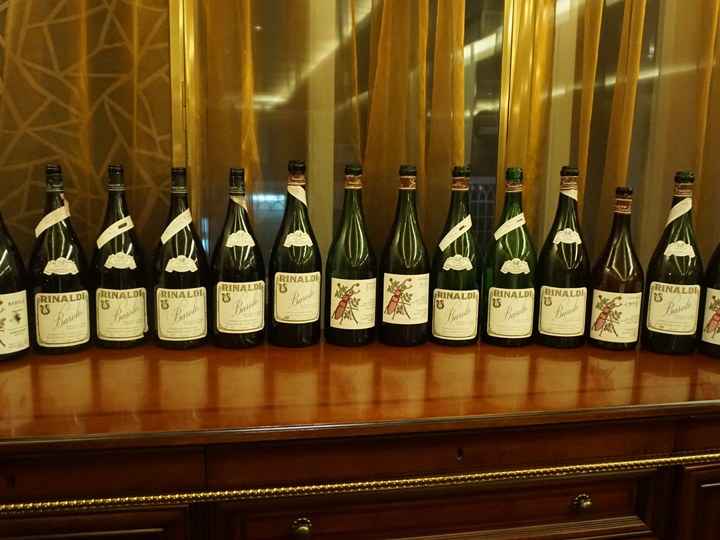
For Rinaldi specifically, the two Barolo bottlings are not single-vineyard wines: Brunate combines Brunate and Le Coste, while Tre Tine is also a deliberate cru blend. Bottles occasionally surface through secondary channels and at auction (Acker, Hart Davis Hart, and Sotheby's Wine have all handled Rinaldi in recent years). Buying at auction does not create an estate relationship, but it demonstrates seriousness to a merchant who might.
For Mascarello, the single Barolo is the only wine; there is no second label, no entry-point Dolcetto allocation that opens a back door. The Dolcetto d'Alba and Barbera d'Alba are produced in small quantities and allocated through the same importer channels. Buying them signals genuine engagement with the estate's full range, not merely a trophy hunt for the Barolo.
Timing your request for January or February, after the harvest has settled and before the spring tasting season, gives the family a stronger chance of having an hour free. Keep the request short, specific, and in Italian if possible.
| Estate | Access Difficulty | Visit Format | How to Book | Allocation Route |
|---|---|---|---|---|
| Bartolo Mascarello | high, no public visits | Informal cellar, by introduction only | Direct contact (phone/letter) or importer introduction | Via specialist importer (e.g. Polaner Selections, Lea & Sandeman) |
| Giuseppe Rinaldi | high, appointment only | Informal cellar, by introduction only | Phone, email, or importer introduction | Via Louis/Dressner (US) or specialist merchant |
| Giacomo Conterno | High, limited visits, by appointment | Cellar tour + tasting, small groups | Direct email request; some merchant facilitation | Via specialist importer; Monfortino allocation extremely tight |
| Elvio Cogno | Moderate, appointment preferred, more accessible | Structured tasting room, full range | Direct contact via website | More widely distributed; easier merchant access |
| Vietti | Low-moderate, tasting room open by appointment | Formal tasting room in Castiglione Falletto | Direct booking via estate website | Widely distributed internationally |
Giacomo Conterno, Monforte d'Alba. Roberto Conterno's cellar is not easy to enter, but it is more formally accessible than either Mascarello or Rinaldi. Monfortino is the Barolo that most directly occupies the same philosophical space: traditional, uncompromising, built for decades. Confirm timing with the estate or your importer. A visit here, arranged through the estate or a specialist merchant, delivers the same sense of Nebbiolo treated as a long-term proposition.
Elvio Cogno, Novello. Valter Fissore and Nadia Cogno run a cellar that is genuinely welcoming to serious visitors. The Ravera Vigna Elena Riserva is a single-vineyard Nebbiolo of real depth, and the estate's position in Novello, less trafficked than Barolo village, means you are tasting in a quieter context. Appointments are easier to secure and the conversation tends to be unhurried.
Cappellano, Serralunga d'Alba. Augusto Cappellano produces Barolo Pie Rupestris and Pie Franco in tiny quantities; Pie Franco comes from ungrafted vines, while Pie Rupestris comes from vines grafted onto rupestris rootstock, in a cellar that shares Mascarello's and Rinaldi's resistance to modernization. Access is similarly restricted, but the estate has occasionally received visitors through the same importer channels (Rosenthal in the US). Worth pursuing through the same route.
Neither estate runs a structured tasting program. If you are received, it will be in the working cellar, Slavonian oak botti lining the walls, the smell of Nebbiolo fermenting or aging depending on the season, and a conversation conducted around a table that also serves as the family's workspace. There is no tasting menu, no printed flight, no hospitality script. Maria Teresa Mascarello is known for welcoming visitors directly and remaining present at the cantina most days.4 Marta and Carlotta Rinaldi bring a warmth that does not extend to tolerating questions about scores or investment value.
You will taste from barrel or from bottle, depending on what the family chooses to open. You may taste a single wine or several across vintages; this is entirely at the host's discretion. One visitor to Bartolo Mascarello arrived and was seated at the tasting table by Maria Teresa's secretary to await the contact person;7 another visit, arranged to collect an allocation, included a tasting with winery staff and partially with Maria Teresa herself.8 The duration is not fixed; the visit runs as long as the conversation warrants. You will not be upsold. You will not be handed a price list. If you leave with bottles, it is because the family decided to sell them to you.
The room itself is the point. Mascarello's cellar on Via Roma sits beneath a building the family has occupied for generations. Rinaldi's cellar is similarly unadorned, no renovation, no design intervention, no attempt to make the space perform for visitors. The botti are old. The light is low. The wines in barrel smell of the Langhe in a way that no purpose-built tasting room approximates. Who you will share this with: almost certainly no one else. These are not group visits.
If you are building a serious collection of traditional Barolo and want to understand the philosophical lineage that runs from Giacomo Conterno through Bartolo Mascarello to the current generation of Rinaldi, a cellar visit here is worth the effort of a multi-year approach. The wines taste differently when you have stood in the cellar where they were made, not because the liquid changes, but because your frame of reference does.
If you are visiting the Langhe for a week and hoping to tick off a cellar visit as part of an itinerary, redirect that energy toward Elvio Cogno or Vietti, both of which offer structured, bookable experiences that are genuinely worth your time. The Mascarello and Rinaldi visits are not experiences to be consumed; they are relationships to be earned.
The occasion that justifies the chase: a significant birthday or anniversary trip built entirely around the Langhe, with months of lead time and a merchant relationship already in place. A professional visit with a clear editorial or trade purpose. A collector who has been buying these wines for a decade and wants to close the loop between bottle and place.
Yes, but only if you approach it correctly and accept that the timeline is not yours to control. Both Bartolo Mascarello and Giuseppe Rinaldi remain cellars where the wine is made the same way it was made forty years ago, by families who have no interest in scaling the experience for visitors. That is what makes a visit worth having, and what makes it hard to arrange.
The allocation list is the only route that reliably works. Build a purchase history with the estate's importer, Polaner Selections for Bartolo Mascarello or Louis/Dressner for Giuseppe Rinaldi in the US, and Lea & Sandeman in the UK, before you ask for an introduction. Write in Italian. Request in January or February. Be prepared to wait a full year or more. If the answer is no, Giacomo Conterno's cellar in Monforte d'Alba is especially direct substitute, the same Nebbiolo philosophy, a slightly more accessible door.
For most collectors, the wines themselves are the more achievable prize; the visit, when it finally happens, is the confirmation of something you already knew from the glass, and that, in the end, is what makes the Langhe worth returning to.
No. Neither estate operates a walk-in tasting room or public cellar door. Arriving unannounced is unlikely to result in a visit and may damage any future prospect of one. Giuseppe Rinaldi accepts visits strictly by appointment only; Bartolo Mascarello receives visitors only through prior arrangement, typically via an importer introduction or a direct request that has been accepted in advance.
Neither estate publishes a booking lead time. For these small family operations, a request made several months in advance, ideally in January or February for a spring or summer visit, gives a stronger chance of a response. Confirm timing directly with the estate; do not plan travel around an assumed availability window.
Not directly. Auction purchases do not create a relationship with the estate. What matters is a purchase history with the estate's official importer, Louis/Dressner in the US for Rinaldi, Polaner Selections in the US (or Lea & Sandeman in the UK) for Mascarello, which can then be drawn on when making an introduction request.
No verified ticketed or commercially bookable tasting format exists at either estate. Any third-party operator selling a packaged "Mascarello tasting" or "Rinaldi cellar experience" as a standard product should be verified carefully before booking; neither estate has confirmed any such arrangement.
Late spring (May, June) and early autumn (September, before harvest begins) are particularly practical windows for Langhe cellar visits generally. Harvest itself (late September through October) is the hardest period to secure appointments at any serious estate. August sees many producers take time away from the cellar. Nebbiolo Prima, typically held in late spring in Alba, brings the trade to the region and can be a useful anchor for a broader visit itinerary.
Get the App
Take the shortlist into the En Primeur Club app for concierge access, saved places, and the next step after discovery.
Get Exclusive AccessMore from the editors