← Guides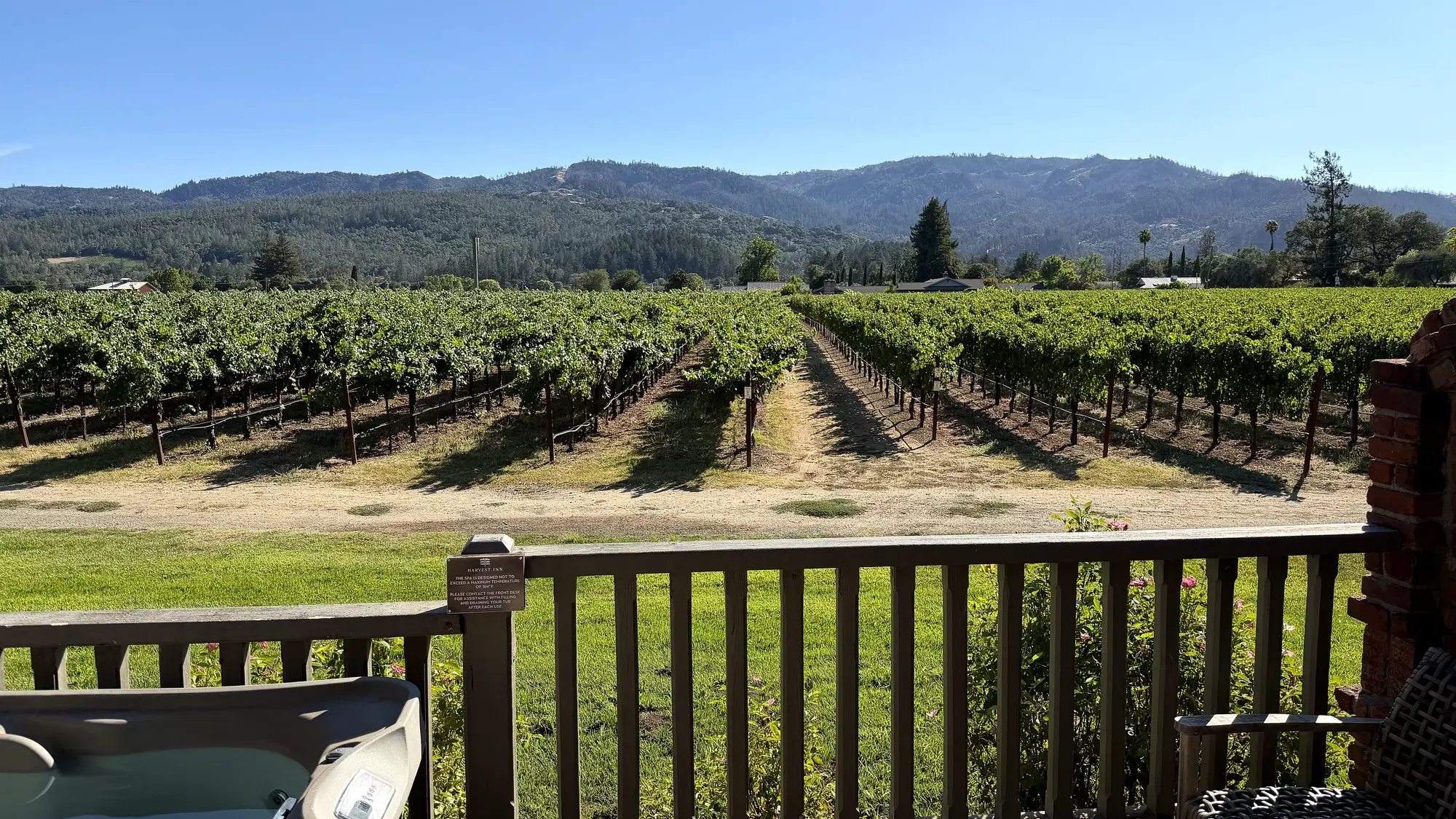
We checked into a Vineyard View Collection Spa room, watched fog move over the Mayacamas from the hot tub, then lingered at Harvest Table over the tomahawk and chimichurri.
We checked into a Vineyard View Collection Spa room, watched fog move over the Mayacamas from the hot tub, then lingered at Harvest Table over the tomahawk and chimichurri.
Harvest Inn is the rare Napa Valley hotel where pulling off Highway 29 feels like crossing a much greater distance. One turn removed us from the traffic of St. Helena and placed us among towering redwoods, deep lawns, old brick paths and Tudor roofs. Within minutes, we were standing in our Vineyard View Collection Spa room with the doors open to a private hot tub, rows of Cabernet Sauvignon and the Mayacamas Mountains.
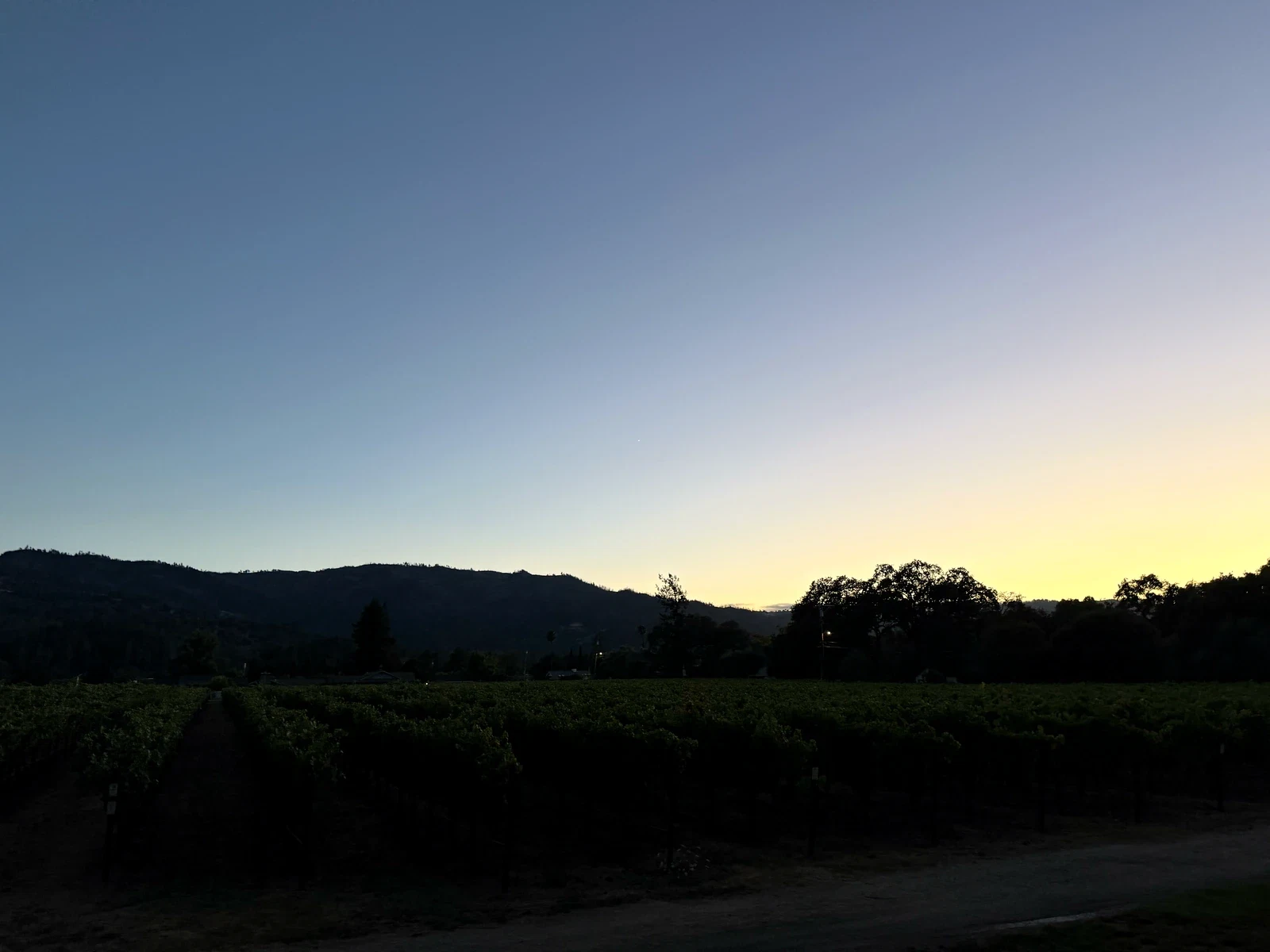
That view changed constantly during our overnight stay. In the late-afternoon sun, the vineyard was bright and sharply drawn. At sunset, the mountains became a dark silhouette behind the vines. By morning, fog had rolled over the Mayacamas and softened the entire scene. We sat in the hot tub and watched it move. It was one of those hotel views that did not need an itinerary built around it; the room itself supplied the reason to slow down.
The rest of the stay was just as memorable. We wandered through redwood groves and past koi ponds, lawns and brick bridges. We ate dinner at Harvest Table, opened a 2005 Lokoya Diamond Mountain District Cabernet Sauvignon, ordered the tomahawk prix fixe, and kept returning to the vivid red chimichurri. Bartender Jesse Earl made us a coffee Negroni, then reached for green Chartreuse when we asked what was behind the bar. Dessert was a bread pudding made from Parker House rolls that we would return for on its own. The next morning, room service brought a breakfast sandwich on a Model Bakery English muffin to our vineyard-facing patio.
Book the hotel for its notable combination of privacy and location, but choose the Vineyard View Collection Spa if the room is available. The outdoor hot tub, fireplace and direct vineyard view turn a good St. Helena hotel into a complete wine-country experience.
Yes. Harvest Inn is an especially strong choice for a couple who wants a peaceful Napa base without being isolated from St. Helena. It has the scale and landscaping of a small resort, the atmosphere of an old wine-country village, and the practical advantages of a hotel on the edge of town. You can spend an afternoon by one of two pools, walk the vineyard-side trail, order dinner at Harvest Table, or use the property as a launch point for winery visits across the valley.
The Vineyard View Collection Spa is the clearest reason to book. At approximately 550 square feet, it is spacious without becoming impersonal. The classic fireplace gives the room warmth, while the private patio and outdoor hot tub open directly toward Whitehall Lane's Leonardini Vineyard. We experienced the view in sun, at sunset and under morning fog, and each version felt different.
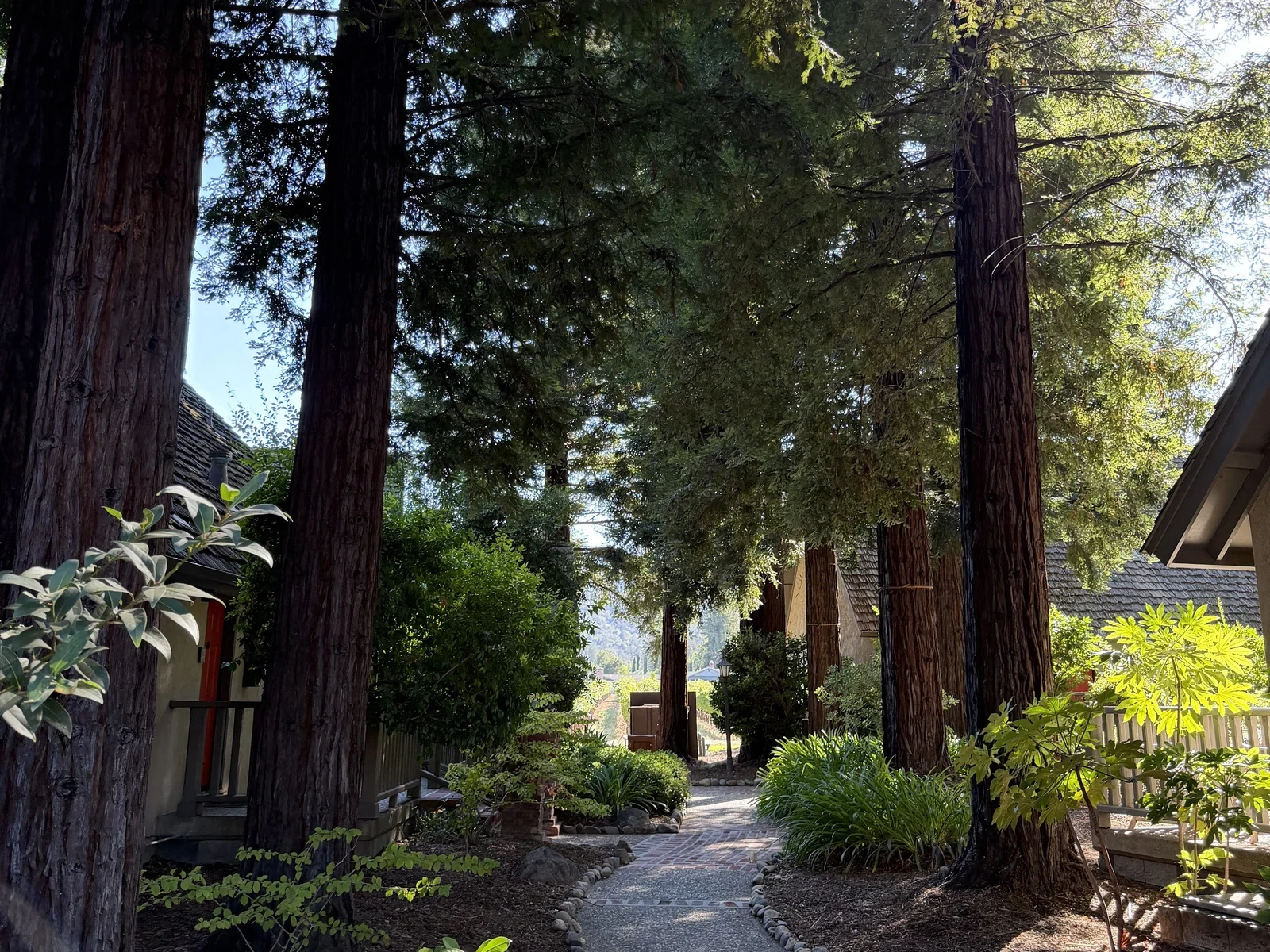
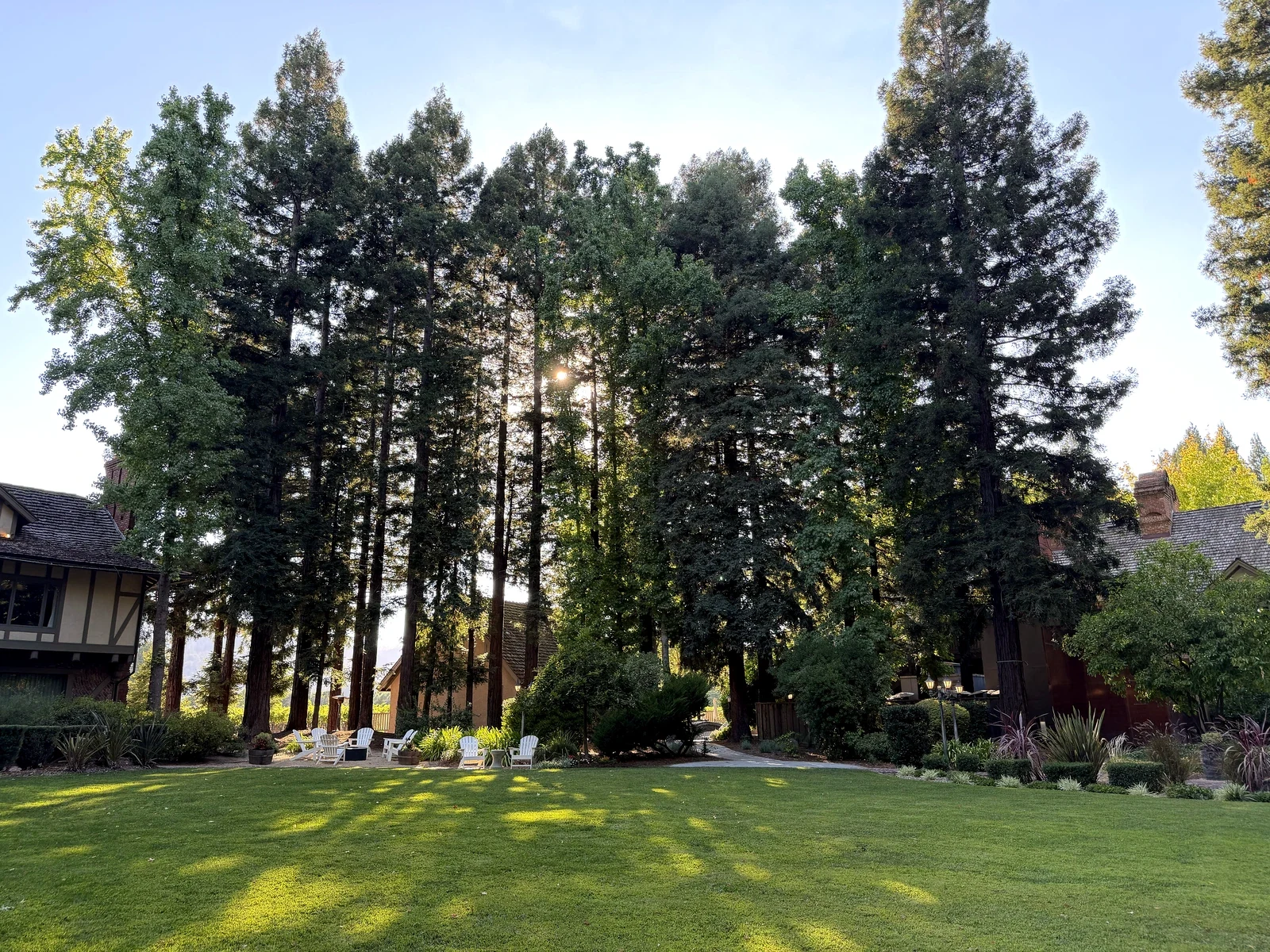
Harvest Inn also succeeds because the grounds have real character. The mature redwoods are not decorative saplings placed during a recent renovation. Hundreds were planted when the hotel was created in the 1970s, and today they make the eight-acre property feel established, shaded and almost hidden. The brickwork, Tudor Revival buildings, fountains and lawns create a visual identity that is uncommon among Napa hotels built around a contemporary neutral palette.
Our answer is not merely “yes, if you need a place to sleep between tastings.” It is yes if you want the hotel to contribute its own set of wine-country memories: a private soak above Cabernet vines, a fireplace after dinner, a serious bottle opened at the restaurant and breakfast outside while fog still touches the mountains.
| At a glance | Our experience |
|---|---|
| Location | 1 Main Street, at the southern entrance to St. Helena on Highway 29 |
| Property | Eight vineyard-side acres with mature redwoods, gardens, lawns, brick paths and fountains |
| Our room | Vineyard View Collection Spa, room 306, approximately 550 square feet |
| Room highlights | King bed, classic fireplace, private patio and private outdoor hot tub facing Leonardini Vineyard |
| Best for | Couples, wine travelers, special occasions, and guests who want privacy close to central St. Helena |
| Restaurant | Harvest Table, led by Executive Chef Colin Rupp and General Manager Marcin Furmankiewicz |
| Favorite dinner order | Tomahawk prix fixe for two with the red chimichurri, followed by Parker House roll bread pudding |
| Favorite drink detail | A 2005 Lokoya Diamond Mountain District Cabernet Sauvignon, Jesse Earl's coffee Negroni, and Chartreuse behind the bar |
| Our verdict | Book it, and prioritize the Vineyard View Collection Spa |
Harvest Inn occupies a wonderfully deceptive address. It is at 1 Main Street, directly along one traveled north-south route through Napa Valley, yet the property does not feel exposed to that road. The transition happens almost immediately. Trees absorb the view and sound of the highway. Low buildings appear between redwoods. Brick paths move away from the parking areas and into landscaped enclaves.
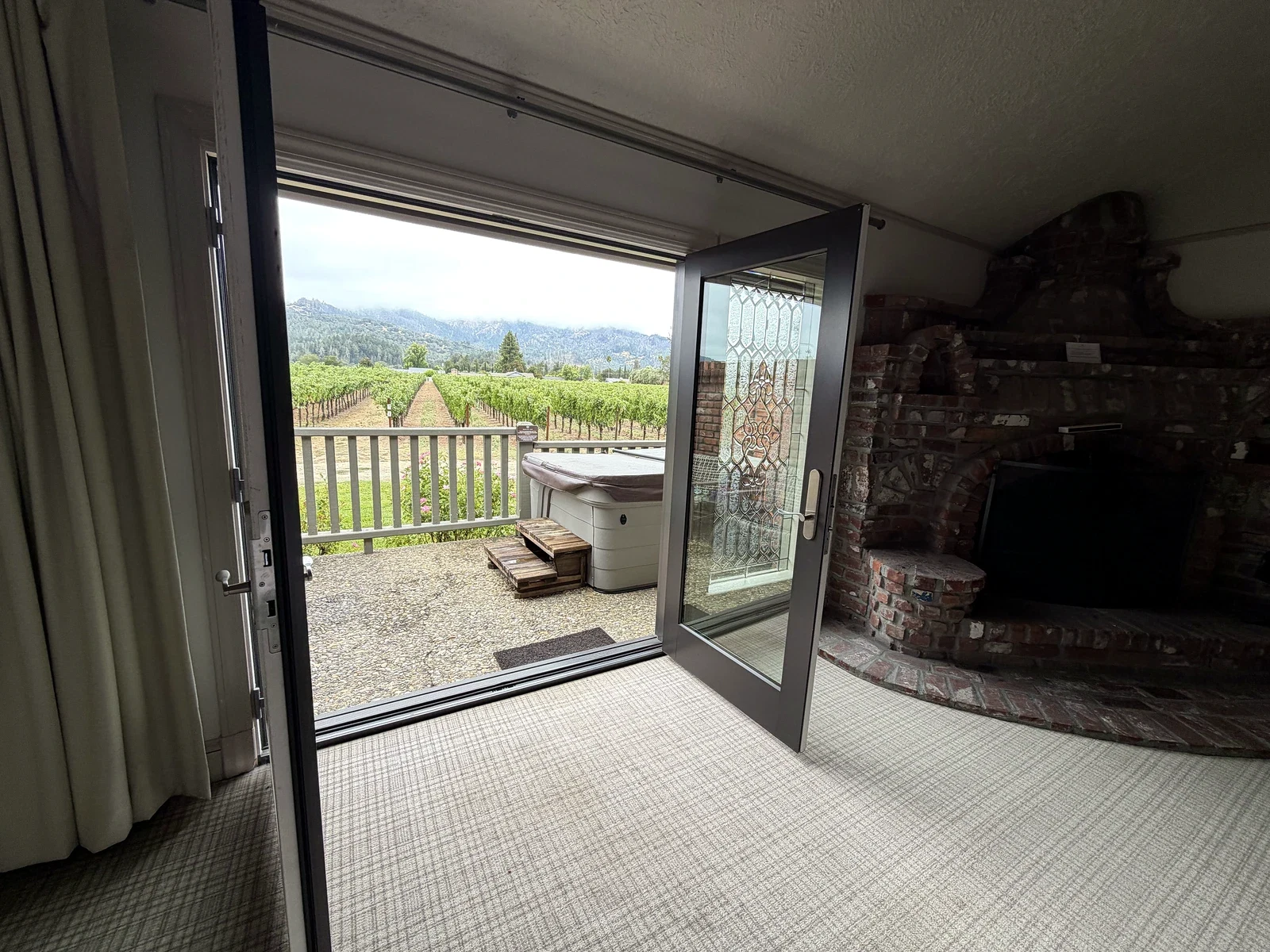
Check-in was fast and easy. That mattered because the room was the real arrival moment. We crossed the property, opened the red door to room 306 and saw the fireplace first, then the vineyard through the glass beyond the bed. Opening those doors revealed the private patio and hot tub. The sequence gave the room a sense of discovery: warm and enclosed on one side, completely open to the landscape on the other.
It is easy for a hotel to call itself an oasis. Harvest Inn earns the description spatially. The highway remains useful, the town remains close, and both recede once you are inside the grounds. We could have driven to downtown St. Helena in minutes, but the lawns, redwoods and vineyard made staying on the property feel like a legitimate plan rather than a compromise.
The buildings initially read as English country architecture: steep roofs, half-timbering, stucco, leaded glass, stone and an almost storybook relationship with the gardens. The more precise description is German-Tudor or Tudor Revival. Harvest Inn's history identifies a specifically German-Tudor vocabulary, even though the broader Tudor Revival tradition is rooted in English architecture.
That distinction helped explain what we were seeing. The property is not one grand manor arranged around a formal axis. It feels like a village assembled from cottages, brick terraces, chimneys and small crossings. An exterior wall might be pale stucco and dark timber; the next turn reveals rough stone, deeply colored brick or a fountain under redwoods.
The property opened April 3, 1978, with the first 20 rooms that day. Richard Geyer originally developed a 20-room hotel on the eight-acre site and planted approximately 320 redwoods. More than two million bricks were reportedly used across the property's paths, terraces, fireplaces and chimneys. Those numbers could sound like trivia until you walk the grounds. Brick is everywhere, but it is weathered, irregular and integrated into the landscaping rather than used as a decorative surface.
The style will not appeal only to architectural purists. Its practical effect is warmth. The heavy fireplaces feel natural in the rooms. The paths invite wandering. Mature trees place the buildings in shade. At a moment when many luxury hotels converge on the same light-oak minimalism, Harvest Inn feels unmistakably itself.
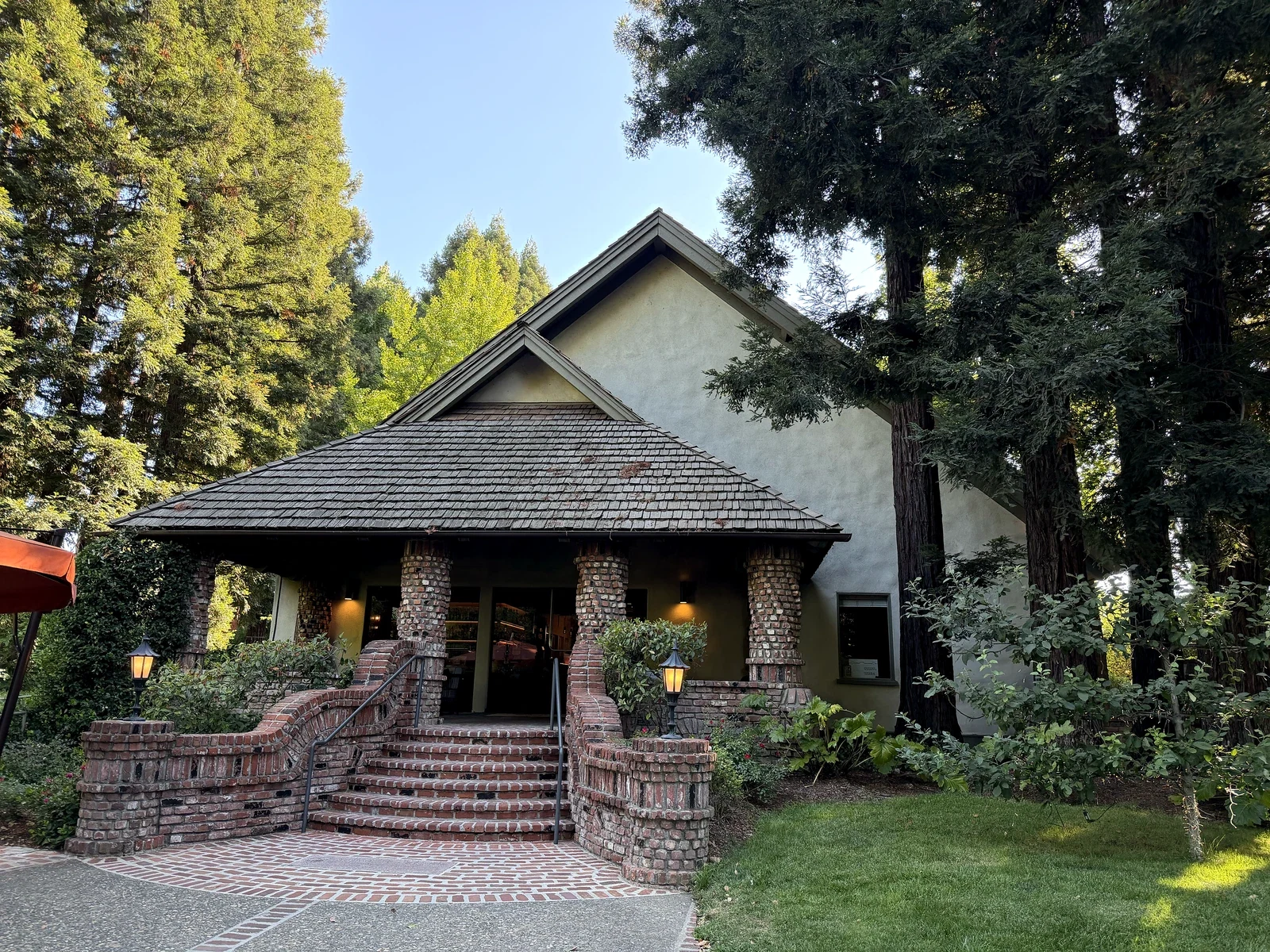
The grounds are worth exploring without a destination. We crossed broad lawns, followed paths through redwood groves, passed koi ponds and fountains, and found small seating areas that felt removed from the rest of the hotel. The mature canopy keeps revealing and concealing buildings as you walk.
Among the stronger views looks back across the lawn toward the Tudor Revival structures and redwoods. Another opens toward the vineyard and Mayacamas. The property can feel shaded and woodland-like in one direction, then unmistakably agricultural in the other. That combination is central to its atmosphere.
There are two heated outdoor pools, one oriented toward adults seeking quiet and another for families. Both have hot tubs and lounge areas. The property also has bocce, outdoor fire pits, a vineyard-side path, a 24-hour fitness center and treatment rooms supported through a partnership with Health Spa Napa Valley. Food and drinks can be ordered at both pools and by the bocce court.
The large lawns make more sense once you learn how much event programming happens here. Harvest Inn hosts weddings, private dinners, receptions and seasonal gatherings in several distinct outdoor spaces. The Vineyard View Terrace can accommodate 130 people, while the 2,500-square-foot Manor House Lawn can handle a larger reception. Weddings can go up to 150 guests. Even without an event underway, those open spaces prevent the eight acres from feeling overbuilt.
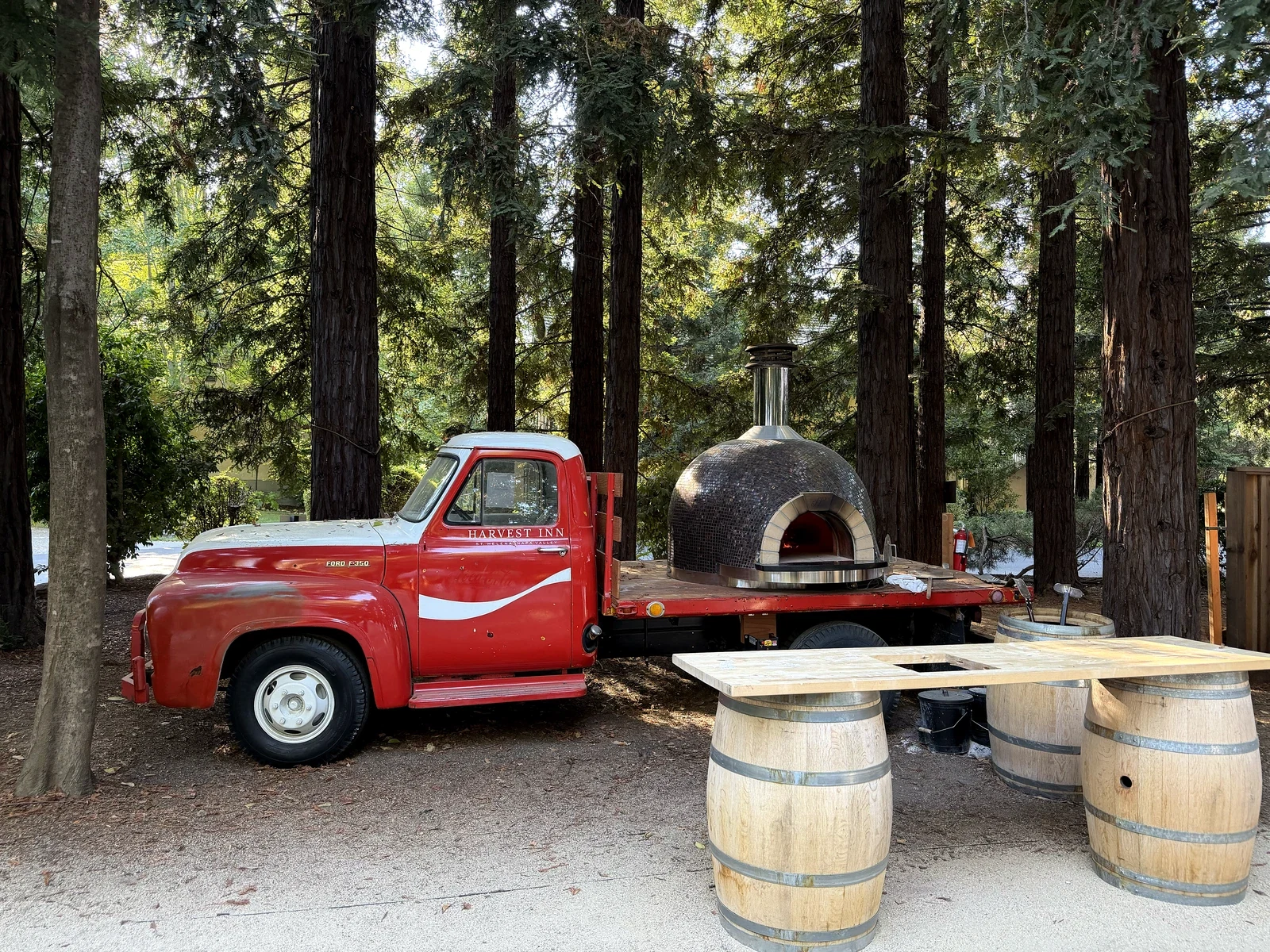
Particularly charming object on the grounds may be a red vintage truck carrying a domed pizza oven. It sits among the trees near barrels and outdoor seating, more sculpture than ordinary food truck until the oven is fired.
The conversion captures Harvest Inn's sense of humor. The property can host a formal vineyard dinner, then serve wood-fired pizzas from a restored truck during another event. Its current Cigars, Bourbon & Blues programming explicitly uses the Harvest Inn pizza truck alongside live music, bourbon and cigars. The truck also makes the bocce and event area feel less like a generic resort recreation zone.
We found ourselves stopping to photograph it from several angles. In a hotel full of expensive details, this was among the more memorable because it felt specific. It belongs among the redwoods, and it tells you that Harvest Inn is comfortable combining polish with a little playfulness.
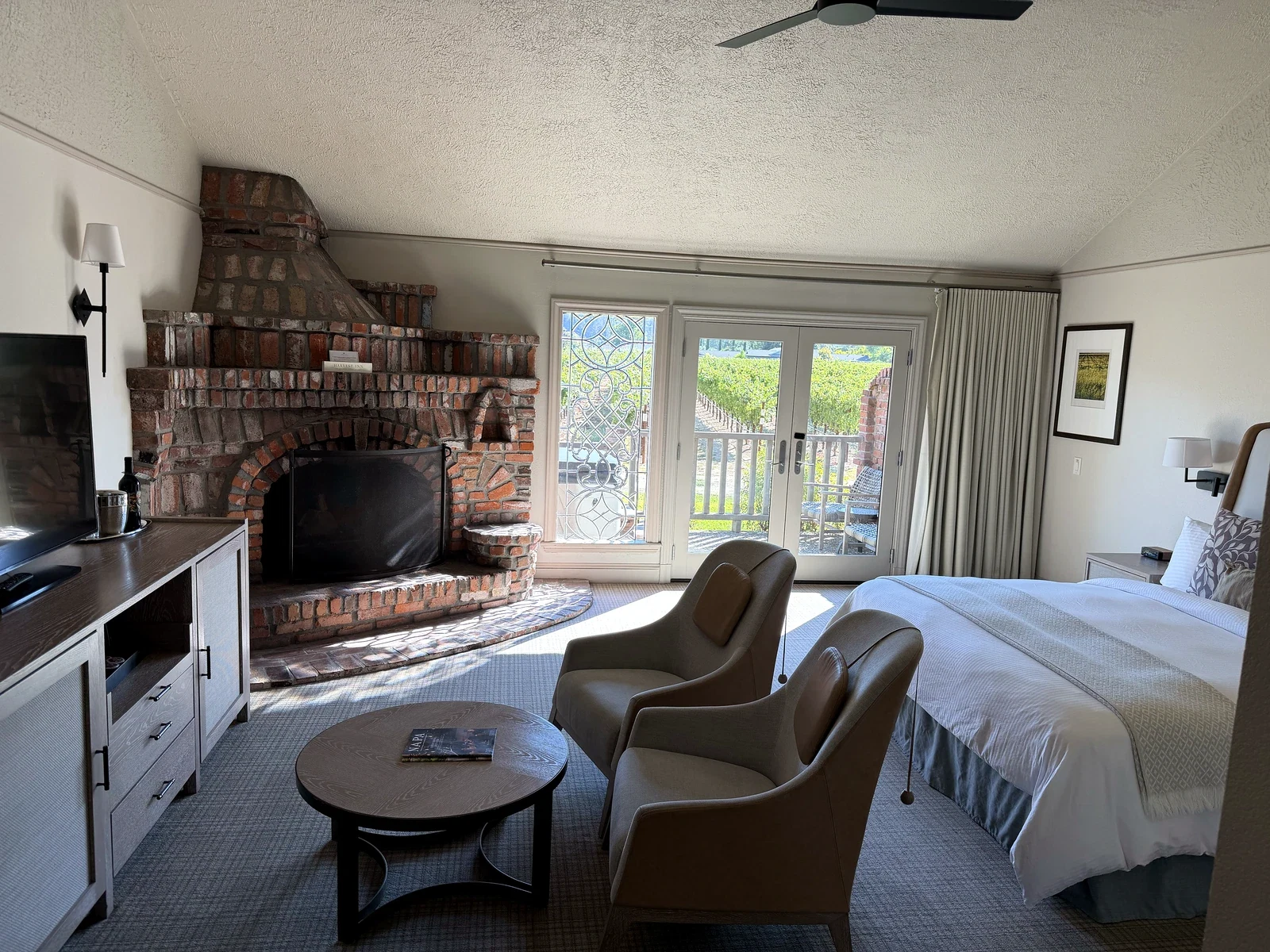
The official room name matters because Harvest Inn has several vineyard categories. We stayed in a Vineyard View Collection Spa, not the larger two-story Vineyard View Collection Suite. The Spa category is approximately 550 square feet and includes a king bed, classic fireplace, private vineyard-facing patio and outdoor hot tub.
The room felt notably spacious and clean. A large brick fireplace occupies one wall without making the rest of the space feel cramped. Two lounge chairs and a small table create a proper sitting area. The bed faces toward the patio doors, so the vineyard remains visible from much of the room. The design is comfortable and understated, allowing the brick and view to provide the drama.
The word “spa” refers to the private outdoor hot tub. That is an important booking distinction. Harvest Inn also offers on-property treatment rooms, but the room category itself is defined by the tub on the patio. We used it more than once, and it changed how we structured the stay. Instead of treating the room as a place to return after dinner, we came back early enough to soak at sunset and again the next morning.
The fireplace provides the counterpoint. A hot tub opens the room toward Napa's landscape; the brick hearth pulls it inward. In cooler weather or rain, that pairing would be even more valuable. It gives the room a strong sense of season without depending on a single type of weather.
The patio looks across Whitehall Lane's Leonardini Vineyard, a 14-acre site with a long agricultural history. The vineyard was first planted in the late 1800s, later used as pasture, and replanted under Whitehall Lane's direction in 1989. Today it is planted to Cabernet Sauvignon.
From our hot tub, none of that history was abstract. The rows began just beyond the railing and pulled the eye directly toward the Mayacamas. In full sun, we could see the geometry of the vineyard. At dusk, the foreground darkened before the sky. By morning, fog settled over the ridge and changed the view from crisp to cinematic.
The private setting matters. This was not a shared pool deck or a tub screened by landscaping. We could step directly outside in robes, sit in the water and look over working vines. The patio also had chairs for coffee or wine, making it useful even when we were not soaking.
For us, this was the defining experience of Harvest Inn. Napa has many beautiful hotel rooms and many hotel pools. A private hot tub placed this close to a Cabernet vineyard is much harder to replicate.
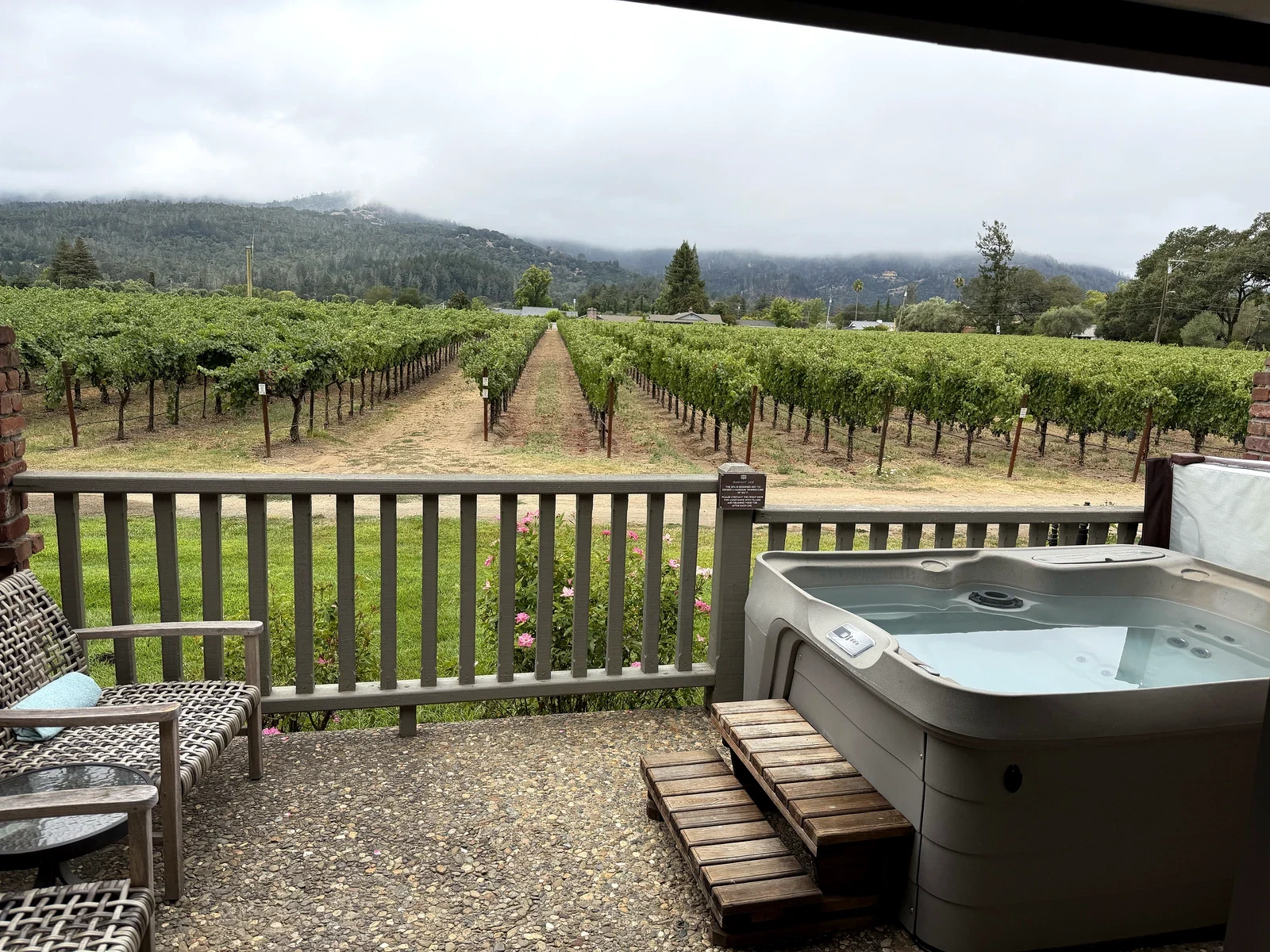
The same room produced three different moods in less than a day. Late afternoon was bright and expansive. The mountain ridge was clearly defined, and the vines held every shade of green. Sunset simplified the landscape into layers: vineyard, ridge and sky.
After dark, the property became extremely quiet. The vineyard absorbed most surrounding light, and the sky felt larger than it had from the road. We lit the fireplace after dinner and let the evening contract around the room.
Morning was one beautiful version. Fog moved over the Mayacamas and caught along the upper slopes while the vineyard remained visible below. The hot tub steamed against the cool air. A view that had felt summery the day before suddenly became cozy and almost autumnal.
The experience made an overnight stay feel more complete than the number of hours suggests. We did not simply see the vineyard once. We watched light and weather rewrite it.
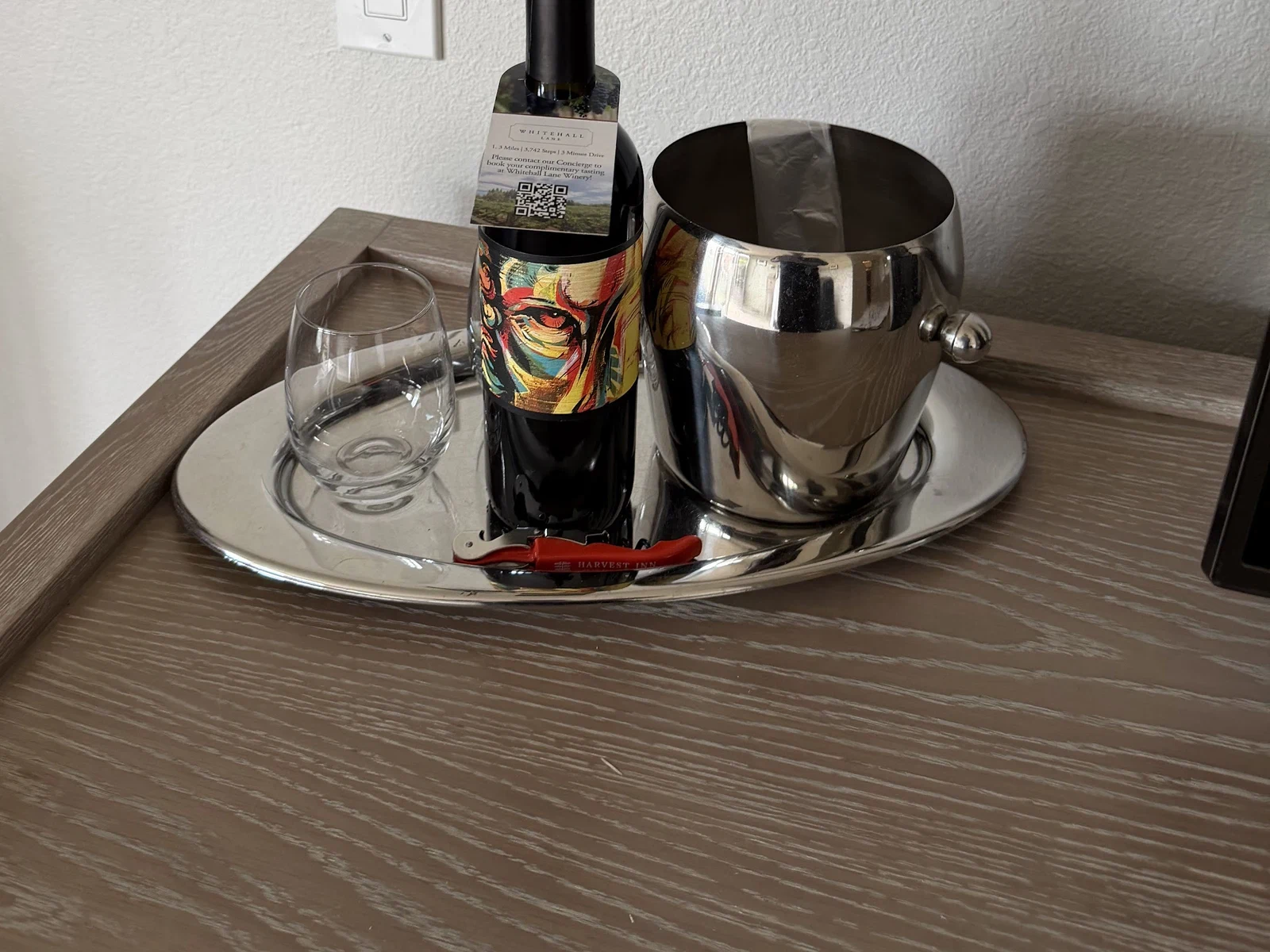
Vineyard View rooms currently include a bottle of Whitehall Lane Tre Leoni red wine, and ours waited with glassware and an ice bucket. The welcome made sense in context: our room looked across the Leonardini family’s vineyard, and Whitehall Lane is closely tied to that land.
Tre Leoni means “three lions,” and Whitehall Lane says the name honors three generations of the Leonardini family. The vintage on our bottle was not legible in our photographs; the producer’s 2023 tech sheet lists Cabernet Sauvignon, Merlot and Malbec.
Harvest Inn identifies the view as Leonardini Vineyard and the bottle as Whitehall Lane Tre Leoni, but Whitehall Lane does not claim that every grape in the blend comes from the rows outside the room. The connection is familial and geographic rather than a single-vineyard provenance claim.
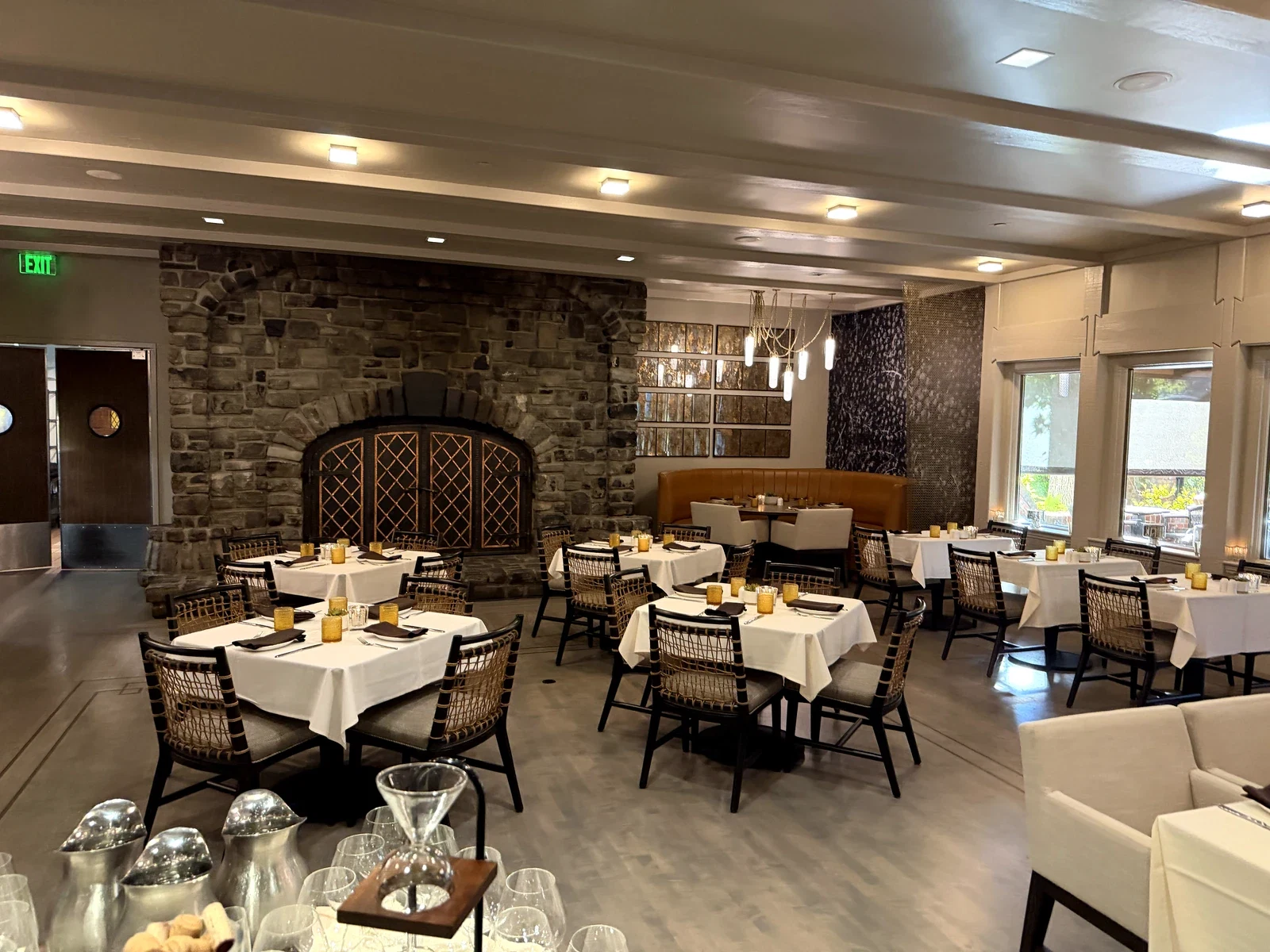
We would return to Harvest Table even without staying at the inn. The restaurant is integrated into the property but has its own sense of place: a large brick fireplace, warm wood, substantial tables, a garden-facing terrace and enough windows to keep the room connected to the grounds.
The current leadership team is worth distinguishing. Vern Lakusta is Harvest Inn's general manager. Marcin Furmankiewicz is the general manager of Harvest Table. Executive Chef Colin Rupp leads the kitchen. Rupp's background is unusually broad: he worked as an Alaskan salmon fisherman, studied British brewing technology, led Renata's Hearth at the Arizona Biltmore, and rose to executive chef at Morimoto Napa before joining Harvest Inn. That progression helps explain a menu that moves comfortably between wood fire, serious meat, local produce and more globally accented details.
Our August menu was seasonal and should be read as a snapshot. What felt durable was the restaurant's ability to satisfy two different Napa desires at once. It served a large-format tomahawk with proper sauces and a deep wine list, but it also paid attention to a hamachi crudo, herb salad, local tomatoes, Parker House rolls and cocktails. It was generous without becoming blunt.
The menu began with Parker House rolls and cultured butter. They were glossy, soft and rich enough to become more than a bread service. Their importance returned at dessert, when the same style of roll became the basis for bread pudding.
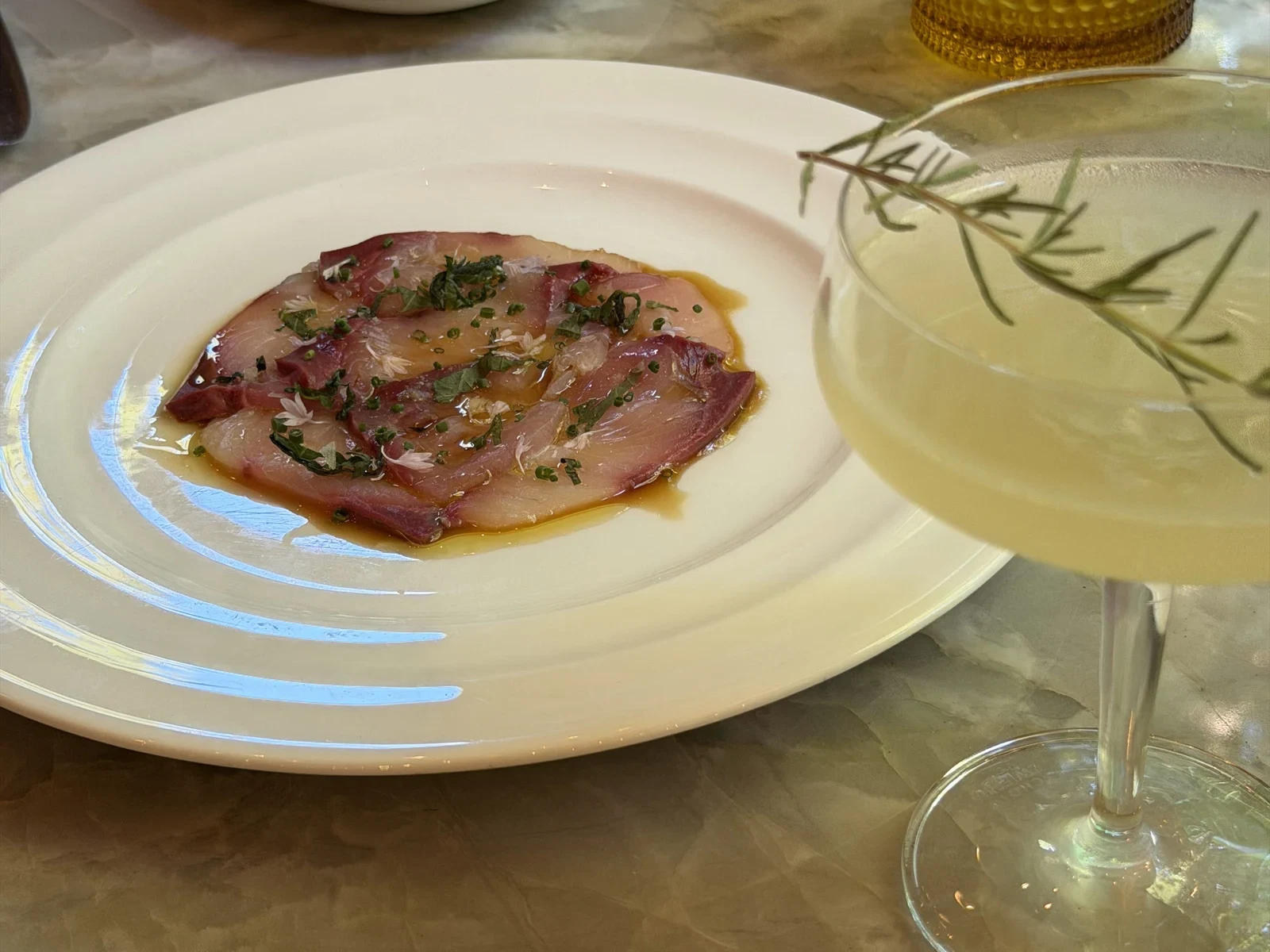
The hamachi crudo was among the more polished plates: thin slices of fish dressed with yuzu, tamari, olio nuovo and shiso. Citrus and soy gave it a clean structure, while the fresh oil rounded the edges. It was an effective first course with wine because it woke up the palate without creating too much weight.
We also had the kind of tomato dish that makes sense only in late-summer Napa: burrata with heirloom tomato, pain au levain and olio nuovo. The team told us about a local farmer who arrives with tomatoes in her van and waits while the restaurant collects them before she leaves. The story is funny, but it also describes an actual supply relationship: the ingredient arrives with a person attached to it.
The bib and herb salad accompanied the prix fixe with parsley, thyme, tarragon and an ume-Dijon vinaigrette. It was crisp, aromatic and more interesting than a token steakhouse salad. Those lighter plates gave the dinner somewhere to go before the tomahawk arrived.
During our August 2026 visit, the photographed menu offered a $175 prix fixe for two with Parker House rolls, a Bibb-and-herb salad, a tomahawk, a choice of side and sauces, and dessert. An optional $100 pairing featured Old Soda Springs Cabernet Sauvignon 2020; we did not order that pairing. As of August 24, 2026, the official menu instead listed a 40-ounce Black Angus tomahawk at $155 à la carte, with sauces priced separately. Menus and prices change, so treat our dinner as a snapshot of the visit rather than a standing package.
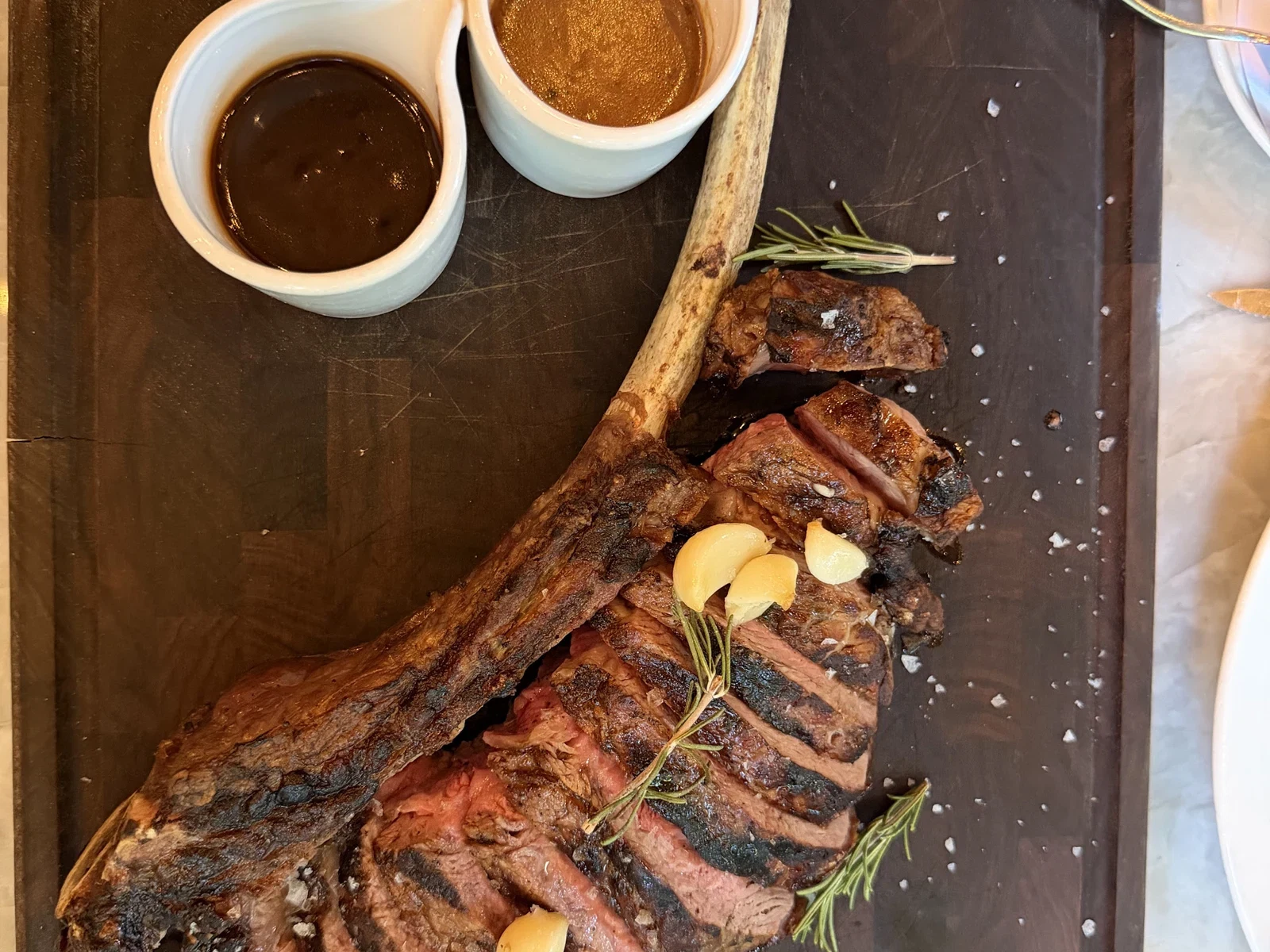
The steak arrived sliced on a large wooden board with the bone intact, roasted garlic, rosemary and three sauces. The spectacle was real, but the cooking delivered. The meat had a dark, smoky crust and a warm pink center. It was the right level of abundance for a wine-country dinner, especially with a mature Cabernet on the table.
The sauce choices were demi-glace, au poivre and red chimichurri. The red chimichurri was our favorite. It was brighter, looser and more vivid than the green herb sauce most people picture, with enough acidity and texture to cut through the steak. We kept returning to it even with the other two sauces beside it.
The size of the tomahawk also made the service important. The team presented it cleanly, the slicing made sharing easy, and the pacing never felt rushed. A large steak can dominate an evening; here it anchored one.
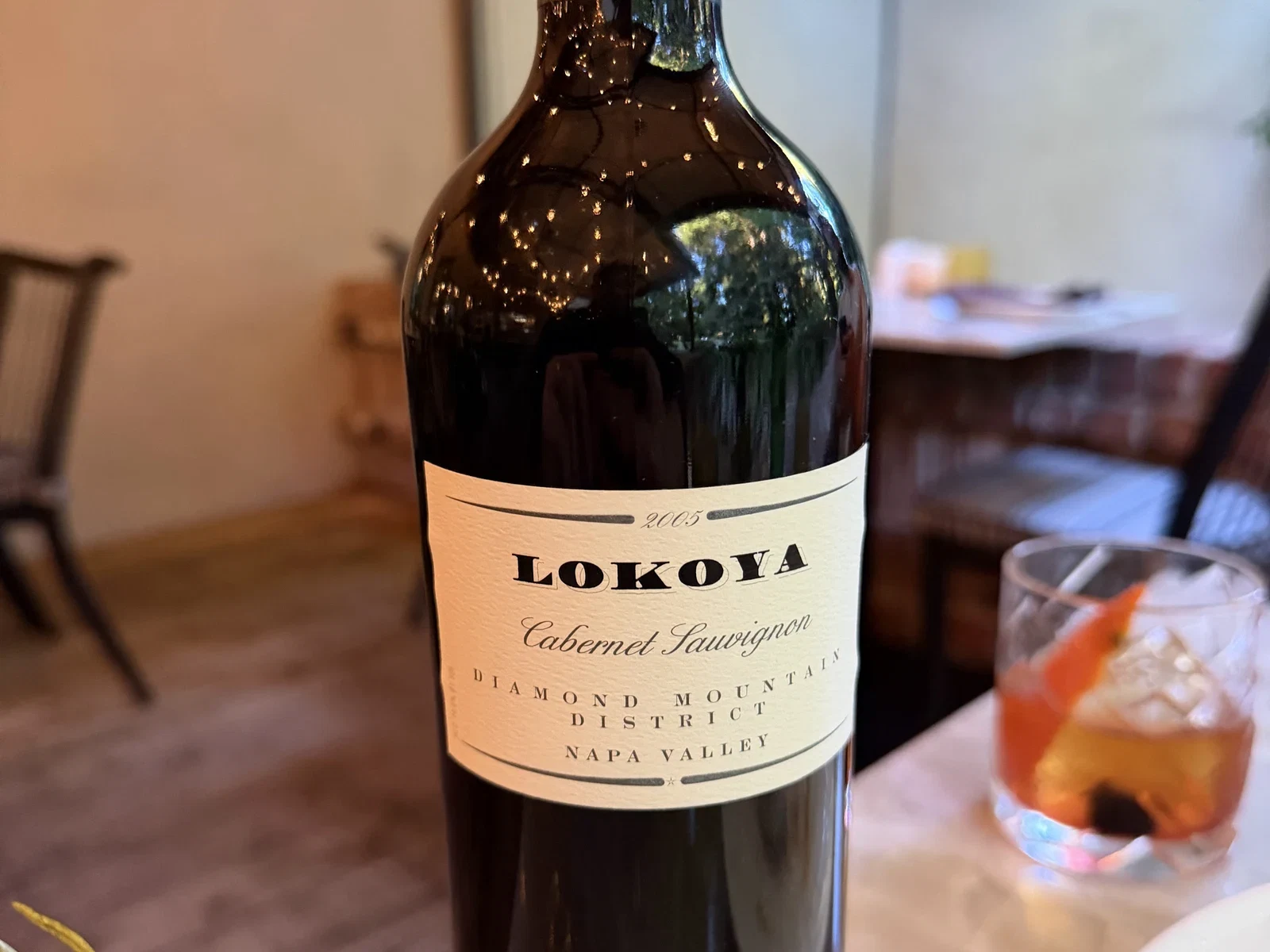
Harvest Table’s Napa-focused wine list gave us the confidence to order a 2005 Lokoya Diamond Mountain District Cabernet Sauvignon. Opening a mature mountain Cabernet at a hotel restaurant could have felt excessive. In this setting, with the vineyard outside and a tomahawk on the way, it felt completely coherent.
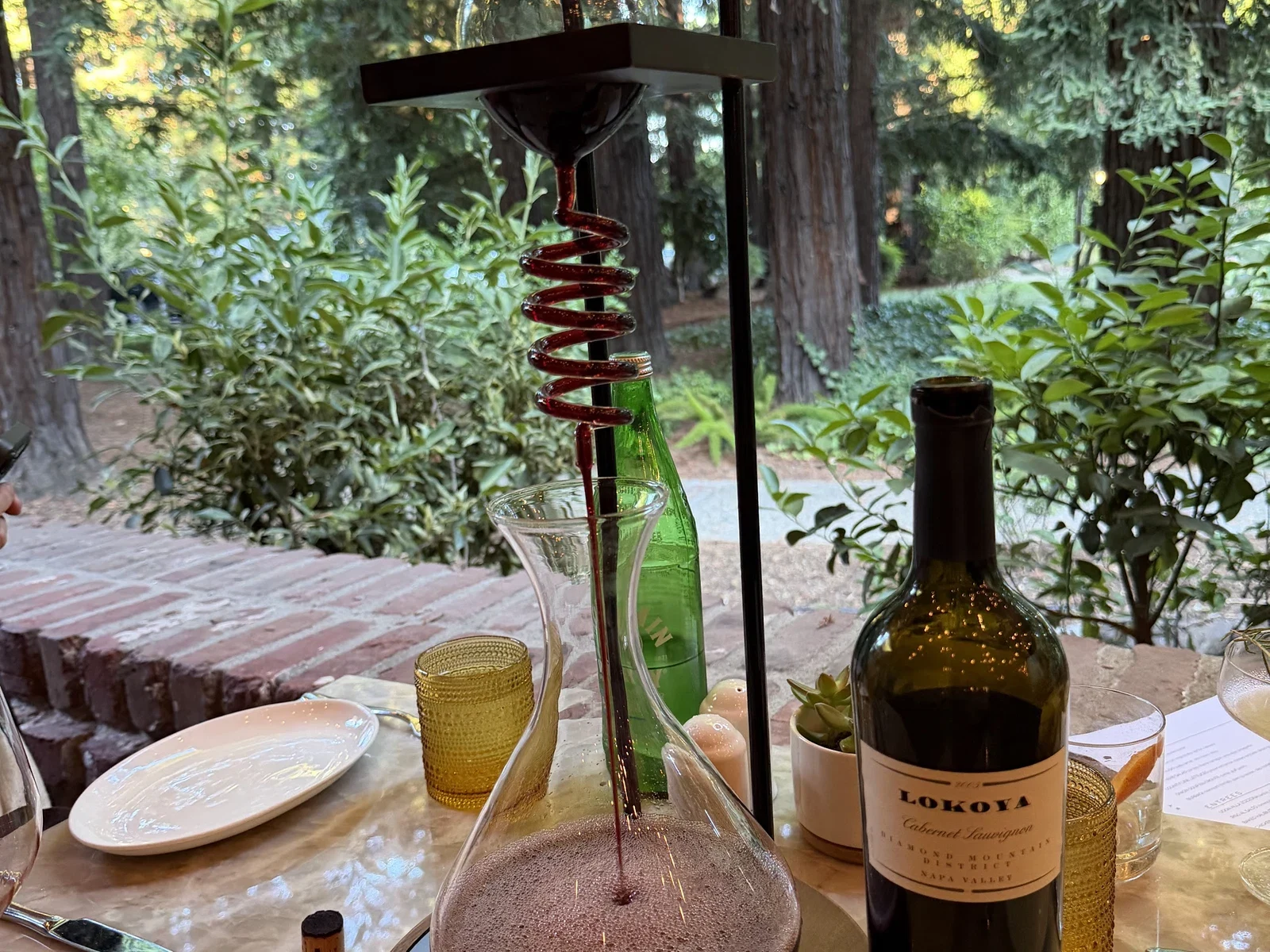
The bottle was in beautiful condition. Time had softened the wine's power without erasing its dark fruit or mountain structure. It expanded with air, so the team used a dramatic spiral decanter that turned the service into part of the table. Watching the wine descend through glass coils was playful, but it also gave the bottle the aeration it needed.
The Parker House rolls, herb salad and steak all interacted with the wine differently. The rolls brought out texture and warmth. The salad refreshed the palate. The tomahawk supplied the obvious match of char, fat and protein. Mature Cabernet can be overwhelmed by an overly sweet or heavy sauce, which is another reason the red chimichurri worked so well.
Harvest Table also pours accessible Napa bottles and wines by the glass. The point is not that every guest needs to order an older Lokoya. It is that the list and team were prepared when we did.
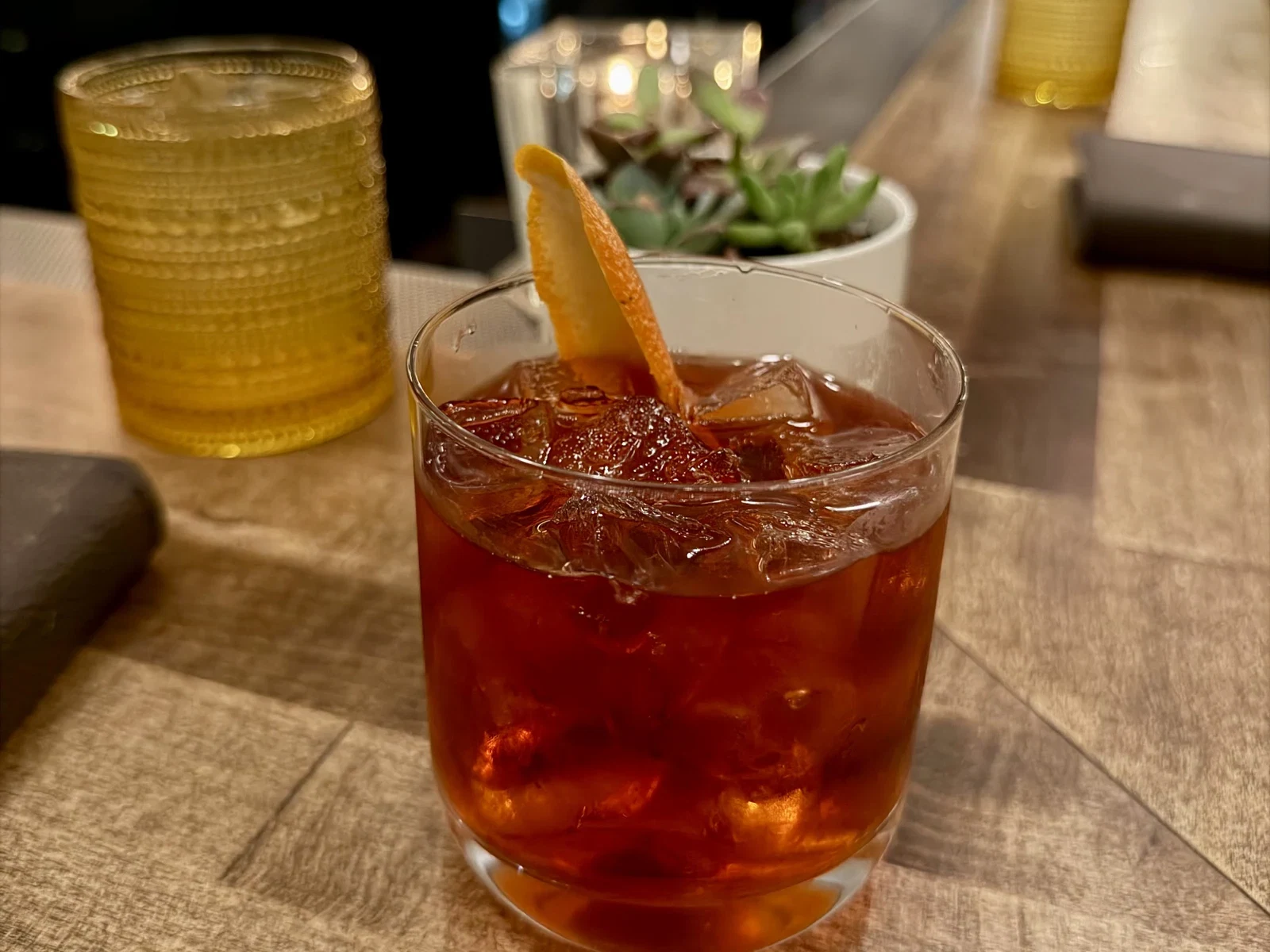
The bar program was one of the happiest surprises of the stay. Jesse Earl, our bartender, was knowledgeable, curious and genuinely fun to talk with. A good hotel bar can change the whole rhythm of a property, and Jesse made Harvest Table feel like a place where it was worth staying after dinner rather than moving on.
He made us a coffee Negroni that was excellent: bitter, aromatic and rich without turning into a dessert drink. Coffee and a Negroni's bitter orange structure can compete if either is pushed too hard. This version found the middle, preserving the cocktail's aperitivo character while giving it a roasted depth.
Then came the detail that immediately earns our attention at any bar: there was green Chartreuse within reach. Jesse poured it without ceremony, which was part of the pleasure. Chartreuse has become difficult enough to find that seeing it treated as a living spirit rather than a trophy bottle says something about a bar's confidence.
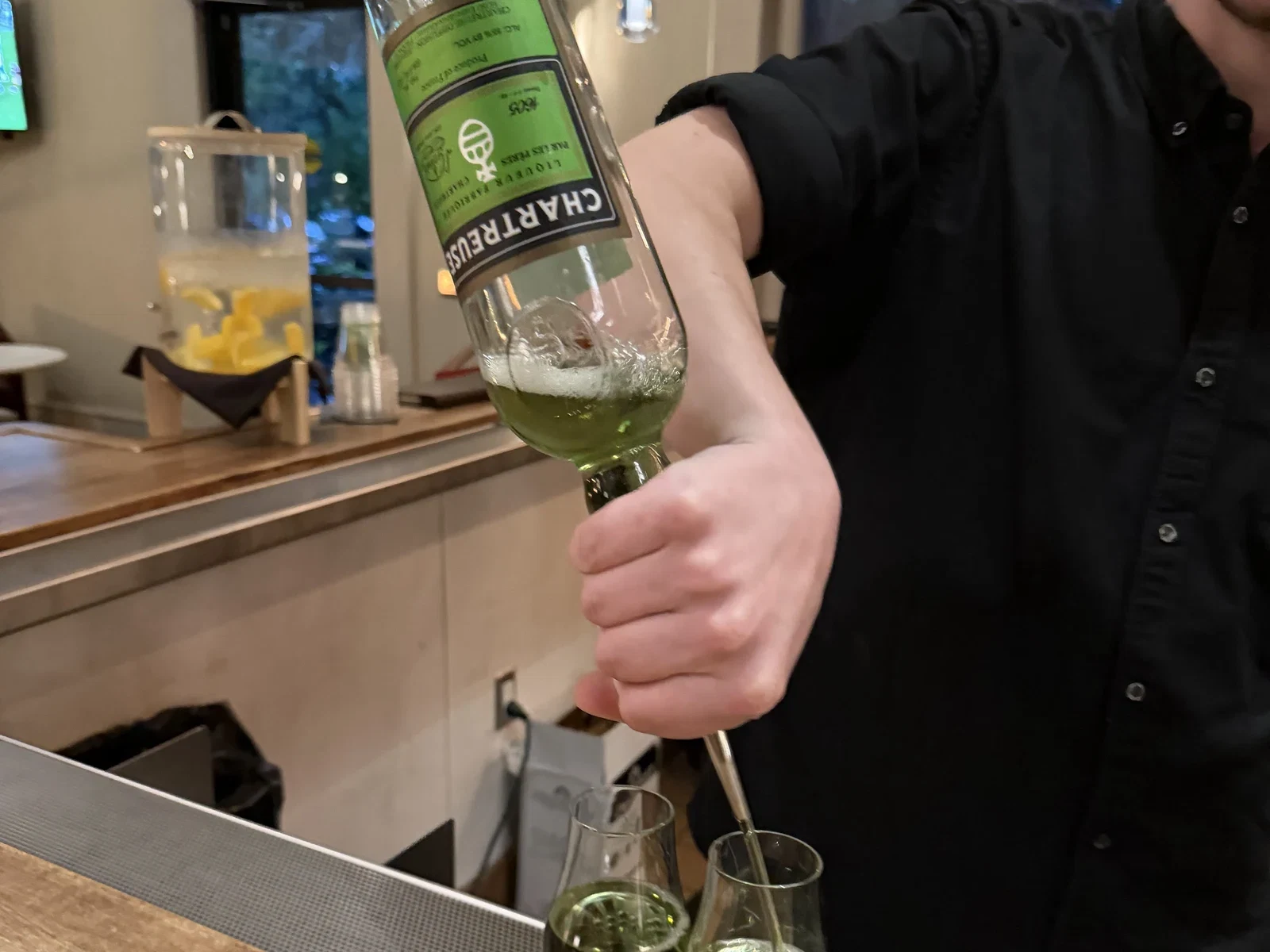
The current cocktail list changes seasonally. At research time it included drinks such as the 320 Redwood Manhattan and Napa 750, while Happy Harvest Hour ran Monday through Friday from 3 to 6 p.m. with several $6 bites and cocktails. Our coffee Negroni was a firsthand drink, not a guarantee that it will appear on the current printed menu. Ask Jesse or the bar team what they are excited to make.
The dessert that stayed with us was the bread pudding made from Parker House rolls. It arrived as a deeply caramelized rectangle with ice cream and dark sauce. The outside had structure; the center remained custardy and soft.
Using the restaurant's own rolls gave the dessert continuity. The bread service at the beginning of dinner returned in a transformed, richer form at the end. It also avoided the heaviness that can make bread pudding feel like a challenge after steak. The portion was generous, but the contrast of warm pudding and cold ice cream kept us going back.
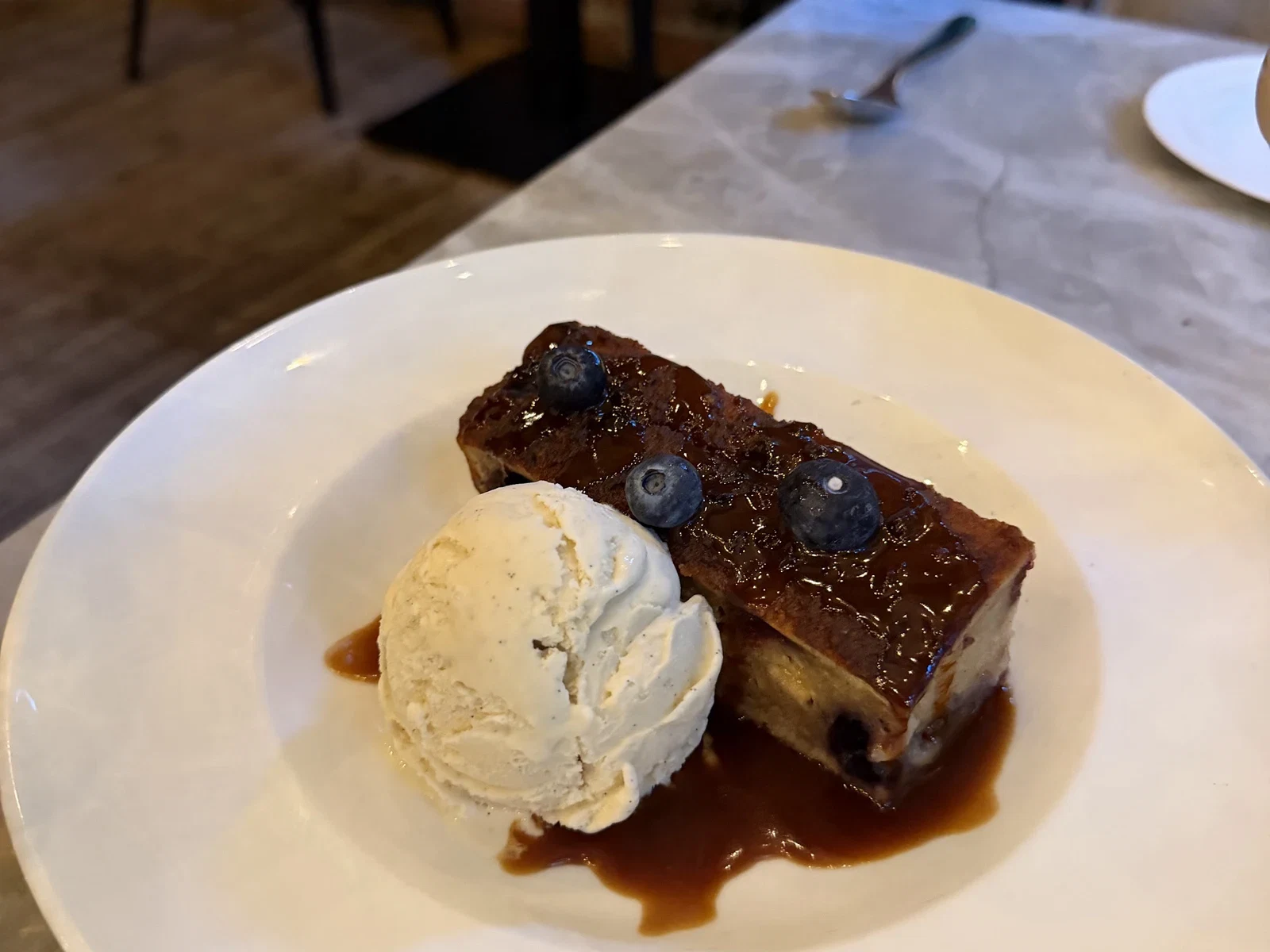
We would order it again without hesitation. If the exact dessert has rotated off, we would still ask whether the kitchen is making any bread pudding from the Parker House rolls. It was the clearest example of Harvest Table turning something familiar into a signature.
The next morning, we kept breakfast simple and ordered room service. The HT breakfast sandwich arrived on a Model Bakery English muffin with an over-easy egg, Hobbs bacon, basil aioli, greens and breakfast potatoes. The restaurant's current version changes in small ways with the menu, but the Model Bakery muffin is the key.
It held the runny egg and bacon without becoming tough or disappearing beneath the filling. The potatoes were intensely browned and plentiful, the kind of side that makes a breakfast sandwich feel like a complete brunch rather than a hand-held snack.
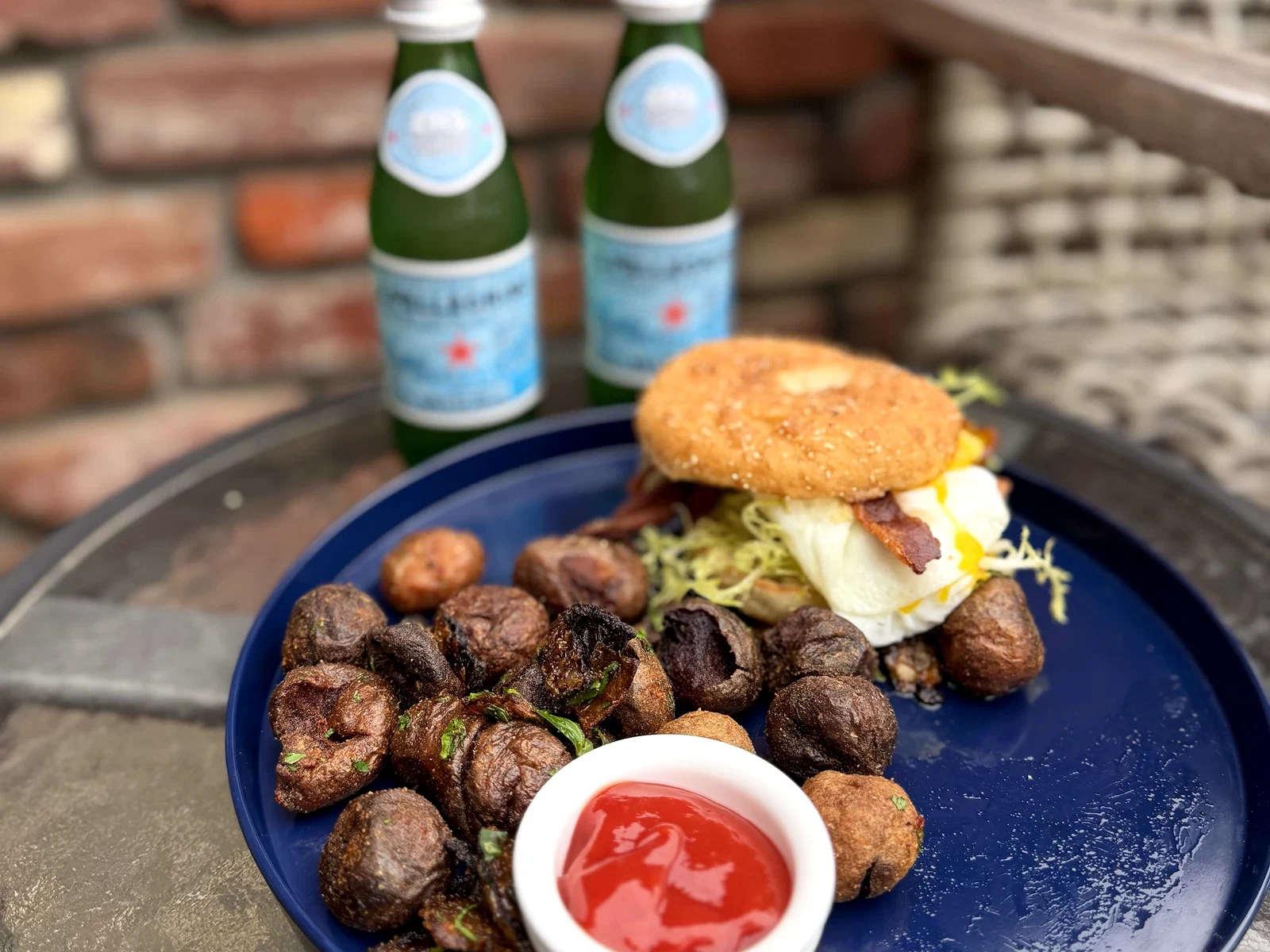
We ate outside with the fog still hanging over the mountains. That setting polished one casual meal of the stay. Room service can sometimes feel like a lesser version of the restaurant; here it allowed us to use the room's greatest amenity for another hour.
Harvest Table currently provides in-room dining during restaurant hours. Breakfast is served Monday through Friday, with brunch on weekends, but hours and menus should be confirmed directly for the dates of a stay.
Harvest Inn programs its grounds more ambitiously than we expected. Current experiences include monthly One Main Cigar Dinners from March through November, a Harvest Table Dinner Series built around local wineries, breweries and distilleries, and monthly Friday winemaker dinners from May through October. Those dinners begin at 6 p.m. and often sell out.
Seasonal programming has also included Oktoberfest, yoga with Mayacamas views, guided vineyard outings and Cigars, Bourbon & Blues with live music and pizzas from the vintage truck. The Napa Valley 750 brings pre-1972 sports cars together for a multi-day driving and culinary event supporting NALP (Napa Artisan Legacy Project).
During our conversations, the team also described more intimate formats: vineyard dinners, whiskey-focused evenings, pizza and caviar by the bocce area, and collaborations with notable Napa figures. Those examples reveal the property's range, but event calendars change. Ask for the exact programming during your dates rather than assuming a past dinner will repeat.
The setting is especially suited to private events. A wisteria-framed Vineyard View Terrace, the Manor House Lawn, Fountain Terrace, Harvest Table patios and Bocce Grove allow an event to move between vineyard, garden and woodland moods without leaving the property. That versatility explains why weddings feel natural here rather than imposed on an ordinary hotel lawn.
Harvest Inn sits at the southern entrance to St. Helena. Downtown is close enough for a short drive, while wineries in St. Helena, Rutherford and Oakville are easy to reach along Highway 29 or the Silverado Trail. The location is practical for a wine-focused itinerary because it avoids committing to either the far north or far south of the valley.
The property recommends a car for travelers arriving by plane, and that remains one flexible choice. Once back at the hotel, however, there is little pressure to leave. Harvest Table covers dinner and breakfast, the bar is worth visiting on its own, and the grounds reward an unstructured evening.
The balance is the point. Some Napa resorts earn privacy by placing guests far from town. Some St. Helena hotels earn convenience by sacrificing the feeling of retreat. Harvest Inn gives you both: an address on the main road and a room that looks only at vines and mountains.
Our recommendation is direct: book the Vineyard View Collection Spa if the private hot tub matters. The room is approximately 550 square feet and combines the features we used most: direct vineyard view, patio, hot tub and fireplace.
The Vineyard View Collection King offers a similar outlook and approximately the same square footage without the private spa. The Vineyard View Collection Suite is much larger at approximately 1,000 square feet, arranged across two levels with two bathrooms and a private deck. That may be a better choice for guests prioritizing interior space over a private tub.
Other Harvest Collection rooms face gardens, fountains or pool areas and can still include fireplaces or patios. They preserve access to the same grounds and restaurant, but they do not recreate the specific experience documented here. If a direct vineyard view is the reason for choosing Harvest Inn, confirm the exact category rather than relying on a general “vineyard hotel” description.
Our room, 306, was excellent. It had a clear central view down the vineyard rows, a secluded patio, and the full combination of hot tub and brick fireplace. Room layouts and assignments can change, but we would request it again.
Harvest Inn's current check-in time is 4 p.m., and checkout is noon. Complimentary parking and Wi-Fi are included. The property is dog-friendly in designated rooms, with current fees and limits listed on the official FAQ. Two electric-vehicle charging stations are available for a fee.
Both pools are currently open from 7 a.m. to 11 p.m., subject to change, and the fitness center is open 24 hours. Spa services are offered daily through treatment rooms on the property and the hotel's partnership with nearby Health Spa Napa Valley.
Vineyard View categories currently include a daily $50 restaurant credit, a bottle of Whitehall Lane Tre Leoni and minibar refreshments; the Spa category also lists sparkling wine. Packages, inclusions and rates change, so verify them on the official Harvest Inn accommodations page before booking.
Harvest Table currently serves weekday breakfast, weekend brunch and dinner daily. The official Harvest Table menus are seasonal. Our tomahawk price, Happy Harvest Hour details, cocktail choices and individual dishes document an August 2026 visit rather than a permanent promise.
| Planning point | What to know |
|---|---|
| Best room for couples | Vineyard View Collection Spa for the private hot tub, fireplace and vineyard-facing patio |
| Stay length | One night captured sunset and morning fog; two nights would leave more time for the pools, grounds and events |
| Dinner | Reserve Harvest Table and ask about the current large-format steak, wine list and off-menu cocktails |
| Breakfast | Room service is especially worthwhile in a vineyard-facing room |
| Wine | The list supports both wines by the glass and mature Napa bottles; ask the team about older Cabernet |
| Events | Check the hotel calendar early because winemaker and cigar dinners can sell out |
| Transportation | A car is useful for wineries, while Harvest Table makes staying on property for the evening easy |
Harvest Inn gave us the Napa experience we wanted without requiring us to manufacture it. The vineyard was outside the room. The private hot tub made us stop and watch the weather. The fireplace made returning after dinner feel like another part of the evening. Harvest Table supplied a serious meal, a mature Napa bottle, great cocktails and a dessert we are still thinking about.
The property's age is an advantage. The redwoods have grown tall enough to create real seclusion. The brickwork has weathered. The Tudor Revival buildings feel embedded in the landscape. New hotels can reproduce the amenities, but they cannot accelerate that sense of place.
The team completed the experience. Check-in was effortless. Jesse Earl made the bar memorable. Harvest Table handled a 2005 Lokoya Diamond Mountain District Cabernet Sauvignon and a large-format steak with confidence. General managers Vern Lakusta and Marcin Furmankiewicz oversee a hotel and restaurant that feel connected without one becoming secondary to the other, while Chef Colin Rupp gives the culinary program enough range to support both a relaxed breakfast and a celebratory dinner.
Would we return? Absolutely. We would request room 306 or another Vineyard View Collection Spa, arrive early enough to walk the grounds before dinner, order the tomahawk and red chimichurri if available, leave time for Jesse's bar, soak under the stars, and have breakfast outside while the fog moves across the Mayacamas. Harvest Inn is an oasis in the heart of St. Helena, and it is already on the list of Napa stays we cannot wait to repeat.
For current room availability and booking terms, check Harvest Inn.
Yes. Harvest Inn combines an eight-acre resort setting with a convenient St. Helena location, mature redwoods, two pools, Harvest Table and unusually strong Vineyard View rooms. Our stay was an enthusiastic yes.
The Vineyard View Collection Spa includes a private outdoor hot tub on a vineyard-facing patio, along with a king bed and classic fireplace. Confirm the exact category when booking. Collectors seeking a Harvest Inn-focused stay should contact the hotel or email concierge@enprimeurclub.com.
We stayed in room 306, a Vineyard View Collection Spa of approximately 550 square feet. It looked directly across Leonardini Vineyard toward the Mayacamas Mountains.
No. It is a spacious room category of approximately 550 square feet. Harvest Inn separately offers a two-level Vineyard View Collection Suite of approximately 1,000 square feet.
The Vineyard View rooms look toward Whitehall Lane's Leonardini Vineyard, a 14-acre St. Helena site planted to Cabernet Sauvignon.
Harvest Inn currently lists a bottle of Whitehall Lane Tre Leoni among its room amenities. Inclusions can change, so verify the current booking terms.
Tre Leoni means “three lions” and honors three generations of the Leonardini family. Our bottle’s vintage was not legible; Whitehall Lane’s 2023 version is a blend of Cabernet Sauvignon, Merlot and Malbec.
Yes. Our tomahawk dinner, 2005 Lokoya Diamond Mountain District Cabernet Sauvignon, coffee Negroni, Chartreuse service and Parker House roll bread pudding made Harvest Table a destination in its own right.
Colin Rupp is the current executive chef. His background includes Renata's Hearth at the Arizona Biltmore and Morimoto Napa, where he rose to executive chef.
Vern Lakusta is the current general manager of Harvest Inn. Marcin Furmankiewicz is the current general manager of Harvest Table.
If available, order the tomahawk prix fixe for two with the red chimichurri and finish with the Parker House roll bread pudding. Menus rotate seasonally.
Yes. The list emphasizes Napa Valley but reaches beyond it, and the team handled our 2005 Lokoya Diamond Mountain District Cabernet Sauvignon with an appropriate decant and excellent pacing.
At research time, Happy Harvest Hour ran Monday through Friday from 3 to 6 p.m. with several $6 bites and cocktails. Confirm the current menu and schedule before visiting.
Yes. Harvest Table currently provides in-room dining during restaurant hours. Our breakfast sandwich came on a Model Bakery English muffin with bacon, egg, greens, basil aioli and breakfast potatoes.
Harvest Inn has two heated outdoor pools, each with a hot tub, plus on-property treatment rooms supported through a partnership with Health Spa Napa Valley.
Yes. Harvest Inn's current official materials list a 24-hour fitness center.
Yes. The property has multiple indoor and outdoor spaces, including the Vineyard View Terrace, Manor House Lawn, Fountain Terrace, Harvest Table patios and Bocce Grove.
Harvest Inn sits at the southern entrance to St. Helena at 1 Main Street. Central shops and restaurants are only a short drive away.
The property is best described as German-Tudor or Tudor Revival, with stucco, timber framing, leaded glass, stone, steep roofs and extensive brickwork.
The property opened April 3, 1978, with the first 20 rooms that day. Hundreds of newly planted redwoods now define the grounds.
Get the App
Take the shortlist into the En Primeur Club app for concierge access, saved places, and the next step after discovery.
Get Exclusive AccessMore from the editors