



World's 50 Best #16 · La Liste Top Restaurants · Tabelog 100 #80
Our verdict
Few addresses in Tokyo's omakase circuit carry the same weight of documentation as Sukiyabashi Jiro in Ginza's Chuo City. Ranked as high as #16 on the World's 50 Best list in 2003 and still tracking on La Liste's global table in 2026, the counter operates on an edomae tradition that has shaped how the rest of the world understands high-end sushi. The regulars return not for novelty, but because the format does not change.

Pearl is the En Primeur Club membership app, where members save venues, book tables and use the concierge.
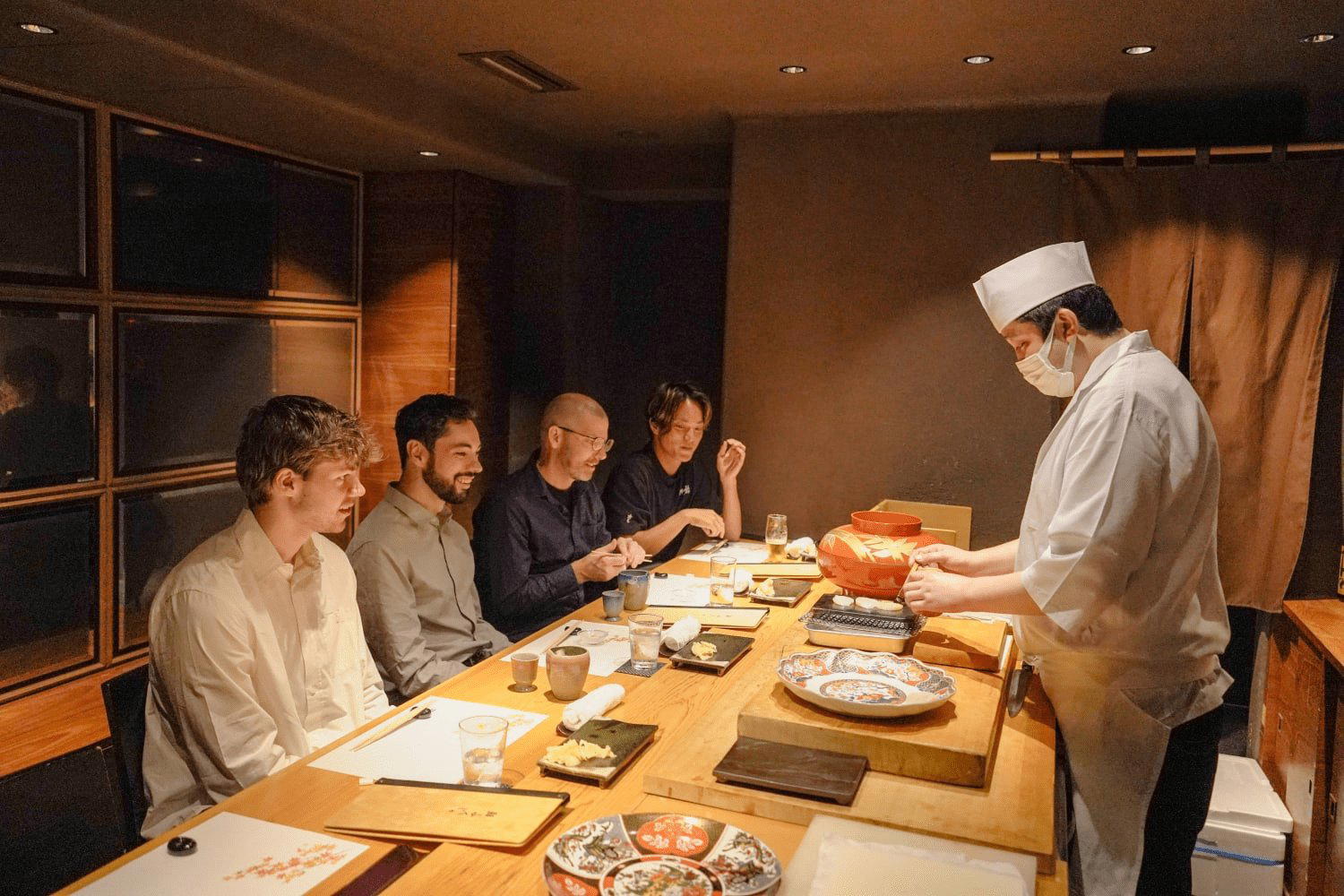
What the Record Shows
Ginza's basement-level sushi counters have defined the upper tier of Tokyo omakase for decades, and few addresses in that bracket carry a documented record as long as Sukiyabashi Jiro. The original counter at Chuo City's 4 Chome addresses, the Honten, as distinct from the Sukiyabashi Jiro Roppongiten, entered international awareness when it appeared on the World's 50 Best list at #22 in 2002 and climbed to #16 the following year. That recognition arrived before most Western audiences had framed omakase as a format worth travelling for. By the time the 2011 documentary accelerated global demand, the waitlist and booking structure had already been shaped by decades of regulars who arrived on schedule and expected consistency, not surprise.
The awards record since then maps a specific trajectory. La Liste placed the counter at 89.5 points in 2025 and 86 points in 2026, while Opinionated About Dining ranked it #88 among Japan's restaurants in 2023, #96 in 2024, and #109 in 2025.
The Edomae Discipline and What Keeps Regulars Returning
Edomae sushi, the Tokyo tradition that predates refrigeration, built on marinated, pressed, and lightly cured fish rather than raw cuts served immediately, demands a different relationship between guest and counter than most modern omakase formats. There is no innovation agenda, no seasonal reinvention for its own sake, and no chef-as-auteur narrative driving the sequence. What brings regulars back is the inverse of novelty: the knowledge that what was served last time will be served again, executed to the same standard, at the same pace, in the same room.
This is a rarer proposition than it sounds in a city where chefs regularly introduce new formats, imported ingredients, and cross-cultural references. The regulars at counters operating in the strict edomae tradition are not looking for what has changed; they are calibrating against what has not. The rice temperature, the compression of each piece, the ratio of fish to vinegared grain, these are the metrics a returning guest carries forward. At a counter with as much documented history as this one, those metrics have been tested across a record that extends back further than most of its competitors have been open.
For readers exploring the broader edomae tradition in Tokyo, Edomae Sushi Hanabusa provides a useful comparative reference point, and Hiroo Ishizaka represents a different expression of the same discipline in a distinct neighbourhood context.
The Counter in Its Ginza Context
Ginza's concentration of high-end counters has intensified over the past decade. Where the neighbourhood once housed a handful of internationally referenced addresses, it now contains a layered market with significant spread in price, format, and competitive signals. The basement location on Chuo City's 4 Chome block places Sukiyabashi Jiro in the traditional Ginza core, a zone where proximity to luxury retail and corporate entertainment has historically supported the most expensive tier of dining.
That rating gap is worth reading correctly. Counters operating at this level of formality and price tend to polarise general audiences while sustaining the loyalty of the narrower cohort for whom the format is the point. The regulars who have been returning for years are not well-represented in the general review distribution. Their relationship with the counter is expressed through repeated bookings, not public scores.
Where This Counter Sits Against Peers
Comparing Sukiyabashi Jiro to the current generation of Ginza sushi addresses requires separating two things: the quality of the product and the weight of the institutional record. Newer counters can compete on the former; the latter is harder to replicate. The 2002 and 2003 World's 50 Best placements arrived at a moment when global fine dining lists were just beginning to document Japanese cuisine at this level.
Counters with Kanesaka lineage, including Sushi Kanesaka, occupy a distinct but related position in Ginza's competitive hierarchy. The lineage map of Tokyo sushi is complex, with multiple counters tracing influence back to a small number of founding figures. Sukiyabashi Jiro occupies one of the most-cited positions on that map, which is why its influence extends beyond Tokyo. Sushi Shikon in Hong Kong and Shoukouwa in Singapore both represent the export of Tokyo's high-end omakase model to other Asian markets, a pattern that traces in part to the international attention this counter helped generate in the early 2000s.
Operating Hours and Practical Notes
The counter operates Monday through Saturday with a lunch service from 11:30 am to 2:00 pm and dinner from 5:30 pm to 8:30 pm. It is closed on Sundays. Reservations: The booking structure at counters of this type is typically managed through phone or introduction; confirm the current method directly, as it may have evolved. Location: Basement level, 4 Chome-2-15 Tsukamoto Sogyo Building, Ginza, Chuo City, Tokyo. Getting there: Ginza Station on the Tokyo Metro Ginza, Hibiya, and Marunouchi lines provides the most direct access; the address is within a short walk of the station's main exits. Budget:
Tokyo Beyond This Counter
Readers using this address as an anchor for a broader Tokyo itinerary will find a full range of editorial coverage in our full Tokyo restaurants guide, alongside category-specific resources for hotels, bars, wineries, and experiences in the city. For those extending a Japan itinerary beyond Tokyo, the EP Club covers the country's other major dining cities in depth: HAJIME in Osaka, Gion Sasaki in Kyoto, akordu in Nara, Goh in Fukuoka, 1000 in Yokohama, and 6 in Okinawa each represent their respective cities' high-end dining in distinct ways.
Frequently asked questions
What should I order at Sukiyabashi Jiro?
The format is omakase, meaning the sequence is set by the kitchen rather than chosen by the guest. There is no menu to select from in the conventional sense. At edomae counters operating at this level, the chef determines the order and composition of each piece based on the day's fish, and the guest's role is to receive the sequence as presented. What regulars understand, and first-time visitors sometimes do not, is that the absence of choice is the point. The discipline of the format is what defines the experience, and attempting to request substitutions or modifications sits outside the implicit contract of the counter. If there are specific dietary requirements, these should be communicated well in advance of the reservation, ideally at the time of booking. For cuisine-level context on edomae tradition and what distinguishes it from other omakase formats, see our coverage of Edomae Sushi Hanabusa and Harutaka.
Fast Comparison
| Venue | Cuisine | Price | Awards | Notes |
|---|---|---|---|---|
| Sukiyabashi JiroThis venue (the venue you are viewing) | Edomae Omakase Sushi | $200–300 | World's 50 Best #16 · La Liste Top Restaurants | Not listed |
| Harutaka | Edo-Style Omakase Sushi | $200–300 | 3 Michelin Stars · World's 50 Best #76 | Sushi |
| RyuGin | Modern Kaiseki | $500+ | 3 Michelin Stars · World's 50 Best #41 | Kaiseki, Japanese |
| L'Effervescence | Modern French with Japanese Influences | $200–300 | 3 Michelin Stars · World's 50 Best #69 | French |
| HOMMAGE | Modern French with Japanese Influences | $150–200 | 2 Michelin Stars · World's 50 Best #78 | Innovtive French, French |
| MAZ | Innovative Peruvian-Japanese Fusion | $150–200 | 2 Michelin Stars · World's 50 Best #28 | Innovative |
Recognition history
Dated appearances from independent guides and award organizations, with the underlying list record or original source where available.
World's 50 Best Restaurants #16
World's 50 Best
La Liste Top Restaurants
La Liste
Opinionated About Dining Top Restaurants in Japan Ranked #140
Opinionated About Dining
Tabelog 100 #80 · No. 80
Tabelog · Tabelog 100 - Sushi - TOKYO - 2025
Full recognition history (9 entries)
La Liste Top Restaurants
La Liste
Opinionated About Dining Top Restaurants in Japan Ranked #109
Opinionated About Dining
Opinionated About Dining Top Restaurants in Japan Ranked #96
Opinionated About Dining
Opinionated About Dining Top Restaurants in Japan Ranked #88
Opinionated About Dining
World's 50 Best Restaurants #22
World's 50 Best
Sukiyabashi Jiro
Featured Guides
Continue exploring
More in Tokyo
Restaurants in Tokyo
All restaurants in Tokyo →
Bars in Tokyo
All bars in Tokyo →


Details
- Classic
- Elegant
- Intimate
- Well Known
- Sophisticated
- Minimalist
- Special Occasion
- Solo
- Business Dinner
- Chefs Counter
- Sake Program
- Sustainable Seafood
- Omakase
- Counter Dining
- Sake Program
Current opening hours
- Monday
- 11:30 AM–2 PM, 5:30–8:30 PM
- Tuesday
- 11:30 AM–2 PM, 5:30–8:30 PM
- Wednesday
- 11:30 AM–2 PM, 5:30–8:30 PM
- Thursday
- 11:30 AM–2 PM, 5:30–8:30 PM
- Friday
- 11:30 AM–2 PM, 5:30–8:30 PM
- Saturday
- 11:30 AM–2 PM
- Sunday
- Closed
Hours can change for holidays and private events. Last verified .
Minimalist, tense, and focused counter seating with precise, fast-paced service emphasizing the art of sushi preparation.