AMANIE
Our verdict
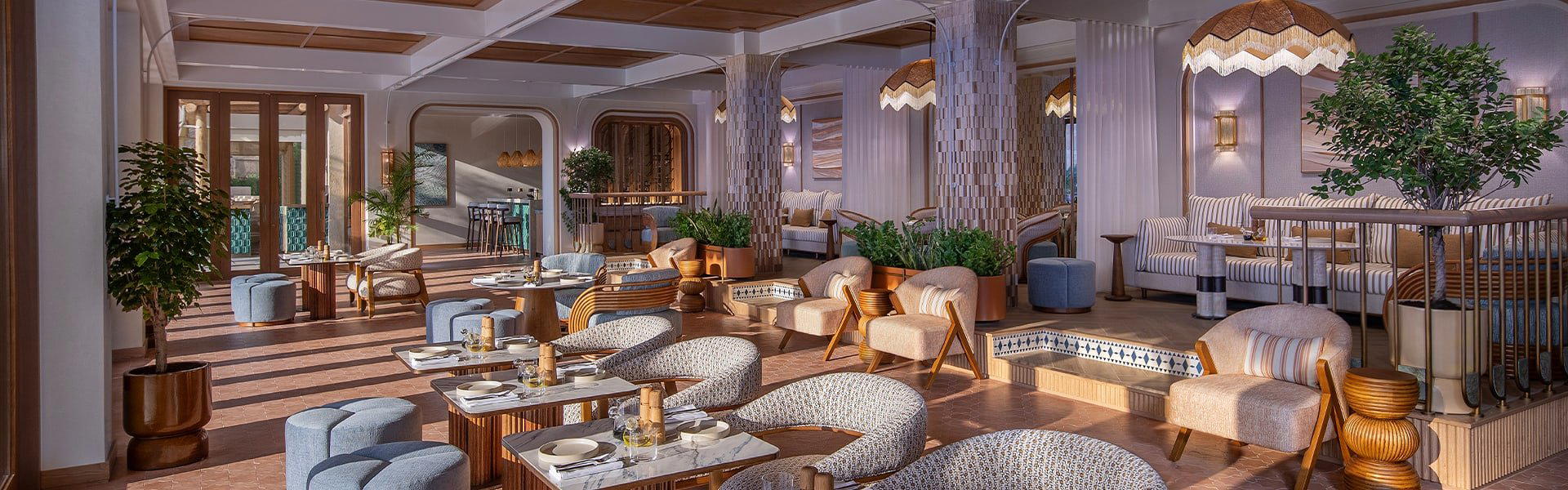
AMANIE sits inside Liwa Desert’s resort-dining circuit, where the setting matters as much as the plate and ingredient provenance carries unusual weight. Read it through the lens of oasis agriculture, Gulf trade routes, and the practical realities of cooking at the edge of the Empty Quarter rather than as a standard city restaurant.

Pearl is the En Primeur Club membership app, where members save venues, book tables and use the concierge.
The menu
What to order
- Mediterranean monkfish pot au feu
- Fresh herb chicken piccata
- Salmon tartare
- Caramelised onion and fig tart
- Smoked sepia tabbouleh
Approaching dinner in Liwa is not a city ritual. The horizon lowers, the dunes take over the frame, and the usual restaurant cues, pavement, shopfronts, passing taxis, disappear. In that context, AMANIE belongs to a small desert-resort dining scene where the room, the supply chain, and the surrounding silence all shape the meal before a menu is opened.
Liwa’s food culture has always been tied to ingredients and cooking habits that can endure heat, distance, and scarcity. Regional staples, preserved flavours, breads, dairy, grilled dishes, and carefully handled supplies form the practical grammar of the area, even when a resort kitchen uses a broader international vocabulary. The stronger reading of AMANIE is therefore not as an isolated dining room, but as part of a desert hospitality format where sourcing has to answer two questions at once: what belongs to the place, and what can be brought in without making the experience feel detached from it.
Oasis sourcing matters more in Liwa than menu theatre
In dense restaurant cities, ingredient stories can become decorative. In Liwa, they carry more consequence. The oasis system around the Liwa crescent is historically linked to date cultivation and seasonal movement, while modern resort dining must balance regional produce with imported luxury expectations. That tension defines much of the meal: the kitchen is working in a setting where locality is meaningful, but total locality would be unrealistic.
This is where AMANIE fits the area’s stronger dining pattern. Nearby resort formats such as Al Falaj, Desert Barbecue, Designer Dining, Spice Spoons, and Suhail show how Liwa dining splits between heritage cues, outdoor spectacle, and resort polish. AMANIE should be judged within that cluster, not against a downtown tasting-menu counter or a beach-club restaurant elsewhere in the UAE.
The ingredient angle also explains why desert restaurants can feel more coherent when they avoid overcomplication. Fire, spice, preserved sweetness, smoke, bread, dairy, and slow-cooked textures have a stronger relationship to the region than elaborate plating for its own sake. A serious Liwa meal does not need to announce authenticity; it needs to make the surrounding geography feel relevant without turning it into stage scenery.
The Liwa resort table is a category of its own
Desert hospitality in the UAE is often misread as a novelty format. At the higher end, it is better understood as a controlled logistics exercise: guests have committed to distance, the resort holds the evening’s tempo, and the restaurant becomes part of a wider stay rather than a quick reservation between other plans. That changes the value calculation. Convenience, pacing, and a sense of place matter more than the breadth of the à la carte choice.
AMANIE’s Liwa Desert setting places it in a desert-resort circuit, far from the restaurant density of major UAE city centres. For travellers comparing the wider UAE, urban restaurants operate with a different rhythm: easier access, more surrounding alternatives, and less dependence on one property or setting as the full evening plan.
That distinction matters for expectation-setting. In Liwa, the question is less “where next?” and more “does the meal make sense after the drive, the dunes, and the long desert day?” The stronger desert restaurants answer through restraint: regional references, measured service, and a menu structure that does not fight the environment. AMANIE sits in that decision frame.
How to read AMANIE against the wider UAE dining map
The UAE’s restaurant scene is increasingly split between global-city dining and destination-resort dining. Dubai and Abu Dhabi can support imported concepts, chef-led openings, and high-turnover neighbourhood venues. Liwa works differently. The audience is smaller, stays are more intentional, and the surrounding desert is not background décor; it is the reason the table exists where it does.
For readers building a broader itinerary, the useful comparison is not only restaurant to restaurant, but category to category. Our full Liwa Desert restaurants guide maps the local dining cluster, while Our full Liwa Desert hotels guide explains why properties drive much of the area’s food culture. The same logic extends to Our full Liwa Desert bars guide, Our full Liwa Desert wineries guide, and Our full Liwa Desert experiences guide: Liwa is planned as a destination, not sampled casually between appointments.
International comparisons can be misleading unless they are used carefully. Urban specialists derive their authority from local specificity, frequent repeat traffic, and the density of the neighbourhoods around them. AMANIE draws from a different source of value: scarcity of setting, desert logistics, and the pressure to make regional ingredients feel anchored rather than ornamental.
The editorial test is simple. If the meal treats the desert as a view alone, it risks becoming resort dining that is moved anywhere. If the cooking gives weight to oasis produce, regional references, heat-conscious pacing, and the practical generosity of desert hospitality, the experience earns its location. That is the standard by which AMANIE should be read.
Frequently asked questions
Is AMANIE suitable for children?
Yes, AMANIE is a resort-style restaurant in Liwa Desert, so it suits mixed-age guests better than a rigidly formal tasting-menu room. The desert setting makes it a practical choice for families planning a wider stay in the area.
Is AMANIE formal or casual?
It reads as resort-smart rather than rigidly formal, which fits a dining room in Liwa Desert. The setting places it in a destination-resort context, not a city-centre fine-dining room.
What's the address for AMANIE?
Liwa Desert.
How far ahead should I plan for AMANIE?
Plan AMANIE alongside your wider Liwa Desert itinerary. Timing is less about a standalone city booking and more about syncing the meal with the drive, the dunes, and the pace of a desert stay.
What do critics highlight about AMANIE?
The main talking point is location: AMANIE sits in Liwa Desert, where sourcing and service logistics matter more than menu theatre. In the UAE dining scene, that gives the restaurant a different brief from downtown hotels and city restaurants.
Is AMANIE good for vegetarians?
Vegetarian diners should check directly with AMANIE before booking. As with many resort-style restaurants in Liwa Desert, the best approach is to confirm current menu options and any dietary requirements in advance.
At-a-Glance Comparison
Comparable venues by cuisine and price in the same metro.
| Venue | Cuisine | Price |
|---|---|---|
| AMANIEThis venue (the venue you are viewing) | Mediterranean | $100–150 |
| Al Falaj | Levantine Middle Eastern | Not listed |
| Designer Dining | Private Desert Dining | Not listed |
| Spice Spoons | Arabic cooking experience | Not listed |
| Suhail | Middle Eastern Fine Dining | Not listed |
Continue exploring
More in Liwa Desert
Restaurants in Liwa Desert
All restaurants in Liwa Desert →
Hotels in Liwa Desert
All hotels in Liwa Desert →
Details
- Scenic
- Elegant
- Quiet
- Sophisticated
- Ornate
- Date Night
- Group Dining
- Special Occasion
- Hotel Restaurant
- Panoramic View
- Design Destination
- Zero Proof
- Local Sourcing
- Mountain
- A La Carte
- Set Menu
- Wine
- Vegetarian Friendly
- Vegan Options
- Gluten Free Options
- Halal
- Allergy Accommodating
Warm, refined, and slow-paced, with a serene atmosphere shaped by the infinity pool, endless desert views, and a day-to-night transition from leisurely lunch to elegant evening dining.