← Guides
A firsthand OVID Napa Valley review with Austin Peterson and Vanessa Conlin MW, spanning the rocky Pritchard Hill vineyard, cellar trials, FLWR sensory tasting, and four 2023 to 24 wines.
A firsthand OVID Napa Valley review with Austin Peterson and Vanessa Conlin MW, spanning the rocky Pritchard Hill vineyard, cellar trials, FLWR sensory tasting, and four 2023 to 24 wines.
OVID Napa Valley began for us with lavender, white sage, and bay laurel on perfume strips, not wine in the glass. With winemaker Austin Peterson and Vanessa Conlin MW guiding us, the custom FLWR sensory exercise became the well-suited introduction to a Pritchard Hill estate built around disciplined experimentation.
High above St. Helena, OVID is one of Napa Valley's serious Cabernet estates, yet the culture is built around the conviction that even a great estate should keep testing its assumptions. The winery takes its name from the Roman poet behind Metamorphoses, and during our full vineyard, cellar, and tasting-room visit, transformation appeared everywhere: in rock becoming soil, young Cabernet vines planted to preserve future grafting options, and experiments that can eventually earn a place in the estate portfolio.
Ripe black grapes hung under yellowing leaves. Red-orange rock surrounded a restrained wood, glass, and concrete building set into the hillside, and Napa Valley opened below the tasting room through walls of glass. The fog made the room feel even more private.
Should you visit OVID Napa Valley? Enthusiastically, yes, especially if you want the people and process behind a coveted wine to matter as much as the bottle. Our flight moved from the 2024 Experiment White W11.4 through the 2023 Experiment Red M2.3, 2023 Hexameter, and 2023 OVID, but the defining pleasure was understanding how every wine fits into the project Austin has spent two decades refining.

Yes. OVID is a notable Pritchard Hill visit for someone who already loves Napa Cabernet and wants to go deeper into vineyard design, élevage, sensory analysis, and the decisions that shape a small-production estate. The setting is spectacular, the appointment is personal, and the experience gave us unusual access to the person who has made the wines for most of OVID's history.
Here is the practical version from our August 13, 2026 visit:
Members should use the email connected to their OVID membership when checking Tock because the winery says that reveals full appointment availability.
OVID takes its name from the Roman poet and Metamorphoses, an epic built around transformation. That is more than literary packaging. The estate treats change as a working method.
Rock weathers into a few inches of soil. A Cabernet Sauvignon vine can become Cabernet Franc through grafting. One acre can be divided into multiple lots, fermented in different vessels, aged in barrels from different forests, and compared over time. An Experiment wine can answer a question well enough that the lesson moves into the flagship program. Hexameter itself began as a 2005 Experiment before OVID refined the idea into a Cabernet Franc-focused estate wine.
The property has changed ownership too. The Duncan family, owners of Silver Oak and Twomey, acquired OVID in 2017. Their public commitment was to let OVID remain OVID, retaining Austin Peterson, vineyard manager David Abreu, Jack Bittner, and the estate's small-lot approach. Nine years later, the visit still felt centered on continuity and patient evolution rather than a corporate reset.
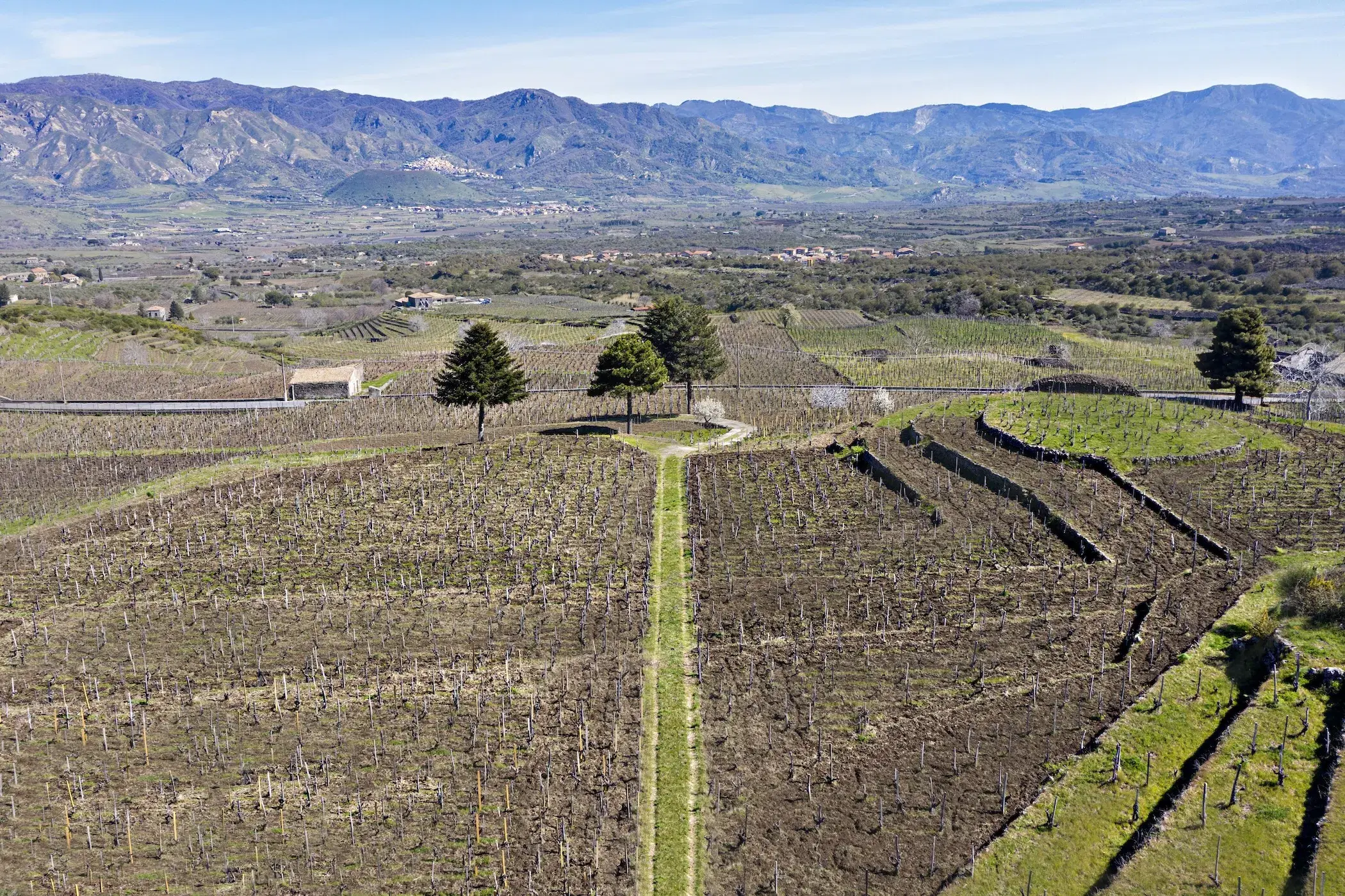
The drive up Long Ranch Road is the first clue that this is not valley-floor Napa. OVID sits at 1,349 feet. Pritchard Hill is the familiar name for this part of the eastern mountains, though it is not an official American Viticultural Area. The estate looks across the valley toward the Mayacamas and, on a clear day, far beyond. During our tasting, bands of cloud and fog moved across the view, making the elevation feel even more dramatic.
The second clue is underfoot. OVID's soils derive from volcanic basalt, andesite, and sandstone formed roughly three to nine million years ago. The Hambright-series topsoil can be only six to twelve inches deep. Large stones are not occasional interruptions; they are the site. The winery appears to emerge from a cut in the same red-orange material.
Austin showed us how color changes across the property. Darker red and orange soils have weathered farther from the parent rock. The younger, more yellow material lies closer to it. OVID associates much of its Cabernet Franc with those yellow soils, while Cabernet Sauvignon has a strong relationship with the rustier iron-oxide ground.

The site has long sunlight and cooling, drying breezes that travel north from San Francisco Bay. OVID farms organically and publicly describes using irrigation only once or twice in a season. The important point is restraint: the vines work in shallow, rocky ground with little help, and the farming seeks to reveal rather than erase that pressure.

David Abreu planned and planted OVID's original vineyard in 2000. Those first vines established what Austin described as phase one: approximately 15 planted acres and the foundation for the estate wines. But the team does not treat that first layout as the final answer.
Phase two added roughly 18 acres and turned the vineyard into a long-term study. Austin walked us through row-spacing trials that included 7-by-4, 8-by-4, and 10-by-5 configurations. Those numbers sound abstract until you stand among the vines. Spacing changes how each plant competes for water, how much canopy and fruit it can carry, how air moves through the row, and how equipment and people work the block.
Some of the younger Cabernet Sauvignon vines were planted with higher graft unions. The choice creates optionality. If Cabernet Franc or another variety ultimately proves better suited to a particular piece of ground, the team can graft the established vine rather than begin again from the roots.
Austin called the current work a third phase: not merely planting more, but doing it better. The broader property Austin described, roughly 300 acres in total, leaves room to ask what OVID could become over a century rather than what will maximize the next release. That time horizon was among the more compelling ideas of the visit. At an established luxury winery, experimentation can easily become a story told after the conclusions are known. Here, we saw trials whose answers may not be clear for decades.
Austin joined OVID in 2006 as an enologist under founding winemaker Andy Erickson and became winemaker in 2010. He is now General Manager and Head Winemaker. A Sonoma native and the son of a winemaker, he has spent almost his entire professional career learning this one property.
Twenty years matters because OVID began without a cellar of precedent. There was no established recipe for how one-acre blocks on this rock plateau should be fermented, blended, or aged. Austin told the story of his father teaching him that great winemaking requires constant experimentation. At OVID, that principle became infrastructure.
The vineyard walk was not a memorized explanation handed down to a hospitality team. Austin could describe why a block was planted the way it was, what the team had learned, where an idea had failed, and what they might change next. He was candid about risk. That made the wines feel less like polished endpoints and more like the current best answers in an ongoing body of work.
The winery's architecture, designed by Howard Backen, is quiet from the outside and deeply functional within. The production floor opens around polished steel tanks, concrete, warm wood, and a long central axis leading toward the barrel rooms. Nothing about it feels oversized for the sake of theater.

Austin described concrete tanks in 2-, 3-, and 4-ton capacities so different pieces of the vineyard can stay separate. He told us that the fabricators had also worked on the concrete cellar at Pétrus. The name is striking, but the more useful point is scale: OVID wants vessel choices that match small vineyard lots rather than forcing the vineyard to match the tank.
The same comparative thinking continues in barrel. The team works across larger and smaller formats, roughly nine or ten coopers, two toast levels, and six single-forest selections. Austin described the current program as approximately 50 percent new oak. Native fermentation is part of the approach, but the cellar is not dogmatic. The goal is to learn which combination gives each lot definition without allowing the vessel to become the dominant flavor.


The barrel room feels quiet and ordered, with rows of casks under warm pendant bulbs and a bright opening back toward the vineyard. Nearby, the library feels more like an archive of questions than a conventional trophy cellar. Tagged bottles and wrapped samples line wood shelves around a central cabinet. The room makes the winery's memory visible.


The tasting room sits at the other end of that work. Wood beams and black steel frame glass walls overlooking the valley. A long table was set with multiple glasses, vineyard maps, notebooks, metal spittoons, and the materials for Vanessa's sensory exercise. Outside, Adirondack chairs and a circular fire pit face the same expansive view.

The room is luxurious without losing the feeling of a working winery. Books fill the low shelves. The vineyard sits immediately behind one wall. Bottles and maps remain on the table as tools, not props. With Austin and Vanessa leading the appointment, the setting encouraged questions rather than ceremony.
Among the more unusual details was an olfactory reset using sheep’s wool. It was a small, almost eccentric gesture, but it captured the experience perfectly. OVID wanted us to notice how our senses were changing, not simply move from one expensive bottle to the next.
Vanessa Conlin became a Master of Wine in 2020. Her career has moved through restaurant wine buying, leadership roles at Arietta and Dana Estates, Wine Access, and Sotheby's. Before wine, she was a professional musician and earned a master's degree in music. That background makes sense in a sensory exercise built around separating individual elements, then hearing how they work together.
The table held an OVID / FLWR scent vocabulary sheet and paper strips labeled lavender absolute, anisaldehyde, ho wood, white sage, and bay laurel.

The exercise made aroma more concrete. Instead of reaching immediately for familiar wine words, we could smell one material in isolation, decide whether it felt floral, anisic, woody, leafy, cool, resinous, or something else, and then return to the glass with a sharper vocabulary. It was serious without becoming intimidating.
It also fit the estate unusually well. OVID's wines are built through comparison: soil colors, grape varieties, vineyard spacings, tank capacities, barrel sizes, forests, toasts, and blends. Vanessa's exercise applied the same method to our own perception. Break a complex thing into components, pay attention, and then put it back together.

It was a smart progression: an exuberant multi-variety white, a red built around a whole-cluster Merlot question, Cabernet Franc-focused Hexameter, and the Cabernet Sauvignon-led flagship.

W11.4 was the clearest proof that the Experiment program is allowed to be genuinely experimental. The wine combined nine grapes from four California appellations:
The blend is precise enough to read like a laboratory record, yet its purpose is pleasure. For us, W11.4 was especially unexpected wine in the flight: aromatic and exuberant, but with enough texture and freshness to keep nine varieties from feeling crowded. It widened the frame before we moved into the reds. OVID's official notes describe white peach, lychee, passion fruit, lavender, rose petal, croissant, Jordan almond, and Gravenstein apple. The lineup made an important point immediately: OVID may be known for mountain Cabernet, but the team is interested in what each experiment can teach, even when the fruit comes from non-estate vineyards and the answer changes completely the next year.
M2.3 asked a narrower red-wine question. The label records 44.16 percent Cabernet Sauvignon, 42.29 percent Merlot, 6.86 percent Petit Verdot, and 6.69 percent Cabernet Franc. OVID fermented a portion of the Merlot as whole clusters, then blended it back at pressing.
M2.3 felt more playful than the estate reds that followed, fragrant, energetic, and intentionally exploratory. That made the transition into Hexameter especially revealing. It is exactly the kind of controlled risk the Experiment program exists to explore. Whole clusters change structure, aroma, and the expression of the Merlot. OVID's published notes move through black cherry, plum, raspberry, lilac, currant, and molasses, followed by white peppercorn, lavender, and chamomile. Whether or not that method becomes part of another wine, the bottle preserves the question and its result.
Hexameter is OVID's Cabernet Franc-focused estate wine. Its name refers to the meter used in Metamorphoses, and its origin connects directly to the Experiment program: a 2005 trial was compelling enough to be refined over four years and eventually given a permanent place in the portfolio.
Of the two estate reds, Hexameter was particularly immediately distinctive to us: the Cabernet Franc brought lift, spice, and savory detail without losing the site's power. The 2023 was especially appropriate to taste with Vanessa because OVID credits her with its official notes. She described star anise, cinnamon, preserved orange peel, bergamot tea, black cherry, sage, and fresh-ground coffee, with espresso, cherry preserves, and a cast-iron mineral note through the finish. The wine spent 21 months in barrel and came from the estate's shallow Hambright soils.
Hexameter also gave the soil discussion a glass. OVID associates Cabernet Franc with younger, more yellow soils nearer the parent rock. The wine is not a fixed 60 percent Cabernet Franc formula; it is a Cabernet Franc-led expression whose blend can change with the vintage.
The flagship brought the visit back to the estate's core. OVID is a Cabernet Sauvignon-based red, with Cabernet Franc providing a counterpoint and smaller amounts of Merlot and Petit Verdot completing the blend. The winery vinifies the vineyard in small sections, makes blending decisions through repeated tasting, and then gives the final wine time to integrate.
The 2023 OVID felt like the synthesis of the day, darker and more architectural than the Experiment wines, but not heavy. Its scale made more sense after seeing how rigorously the estate separates blocks and tests élevage. We tasted it at the end of a day spent looking at the vineyard blocks, vessels, barrels, and maps behind it. That sequence mattered. The bottle no longer represented one generalized idea of "Pritchard Hill Cabernet." It connected to a specific 1,349-foot site, a thin Hambright soil profile, Austin's two decades of decisions, and an estate willing to keep testing what its flagship can become.
OVID combines three things that rarely arrive with equal force.
First, the setting is extraordinary. The rock plateau, glass tasting room, fog, vineyard, and long view across Napa Valley create a genuine sense of place. The property feels remote even though it is reached from St. Helena.
Second, the access was meaningful. Touring with the winemaker who has worked here since 2006 gave us a direct line from each vineyard and cellar choice to the wine. Vanessa added a different kind of expertise, turning the tasting into an exercise in how we perceive aroma rather than simply telling us what we should smell.
Third, the experimentation is real. A nine-grape white and a whole-cluster Merlot trial are not marketing variations on the flagship. Different vineyard spacings, graft strategies, concrete capacities, barrel sizes, coopers, toasts, and forests represent years of questions, some of which may not pay off. That willingness to learn is the source of OVID's confidence.
This was one of those Napa visits that changed how we will understand the wine when we open it later. We will remember Austin examining clusters under yellow leaves, the red-orange rock around the winery, Vanessa passing perfume strips across the table, and four bottles lined up over a vineyard map. OVID is luxurious, but its most persuasive luxury is time: two decades already invested in the site and a willingness to keep asking what it can become over the next hundred years.
OVID receives guests by appointment at 255 Long Ranch Road in St. Helena. Appointments are private and advance reservations are required. OVID members should sign into Tock using the email connected to their membership to see full availability. The winery lists 707-963-3850 as its phone number and reservations@ovidnapavalley.com for private-event inquiries. Collectors seeking an OVID-focused appointment should contact the estate or email concierge@enprimeurclub.com.
Allow time for the drive up the hill and do not stack the appointment tightly between valley-floor tastings. The road and elevation are part of the experience. A visit this technical also rewards attention. Ask about the current Experiment wines, the vineyard phases, and the barrel trials rather than arriving only to compare labels.
OVID offers the beauty expected from a top Napa estate, but the reason to book is deeper: it lets you see a great winery thinking in public.
OVID is a small-production estate on the western edge of Pritchard Hill, best known for its Cabernet Sauvignon-led OVID red, Cabernet Franc-focused Hexameter, and limited Experiment wines. The project emphasizes organically farmed estate fruit, one-acre vineyard blocks, small-lot winemaking, and continuous experimentation.
OVID is at 255 Long Ranch Road in St. Helena, California. The estate sits at 1,349 feet on the western edge of the area commonly called Pritchard Hill. Pritchard Hill is a geographic name, not an official AVA.
Yes. OVID offers private visits by appointment through Tock. Members should sign in with the email connected to their OVID account to see full availability.
Austin Peterson is OVID's General Manager and Head Winemaker. He joined the estate in 2006 as an enologist under Andy Erickson and became winemaker in 2010.
Hexameter is OVID's Cabernet Franc-focused estate wine. It began with a 2005 Experiment and takes its name from the poetic meter of Ovid's Metamorphoses. The blend changes by vintage and can include other Bordeaux varieties.
OVID Experiment wines are limited releases that explore specific vineyard or cellar questions. The grapes, blends, and methods change. Successful experiments can influence the main estate program; Hexameter began this way.
Our August 13, 2026 tasting included 2024 Experiment White W11.4, 2023 Experiment Red M2.3, 2023 Hexameter, and 2023 OVID Napa Valley.
The Duncan family, owners of Silver Oak and Twomey, acquired OVID in 2017. OVID was founded by Mark Nelson and Dana Johnson, and the Duncan family retained the existing vineyard and winemaking team.
Get the App
Take the shortlist into the En Primeur Club app for concierge access, saved places, and the next step after discovery.
Get Exclusive AccessMore from the editors