← Guides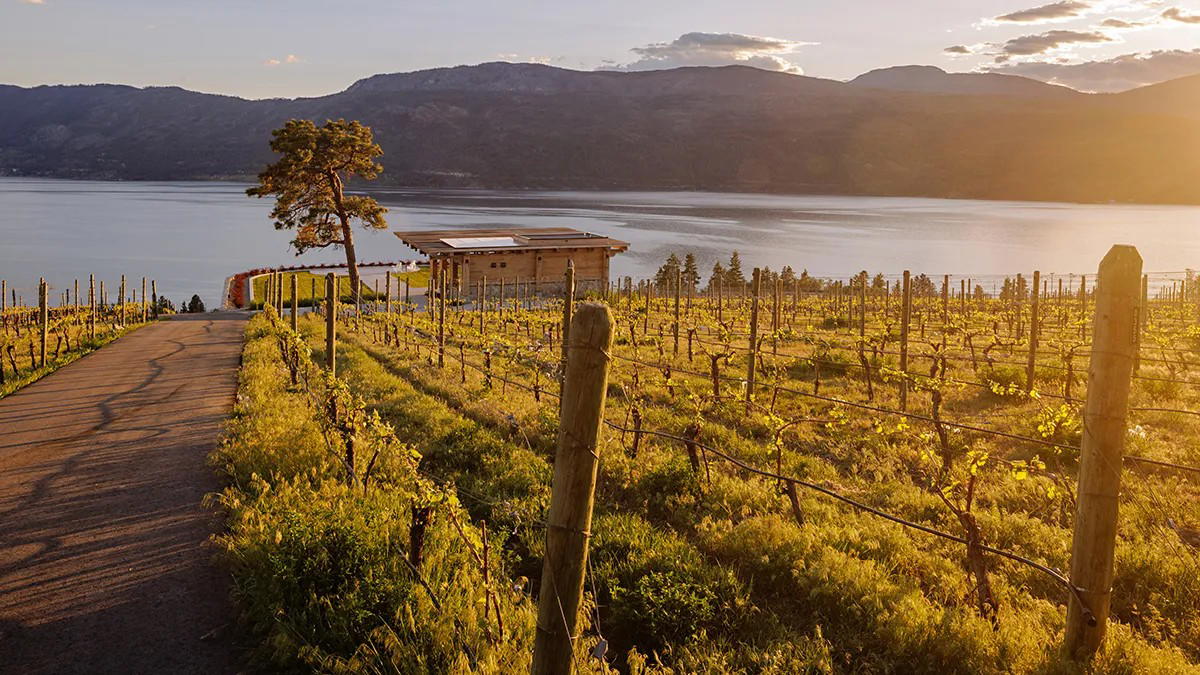
O'Rourke Family Estate's clifftop Kelowna winery, opened summer 2026, marks a new scale of luxury capital reshaping British Columbia's Okanagan Valley.
O'Rourke Family Estate's clifftop Kelowna winery, opened summer 2026, marks a new scale of luxury capital reshaping British Columbia's Okanagan Valley.
A Rolls-Royce Spectre E.V. rolled directly into a wine cave this year, not in Napa, not in Bordeaux, but in Kelowna, British Columbia, where O'Rourke Family Estate hosted a client event for the marque shortly after its grand opening in summer 2026. The estate had been more than a decade in the making, according to Robb Report. That single image, a six-figure electric grand tourer parked among barrels of Pinot Noir on the shores of Okanagan Lake, says more about where Canada's wine country is headed than any tasting note could.
The Okanagan Valley sits roughly a 45-minute flight from Vancouver, a detail that matters more than it might seem. Proximity to a major international gateway has quietly turned a region once known mostly to Canadian weekenders into a target for the kind of capital that built Napa's second act, hospitality-scale wineries designed as destinations first, vineyards second. O'Rourke Family Estate is the clearest evidence yet that the shift is real, and it's not the only project raising the region's profile.
British Columbia's oldest winery dates back to 1918, but the Okanagan Valley itself didn't receive official regional wine designation until 2015. That's a long gap, nearly a century between the first vines and formal recognition, and it explains why the region has spent decades building credibility one vintage at a time rather than through marketing campaigns. Today the valley counts roughly 200 wineries spread along the shores of Okanagan Lake, a number that has grown steadily as producers have proven the terroir can compete on quality, not just novelty.
What's changed recently isn't the wine itself so much as who's investing behind it. Kelowna, on the lake's eastern shore, has become the epicenter of a new wave of capital, money that's funding not just vineyards but full hospitality campuses with restaurants, event spaces, and guest suites attached. It's the same playbook that turned Napa from a farming valley into a global luxury circuit, and it's arriving in the Okanagan roughly four decades after Mission Hill Family Estate first planted the flag for ambition here in 1981.
For collectors and luxury travelers who've already exhausted the usual Napa-Bordeaux-Burgundy circuit, that timing matters. A region with 200 producers and a single century of formal wine history offers something increasingly rare: genuine upside before prices catch up to reputation.
The valley's climate is part of the draw too, it sits among the northernmost winemaking regions in the world, with diverse microclimates and soils running the length of the lake, from the warmer southern reaches near Osoyoos to the cooler benches around Kelowna and Lake Country where Pinot Noir and Chardonnay perform best.
That range is precisely why a region this size can support 200 distinct producers without repeating itself, a Naramata bench Pinot Noir tastes nothing like a Golden Mile Bordeaux blend grown fifty miles south.
The capital now arriving doesn't just build wineries, it builds infrastructure around them. Airport routes, boutique hotel development, and lakefront dining have all expanded in step with the wine industry's reputation, each reinforcing the others. A traveler who once had to choose between a wine trip and a lake vacation can now book both in the same long weekend, a convenience that Napa spent decades engineering and that the Okanagan appears to be compressing into a much shorter window.
| Winery | Location | Founded/Opened | Signature Wines | Notable Feature |
|---|---|---|---|---|
| O'Rourke Family Estate | Kelowna, Okanagan Lake (east shore) | Opened summer 2026 | Pinot Noir, Chardonnay | 220,000 sq ft hospitality campus; hosted Rolls-Royce Spectre event |
| Mission Hill Family Estate | Westbank, Okanagan Valley | Founded 1981 | Chardonnay, Bordeaux blends | Regarded as the region's original luxury winery pioneer |
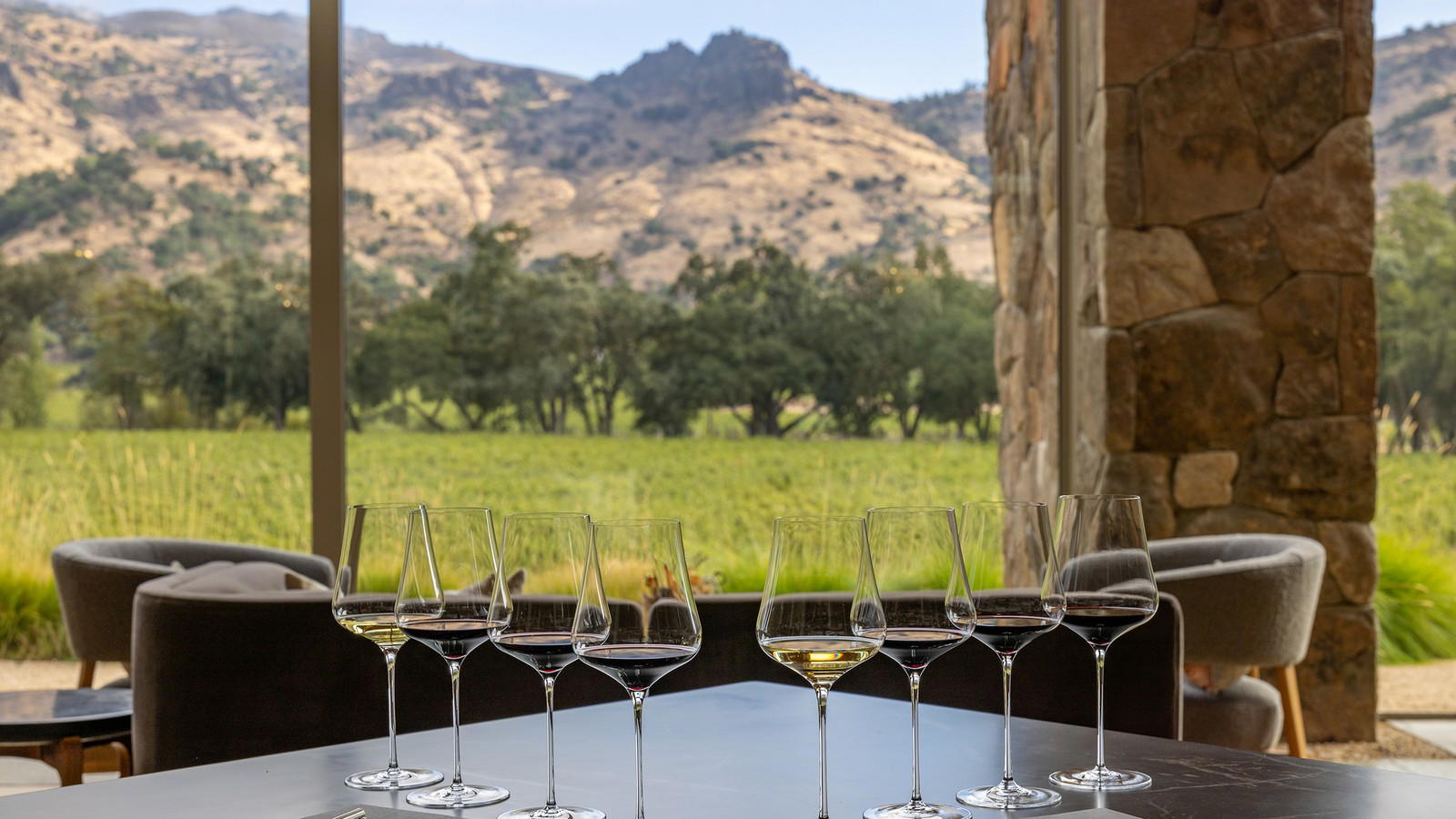
Dennis O'Rourke made his money in construction, and it shows in the scale of what he built. O'Rourke Family Estate spans 220,000 square feet of interior space across multiple buildings, a footprint that puts it in a different category from the tasting-room-and-barrel-shed model most Okanagan visitors know. The estate produces primarily Pinot Noir and Chardonnay, and the property was designed around, and literally inside of, a granite outcropping that predates the vineyard by millennia.
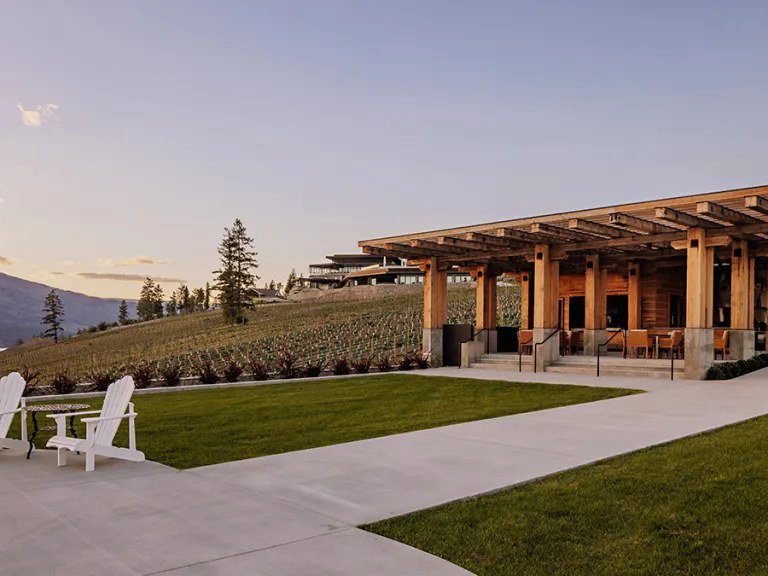
Architect John Taft of Backen & Backen, a firm with a client list that includes a number of West Coast wineries as well as the Beverly Hills home of Ashton Kutcher and Mila Kunis, built the campus in direct conversation with that geology. "This is the geology of the space," Taft said. The rock "is that monolith left over from glaciation, but it is also what is in the vineyard, that rock and everything is what makes their vines struggle, which is, of course, what makes, intense and great fruit."1 It's a rare case where the architectural concept and the winemaking argument are the same rock, the outcropping that forces roots to struggle underground is the same one that shapes the buildings rising above it.
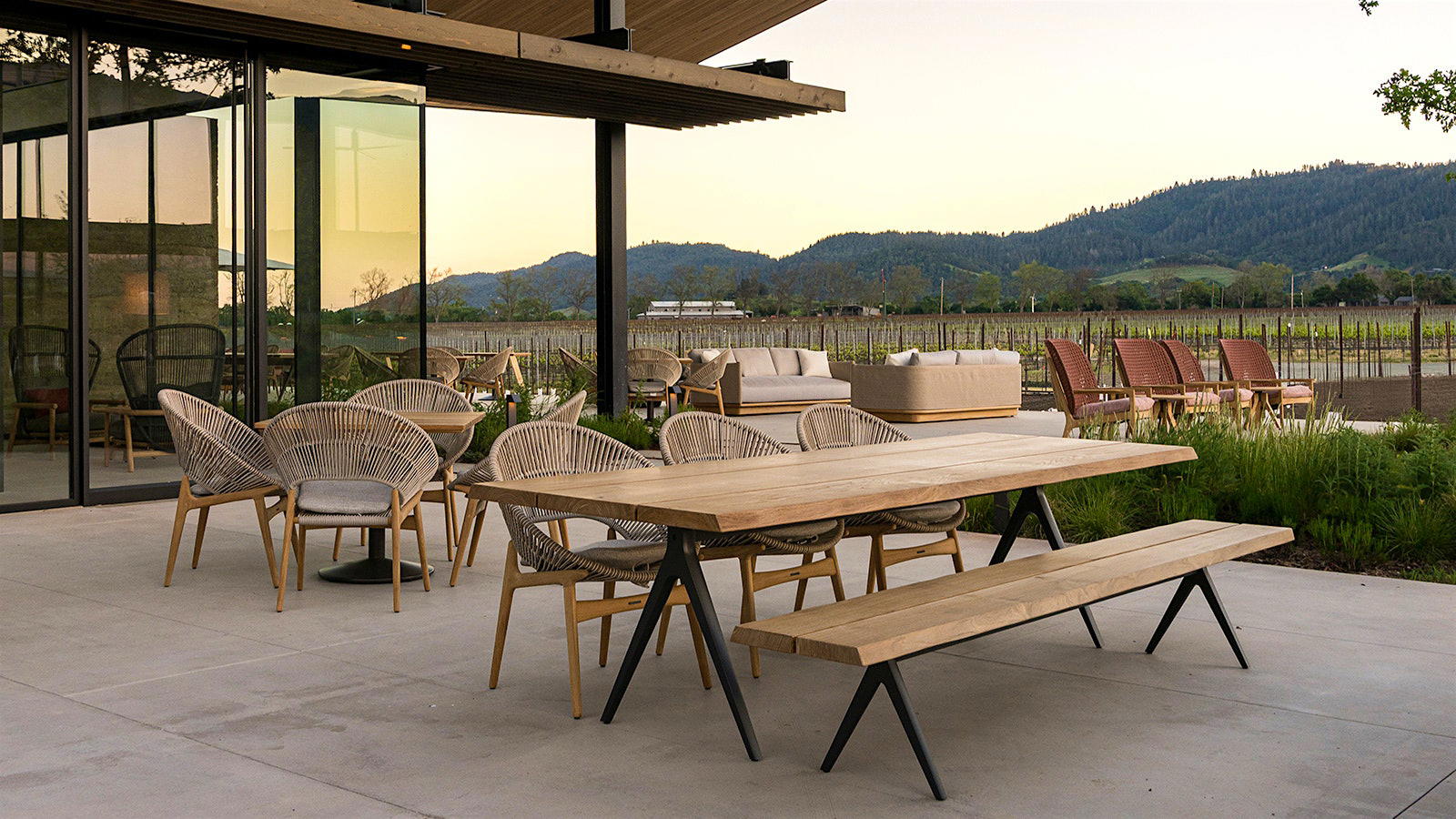
The hospitality build-out reflects that same ambition. Guests can dine at the fine-dining restaurant Row 188 or opt for the more casual Granite Café, and event spaces range from small private rooms to a concrete amphitheater with sweeping, south-facing views over the valley, built to host gatherings of hundreds.
Currently the estate has 23 bedrooms, including four private suites inside the Owners House, part of a property designed to grow well beyond its current footprint.
The scale is deliberate: this isn't a producer adding a guest cottage to an existing tasting room, it's a hospitality campus conceived from the ground up, with winemaking as one program among several.
That full-service ambition is already drawing a clientele accustomed to five-star treatment elsewhere. The Rolls-Royce client event, during which the marque drove its Spectre E.V. directly into the wine caves, wasn't an incidental booking. It's a signal of the kind of brand partnership the estate is positioned to attract: luxury automotive, hospitality groups, and private clients who expect the same caliber of experience they'd find at a Napa cult winery or a Bordeaux château tasting arranged through a private broker.
For O'Rourke, the decision to pour construction-industry capital into a winery rather than traditional markets was personal. "I don't have much fun sending my money to New York, to investment bankers, and looking at it down there," he said. "I have much more fun building something, creating something."2 That instinct, building rather than banking, is precisely what's driving the wave of investment reshaping Kelowna's waterfront, and it explains why a construction entrepreneur, rather than a traditional vintner or wine conglomerate, is the one setting the pace for the region's next decade.
Details:
Row 188 is O'Rourke Family Estate's fine-dining anchor, open Friday through Sunday evenings, a deliberately limited schedule that keeps the room feeling reservation-worthy rather than a tourist-bus stop. Paired with the property's Pinot Noir and Chardonnay program, it's built for the kind of guest who wants the granite-outcropping story explained tableside, not just read off a placard.
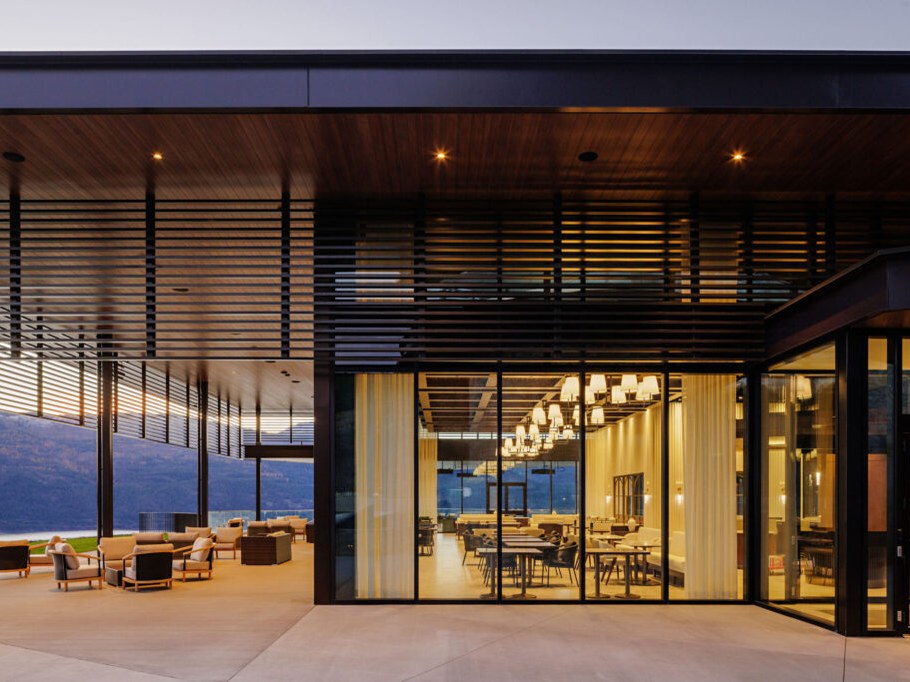
Expect the more casual Granite Café to handle daytime and drop-in visits, while Row 188 carries the evening service, a split that mirrors how larger Napa estates now separate quick tasting-room traffic from a slower, seated experience. The pairing lets first-time visitors sample the estate two ways in a single trip: a relaxed lunch on the terrace overlooking the vineyard rows by day, followed by a formal seated dinner once the light over Okanagan Lake starts to fade.
Details:
Long before O'Rourke broke ground, Anthony von Mandl, the billionaire founder of White Claw and Mike's Hard Lemonade, was making the same bet on the Okanagan. In 1981, he established Mission Hill Family Estate, one of the first wineries in the region, decades before regional designation arrived in 2015.
Mission Hill's amphitheater and architectural presence on the hillside above Okanagan Lake have made it a landmark destination in its own right, hosting a summer concert series that draws visitors well beyond the usual wine-tasting crowd, evenings when the lake catches the last light and a full moon rises over the amphitheater seats as the music starts.
Mission Hill matters to this story not as a competitor to O'Rourke but as proof of concept. Von Mandl demonstrated four decades ago that the Okanagan could support architecture-forward, event-driven hospitality alongside serious winemaking, and that visitors would travel for it.
O'Rourke Family Estate is the newest and largest expression of that same bet, but it's building on ground Mission Hill already proved could hold weight.
Where Mission Hill spent forty-five years establishing that Okanagan wine could draw a global audience, O'Rourke is testing how far that audience's expectations for scale and polish can be pushed in a single opening season.
For visitors plotting an Okanagan itinerary, pairing the two makes sense chronologically as much as geographically: Mission Hill for the region's founding luxury landmark, O'Rourke for its newest and most ambitious. Between them sits roughly the full arc of the Okanagan's transformation from cottage-country wine stop to a destination drawing comparisons to Napa and Bordeaux.
Details:
Rounding out the tier of estates worth booking alongside O'Rourke and Mission Hill is Martin's Lane, situated on Lakeshore Road in Kelowna's Mission district. It's part of the same wave of architecture-led winery development that's redefined what a Kelowna tasting appointment can look like, gravity-flow winemaking and a building designed as much for the view over Okanagan Lake as for the barrel room beneath it.
Martin's Lane fits naturally into a two- or three-estate day trip along the lake's eastern shore, giving visitors a range of architectural styles and hospitality formats within a short drive of downtown Kelowna. Where O'Rourke leans into scale and Mission Hill into legacy, Martin's Lane offers a third register entirely, a tighter, more understated approach to the same terroir story, proof that the region's new investment wave isn't producing one template but several.
Details:
The math for luxury travelers is direct: a region with roughly 200 wineries, a 45-minute flight from a major international airport, and a new wave of capital building hospitality infrastructure that didn't exist five years ago. O'Rourke Family Estate alone represents a scale of investment, 220,000 square feet, a full restaurant program, event spaces built for hundreds, that simply wasn't part of the Okanagan conversation a decade ago.
Land and investment values along the lake have moved accordingly, tracking the same pattern that reshaped Napa's Silverado Trail once architecture-forward estates started arriving alongside the original family wineries. For collectors, that pattern, regions where serious capital follows serious terroir rarely staying under-the-radar for long, is the signal to track. The Okanagan's Pinot Noir and Chardonnay have already earned steady attention from sommeliers in Vancouver, Toronto, and Calgary; what's new is the hospitality infrastructure now built to match.
There's also a practical argument for visiting before the region's full build-out arrives. O'Rourke Family Estate's current 23 bedrooms are only a fraction of its eventual footprint, and Mission Hill has spent decades cultivating a summer concert calendar that fills up well ahead of peak season. Booking now means experiencing both the established landmark and the newly opened flagship before either operates at full scale, a window that, in wine regions with this kind of momentum, tends to close faster than expected.
Booking a trip this year means catching the region at a specific moment, after Mission Hill has spent four decades proving the model works, and just as O'Rourke Family Estate, still expanding toward its full bedroom count, opens its doors for the first full season. That combination of an established landmark and a newly finished, ambitious build rarely lines up this cleanly in a wine region's timeline.
O'Rourke Family Estate is a 220,000-square-foot luxury winery in Kelowna, British Columbia, built by construction magnate Dennis O'Rourke and opened in summer 2026 after more than a decade of development. It focuses primarily on Pinot Noir and Chardonnay and was designed as a full hospitality destination rather than a traditional tasting-room winery.
The estate sits on the shores of Okanagan Lake in Kelowna, on the lake's eastern shore, within British Columbia's Okanagan Valley. The region is roughly a 45-minute flight from Vancouver, making it increasingly accessible for international luxury travelers.
The Okanagan Valley only received official regional wine designation in 2015, despite British Columbia's oldest winery dating back to 1918. That near-century gap explains why the region built its reputation gradually through vintage quality rather than marketing.
The Okanagan Valley is home to roughly 200 wineries spread along Okanagan Lake, ranging from established producers near Osoyoos to newer estates like O'Rourke Family Estate near Kelowna. Diverse microclimates along the lake allow this many producers to make distinctly different styles of wine.
Shortly after its 2026 opening, O'Rourke Family Estate hosted a client event for Rolls-Royce, featuring the marque's Spectre electric grand tourer displayed inside the estate's wine cave. The event signaled the estate's ambitions as a luxury hospitality destination, not just a winery.
Get the App
Take the shortlist into the En Primeur Club app for concierge access, saved places, and the next step after discovery.
Get Exclusive AccessMore from the editors