← Guides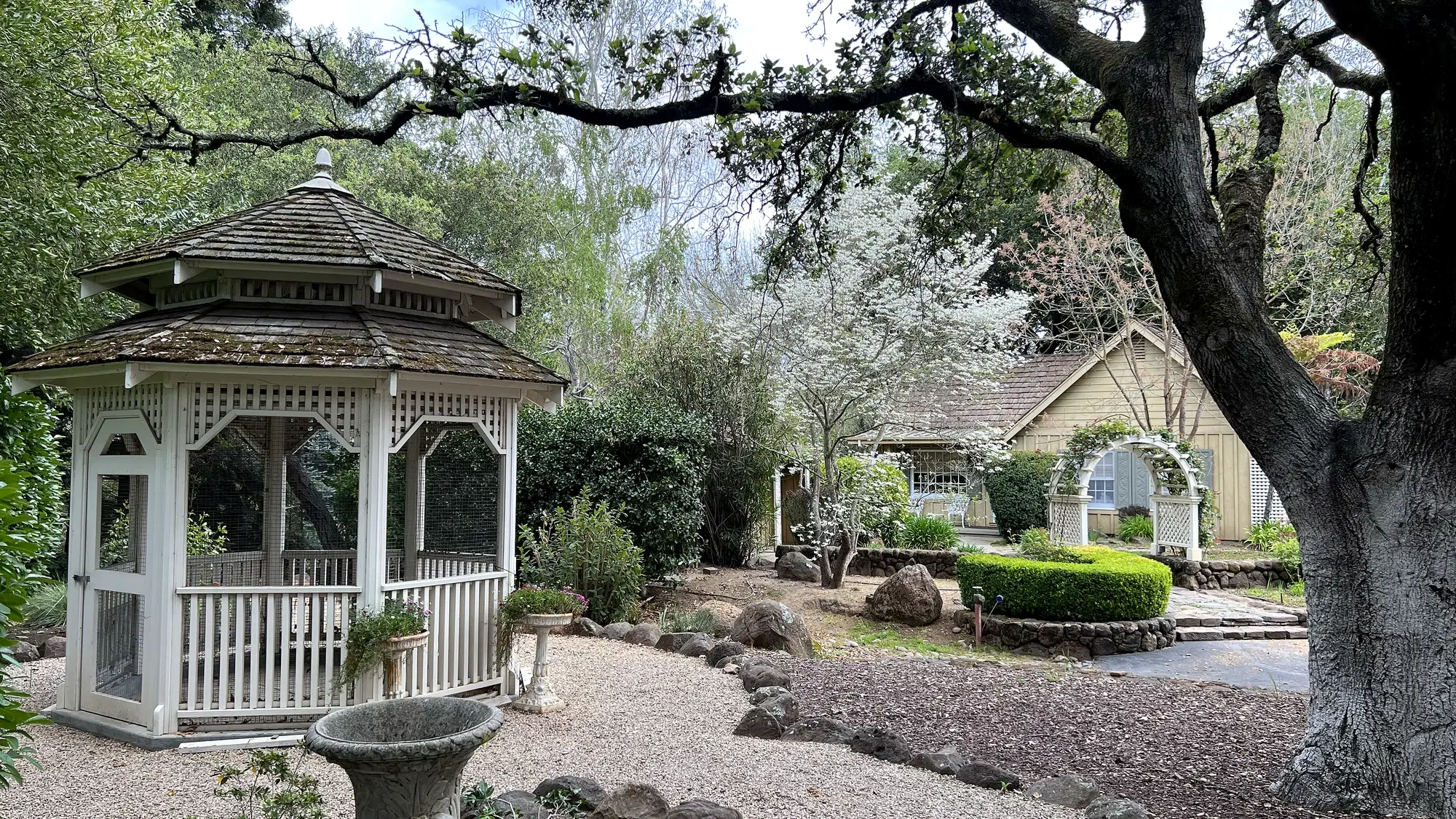
Across multiple member visits to Meadowbrook Farm, Craig led me from quiet Oak Knoll gardens to a hidden barn-loft railroad before Steve Matthiasson's restrained wines reached the table.
Across multiple member visits to Meadowbrook Farm, Craig led me from quiet Oak Knoll gardens to a hidden barn-loft railroad before Steve Matthiasson's restrained wines reached the table.
The room I remember most from Kanpai Wines did not contain a barrel, a fermentation tank or even a tasting table. It was hidden above a barn at Meadowbrook Farm, reached from the quiet gardens of a private Oak Knoll estate. Upstairs, an entire miniature railroad world wrapped around the walls: locomotives, freight cars, tiny buildings, wooded hills, bridges and industrial scenes rendered with the obsessive detail of a film set. We had come to taste wine. Suddenly, we were standing inside one of Napa Valley's most unexpected private collections.
That surprise captures what makes the Kanpai Wines estate experience so different. I visited Meadowbrook more than once as a Kanpai member; this article combines those visits into one cohesive account rather than reconstructing a single afternoon. Craig hosted me during these visits, moving easily between the gardens, the historic residence, the wines and the stories held inside the carriage house. Access came through my Kanpai membership, and the visits felt more like invitations into a family's home than appointments at a commercial tasting room.
The wines deserved that intimate setting. Winemaker Steve Matthiasson brings the balance, brightness and savory structure for which he is known, while owners Peter Chiang and Azumi Kubo give Kanpai its food-first hospitality and Japanese visual language. The result is a deeply personal Napa project whose bottles make more sense when you see the place, hear the family story and understand why each wine has a name rather than a conventional varietal-first identity.
Yes, enthusiastically, if the opportunity is available to you.
Meadowbrook Farm rewards a relationship with the producer. My estate visits were a Kanpai member benefit, with Craig as my host; Meadowbrook is not a conventional public tasting room. Kanpai's current visit page directs public guests to Vintner's Collective in downtown Napa. Anyone hoping to visit the estate should ask Kanpai directly whether member access is available for their date.
If you are invited, go. The combination of historic gardens, personal hospitality, Steve Matthiasson's restrained wines and the almost unbelievable hidden railroad room makes Meadowbrook memorable long after larger, more theatrical wineries begin to blur together. This is quiet Napa at its best: specific, generous and full of stories that reveal themselves slowly.
| Kanpai at a glance | What to know |
|---|---|
| Estate | Meadowbrook Farm in Napa Valley's Oak Knoll District |
| Owners | Peter Chiang and Azumi Kubo |
| Winemaker | Steve Matthiasson |
| Kanpai founded | 2017, after that year's Napa wildfires changed the family's plans for its fruit |
| Visit style | Private member-benefit visits hosted by Craig; current estate access must be confirmed |
| Current public tasting route | Vintner's Collective in downtown Napa; ask Kanpai directly about any estate access |
| Estate signature | Cool-climate Oak Knoll Cabernet with acidity, structure and savory detail |
| Most unexpected feature | An elaborate model railroad hidden above the carriage house |
| Best for | Collectors who value intimate hospitality, food-friendly wine and a sense of discovery |
| My verdict | Worth seeking out if you can secure the invitation |
My relationship with Kanpai began years before I stayed at Okaeri Calistoga, the Japanese-inspired inn created by the same family. Meadowbrook is where the larger world of the brand first made sense to me.
The word kanpai means “cheers” in Japanese, but Peter and Azumi use it as something warmer than a toast. In the family's telling, it represents celebration, togetherness and sharing life with people you love. Those ideas can sound abstract on a bottle. At Meadowbrook, they become practical. Wine is set on a table in the garden. Conversation has room to stretch. The owners' home, the orchard and the stories behind the labels become part of the tasting.
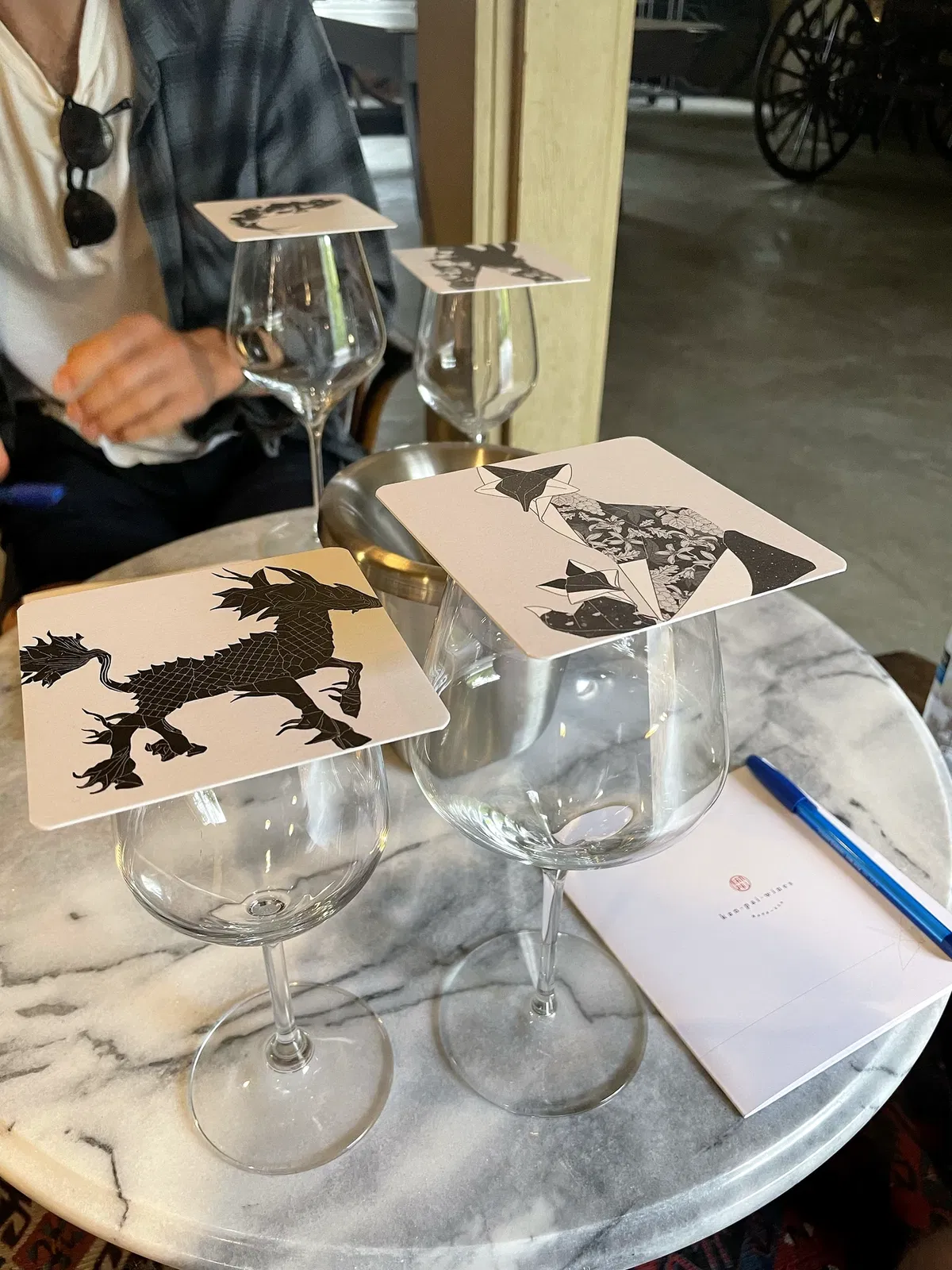
Across the photographs from those visits, one image shows the glasses set beside black-and-white cards carrying the same mythical animals that appear on the labels. Even before the bottles arrive, the table tells you that this is a producer interested in narrative. Kanpai does not separate what the wine tastes like from whom it is for, what food belongs beside it or what a symbol might mean to the family pouring it.
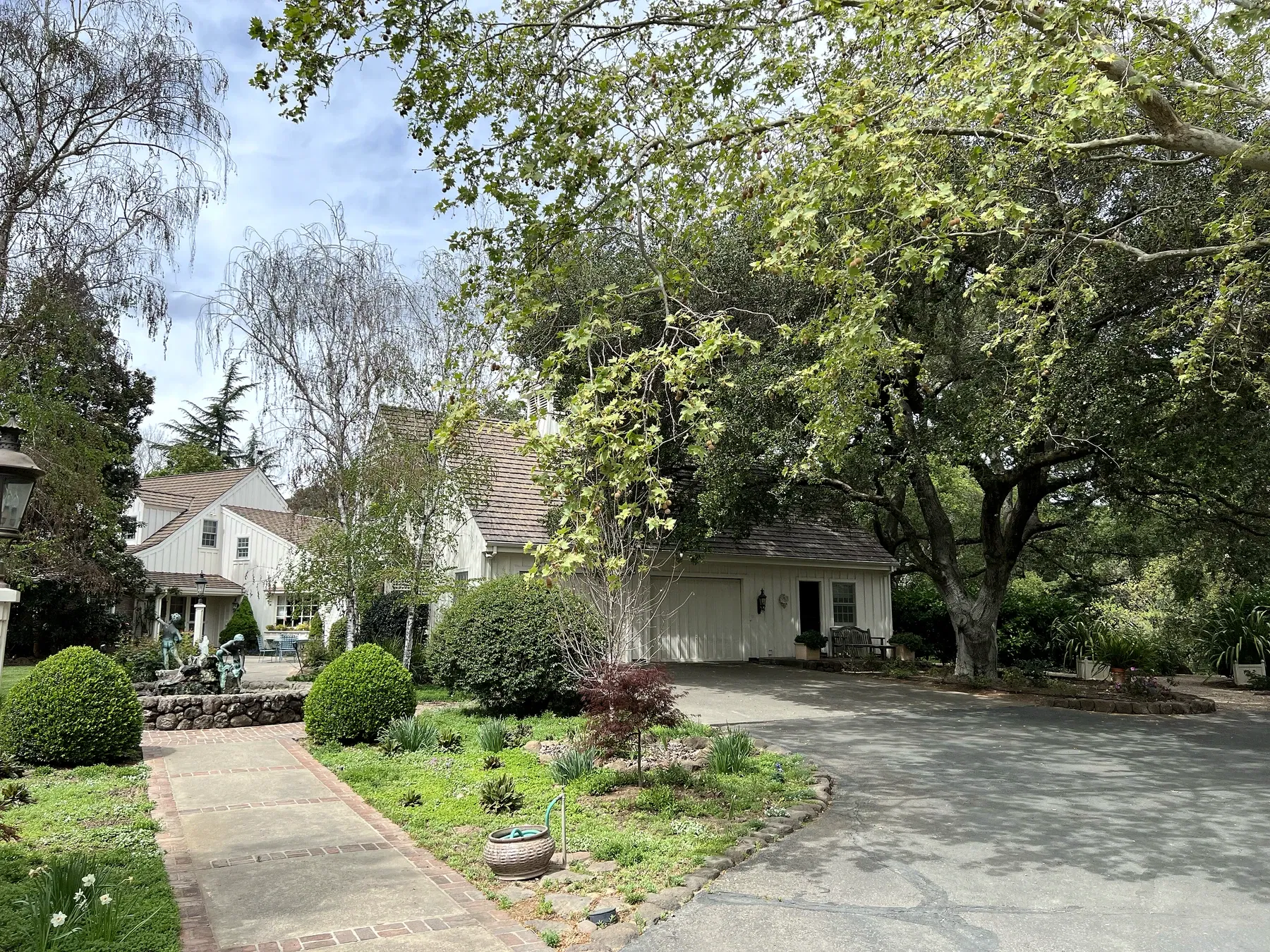
Meadowbrook Farm has no monumental winery façade. The approach is domestic and layered. A drive curves beneath mature trees toward the pale residence and its adjoining structures. Clipped boxwood, old stone edging, spring flowers, a gazebo and informal paths keep pulling the eye away from the buildings.
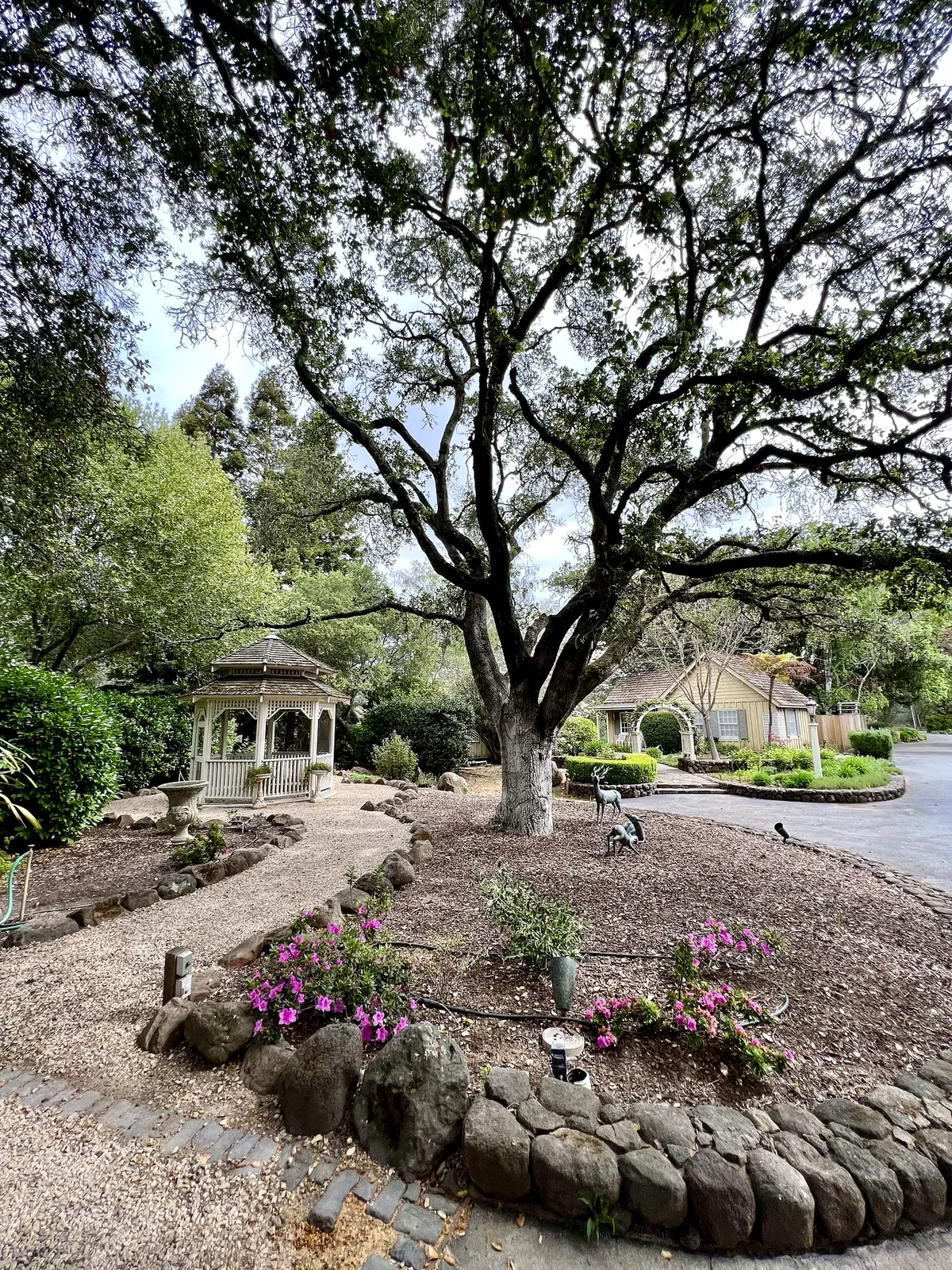
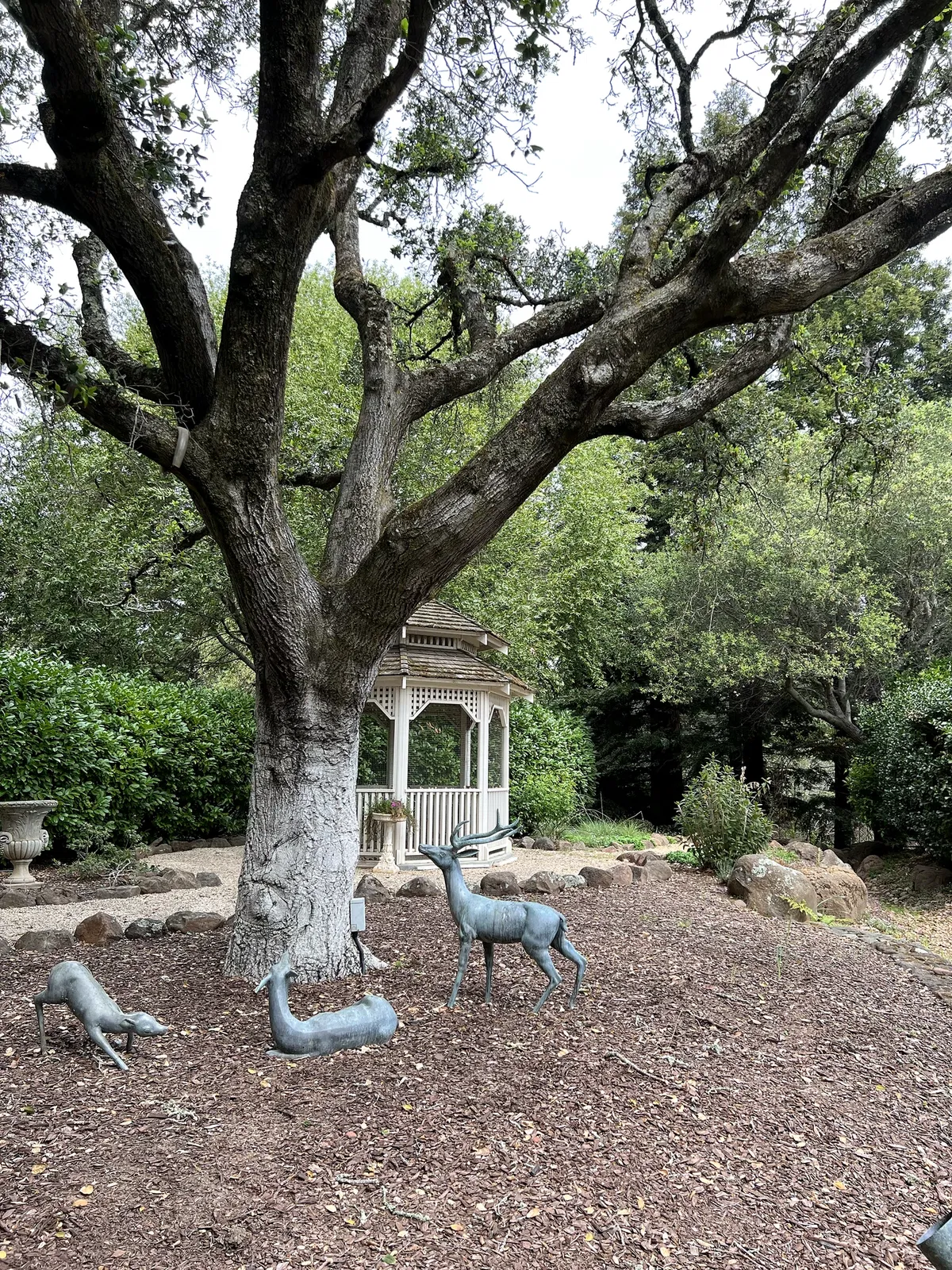
The atmosphere is especially beautiful in spring, when new green growth gives the property a softness that would be difficult to manufacture. A huge oak reaches over the garden. Flowering trees frame doorways. Sculptures of deer and other animals appear near the gazebo. The landscape feels accumulated rather than installed all at once.
That sense of age is important. Meadowbrook existed long before Kanpai. The current owners inherited a place with its own architectural and agricultural memory, then built a wine identity around living with it rather than erasing it. The family story, Japanese label art and Steve Matthiasson's winemaking now occupy an estate whose bones came from a different Napa era.
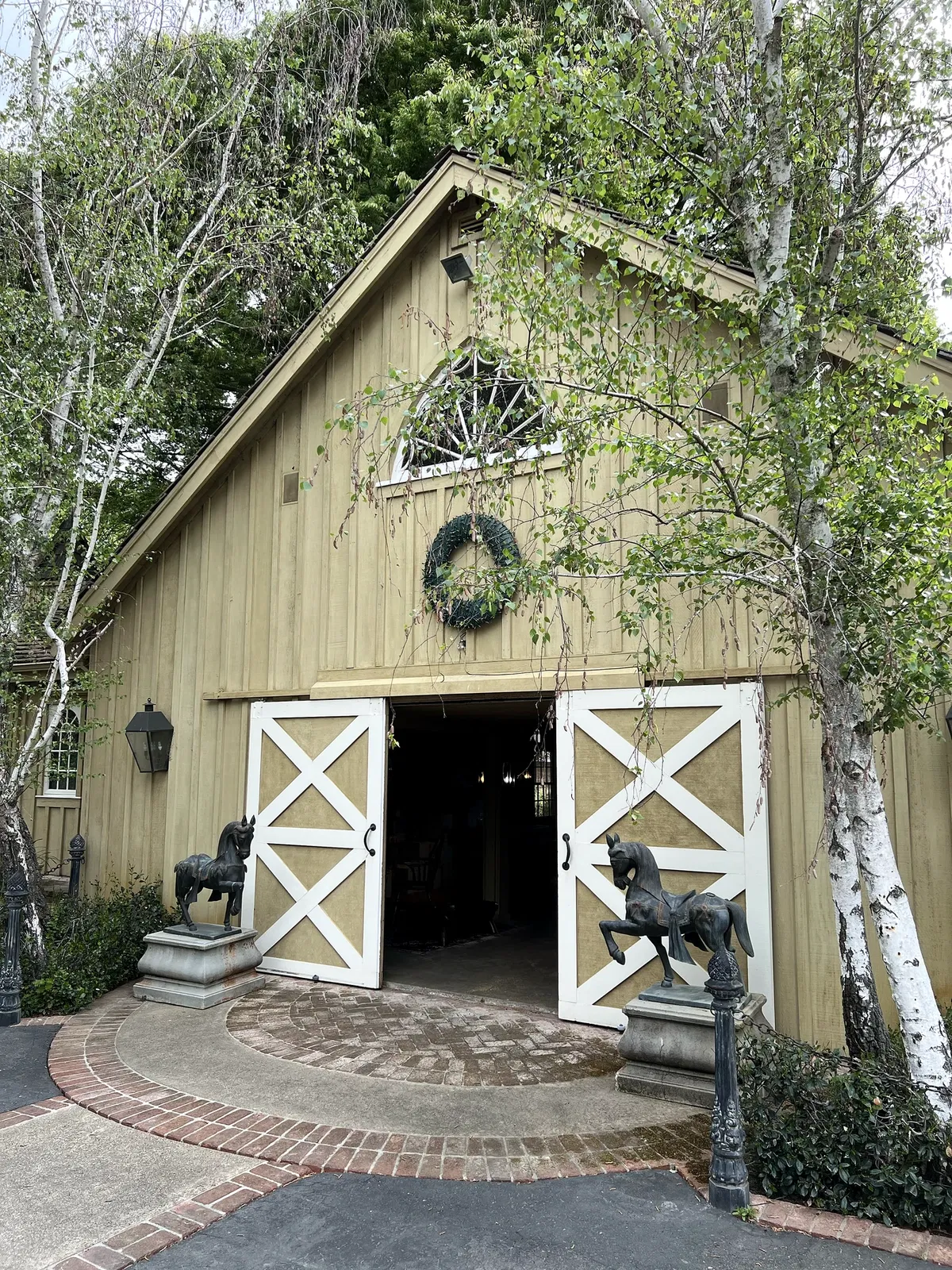
The carriage house is charming even before you know what is above it. The building has broad white cross-braced doors, pale weathered siding and bronze horse sculptures flanking the entrance. From the garden it looks like an elegant barn that belongs to the historic residence.
Then comes the reveal. Above a garage bay is a room devoted to an intricate model railroad. A drop-down staircase leads into the room. Inside, the installation runs along multiple walls beneath a curved ceiling, enclosed behind glass and framed by dark wood. Upholstered chairs line a central counter as if the room were built for long sessions of operating, watching and discussing the system.
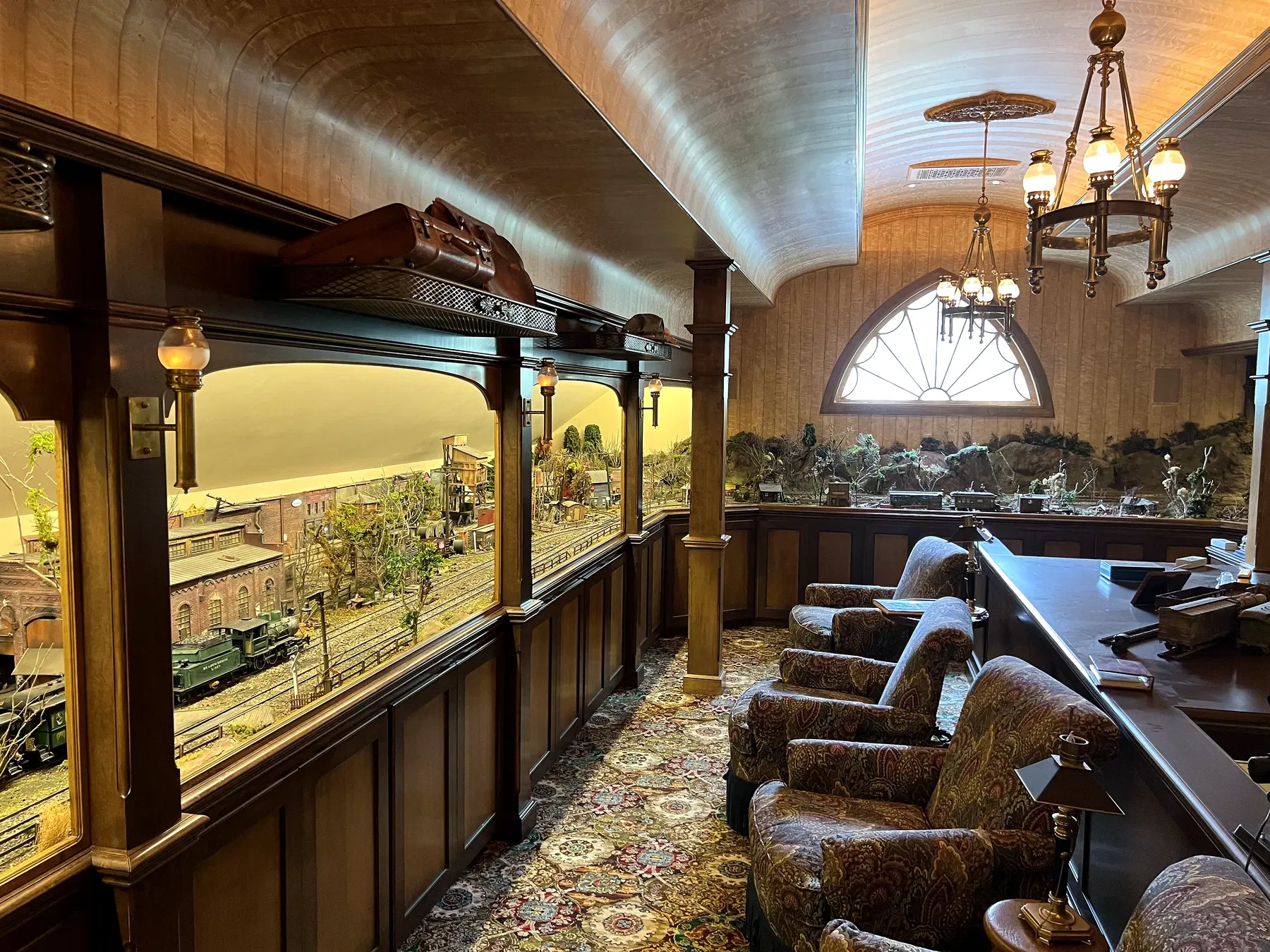
The scale is extraordinary. This is not a train circling a Christmas tree. It is a complete miniature environment with switching yards, commercial streets, weathered structures, mountain terrain, tunnels and freight traffic. Some cars carry Meadowbrook references, anchoring the fantasy to the estate itself.
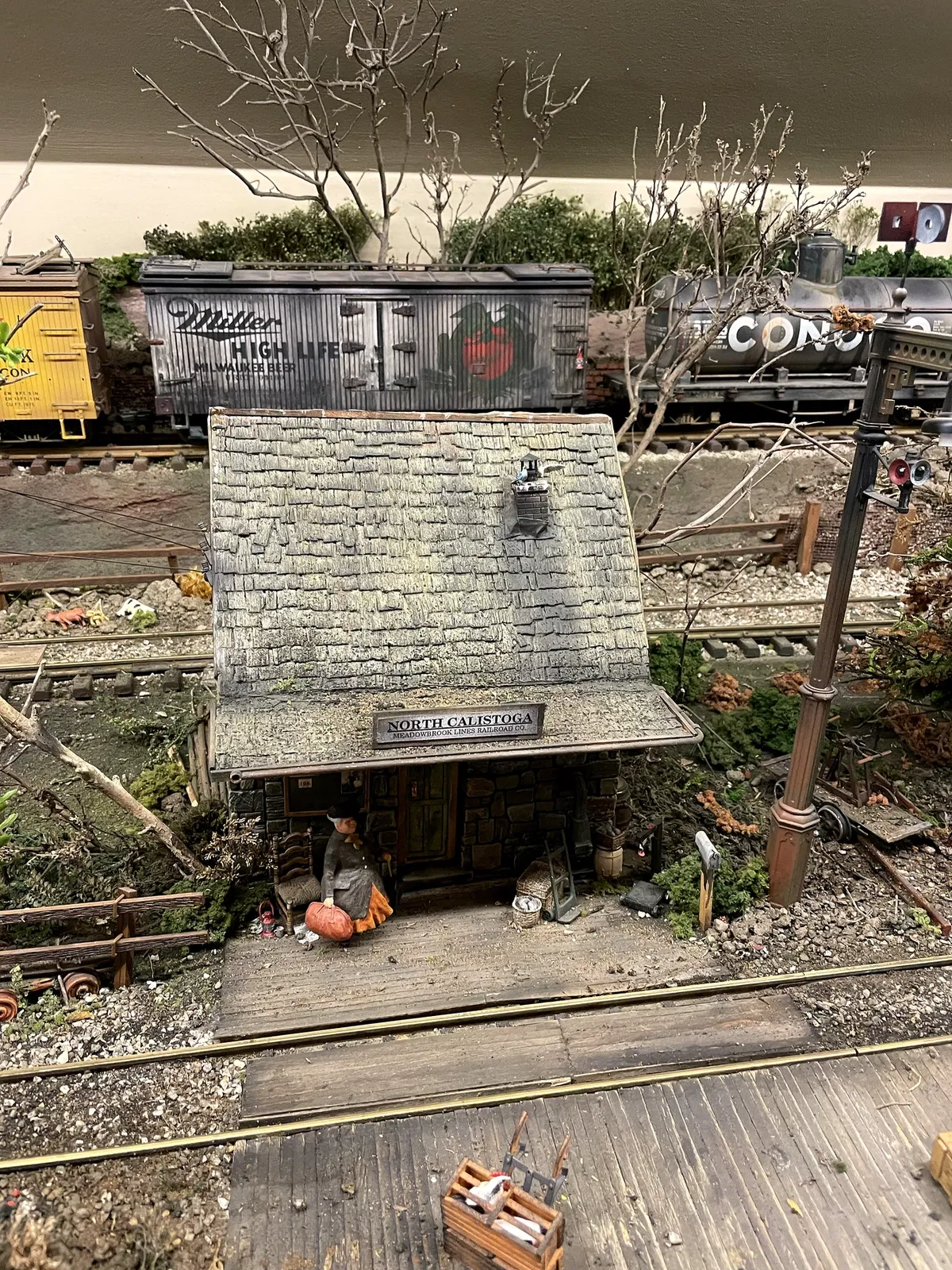
The railroad was commissioned by prior owner Ronald Birtcher, whose family development company had major business ties to Southern Pacific Railroad land. The train room was therefore personal history expressed as an immersive object.
This is the kind of detail that changes how a winery visit feels. The room has little to do with conventional wine education, yet it tells you more about Meadowbrook than another row of barrels would. Private estates are shaped by the passions of the people who lived there. Kanpai's great gift is allowing that eccentric history to remain visible.
The property's earlier history adds another layer. Kanpai's vineyard history says Meadowbrook was built by silent-film actress Lenore Stearns in the early twentieth century. The Napa Wine Project dates the residence to 1928 and describes it as a sprawling 36-room house. Stearns was also an interior designer and collector whose clients reportedly included prominent figures from Hollywood's studio era.
Later owners Ronald and Joanne Birtcher moved to Meadowbrook in 1988. Ronald's railroad fascination produced the extraordinary upstairs room. The Chiang family acquired the property in 2017, inheriting both an established vineyard and an unusually deep domestic history.
The result today is a rare Napa overlap: old Hollywood memory, Southern Pacific railroad history, Oak Knoll agriculture, Japanese symbolism and contemporary wine hospitality. Any one of those subjects could carry a visit. At Meadowbrook, they coexist without being forced into a theme.
Peter Chiang and Azumi Kubo did not initially arrive with a plan to launch a winery. According to Kanpai's official story, the family intended to continue farming Meadowbrook and selling its grapes. The 2017 wildfires came within roughly a mile of the property and left buyers unable to take additional fruit. A difficult harvest became the catalyst for a new label.
Azumi proposed using estate Cabernet Sauvignon to make rosé and directing proceeds toward wildfire relief. The wine became Hi No Tori, Japanese for “Bird of Fire.” Its label carries an origami phoenix, joining a Western symbol of rebirth with the Japanese tradition of folding cranes as a form of prayer during illness or disaster.
Kanpai's official wine page says the winery has donated more than $140,000 from Hi No Tori sales to fire-relief efforts across California. That continuity matters. The story did not end after a charitable inaugural release. Hi No Tori remains a core part of the range in both rosé and Cabernet Sauvignon form.
Peter and Azumi give Kanpai a point of view that is broader than varietal and appellation. Peter attended culinary school and frames wine through the food, place and people around it. Kanpai says every bottle begins with a question: how do we want to drink this wine?
That is a surprisingly useful discipline. It means the Chardonnay is not simply an attempt to make a prestigious Napa white. It was developed in response to Azumi's desire for a wine that could sit beside sushi with the ease of sake. It means the Pinot Noir is imagined for intimate, contemplative drinking. It means balance and acidity are functional choices because the wines are expected to participate in a meal.
Azumi's influence is visible everywhere. Her Japanese heritage informs the names and symbolism. Her love of art shapes the labels. The bottles use origami animals, flowers and mythical guardians rather than the crests, engraving and classical typography that dominate luxury Napa Cabernet.
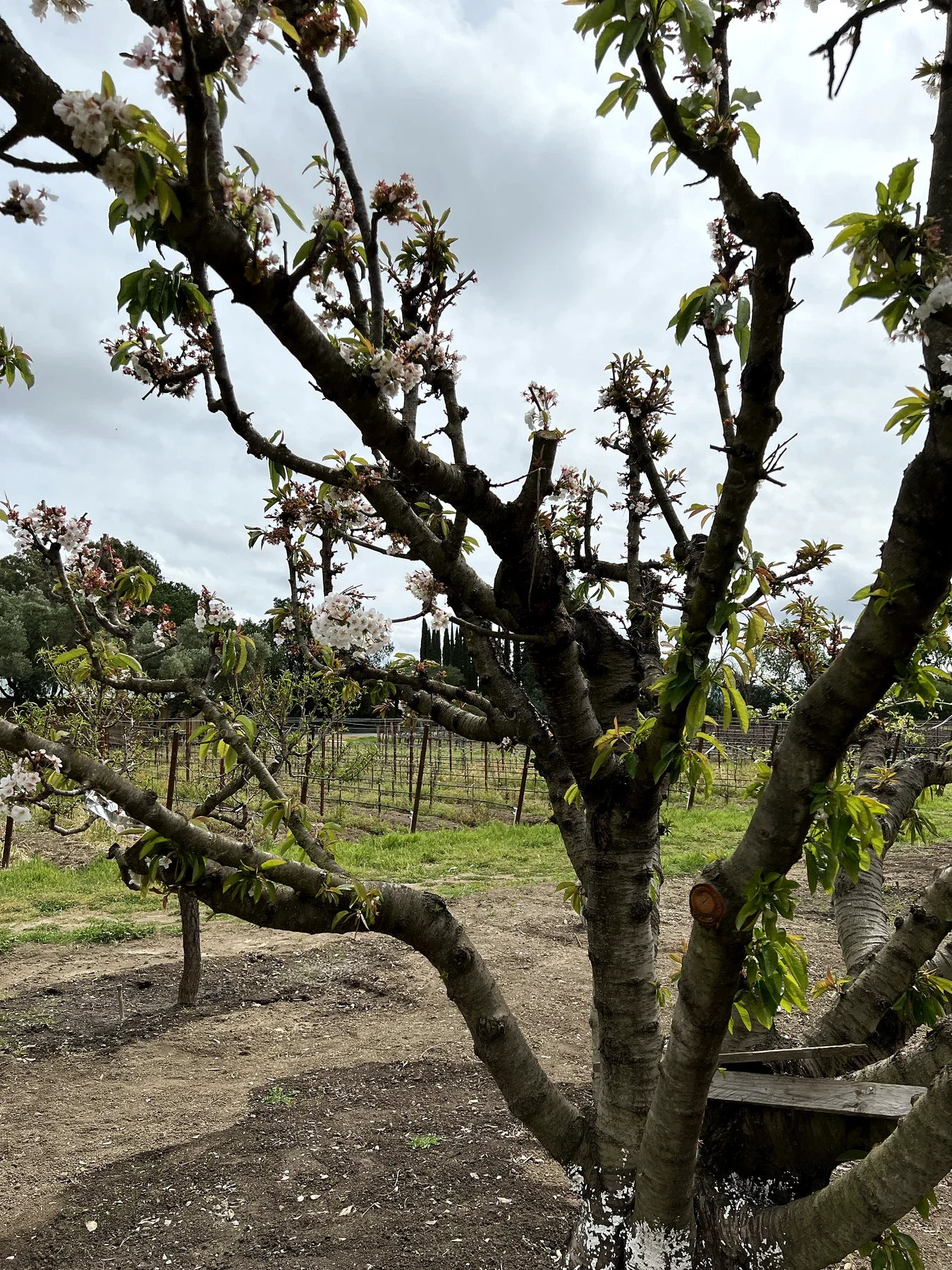
At the estate, that artistic language connects to a living landscape. Kanpai's vineyard history lists fig, olive, persimmon, apple, pear and loquat among the fruit trees, along with a year-round herb garden. Pairing menus can draw ingredients from the farm. The orchard is neither scenery nor a branding metaphor; it is part of how Peter thinks about the table.
Steve Matthiasson was not an outside celebrity attached to the project after it began. His relationship with Meadowbrook's vineyard predates the Chiang family's ownership by more than a decade. He had worked with the site as a farmer and viticulturist, giving him a longer view of the fruit than the young Kanpai label might suggest.
Peter met Steve during a wine-class field trip while in culinary school. Soon after the 2017 fires changed the family's plans, Peter asked him to become Kanpai's partner and winemaker.
The match makes sense. Steve's wines are associated with classical proportions, moderate alcohol, bright acidity and farming-led decisions. Kanpai's official range mostly sits between 12.5 and 13.5 percent alcohol, with the dessert wine as the obvious exception. That is notable in Napa, particularly for Cabernet Sauvignon.
The style does not make the reds slight. The estate Cabernet has structure, dark fruit and tannin. What changes is the emphasis. Savory notes such as tea leaf, olive, cedar and tobacco are allowed to register beside the fruit. Freshness keeps the wines useful through a meal. The point is not to prove that Napa Cabernet can be delicate. It is to show that power can remain articulate.
Meadowbrook Farm sits at the mouth of Dry Creek canyon in the western Oak Knoll District. Its position helps explain the balance in the wines. Cool air descends from Mount Veeder and moderates the afternoon heat, while fog and bay influence make Oak Knoll one of Napa Valley's longer, more even growing environments.
The soils reflect Dry Creek's history. Kanpai describes thin layers of clay mixed with coarse sand above dry cobble and silt. That combination supports drainage while retaining enough moisture and structure for a long season. In the finished Cabernet, the estate identifies a firm backbone of acidity and tannin with savory signatures of olive, tea leaf and tobacco.
The Napa Wine Project describes Meadowbrook as approximately 27 acres, with about 20 acres planted, mostly Cabernet Sauvignon plus a smaller Cabernet Franc block. Kanpai's vineyard history confirms that estate fruit has supplied Stag's Leap Wine Cellars, Robert Mondavi, Joseph Phelps and Opus One.
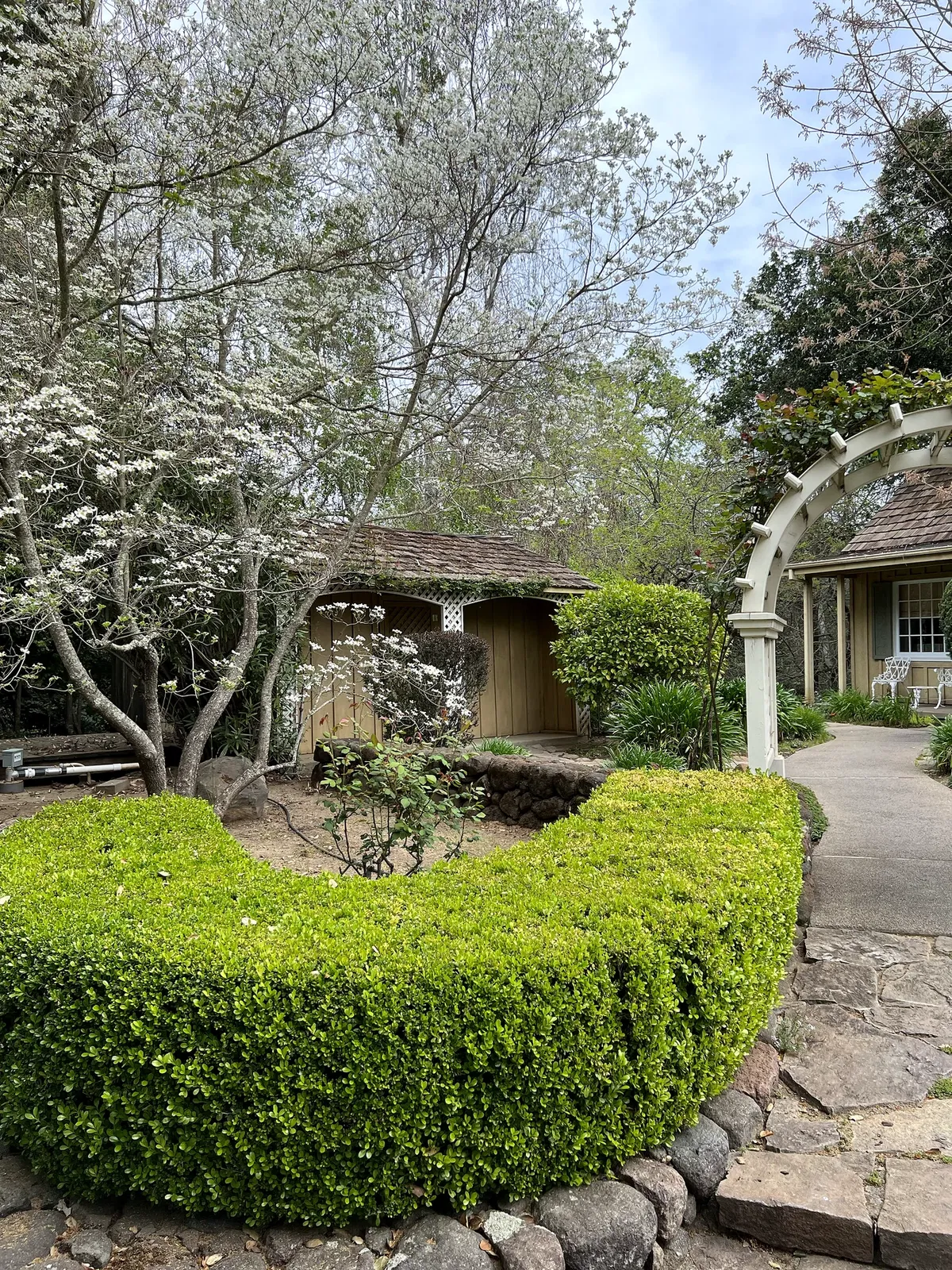
The farming language is equally considered. Kanpai says the vines are organically farmed with limited disruption, cover crops of mustard and pea shoots, and sheep brought in to graze. The fruit trees and herb garden make the property feel abundant, but the viticulture is oriented toward soil life, water penetration and restraint.
The bottle photograph from one of my member visits is a useful record because Kanpai's portfolio has continued to evolve. Across the visits combined here, the photographed lineup included seven expressions: 2018 Mizu No Oto Pinot Noir, two darker reds whose label art aligns with Hikari No Hana and Tsuchi No Koe, 2020 Hi No Tori estate rosé, 2018 Hi No Tori Cabernet Sauvignon, a can of lightly sparkling rosé and 2018 Aki No Mori Chardonnay.
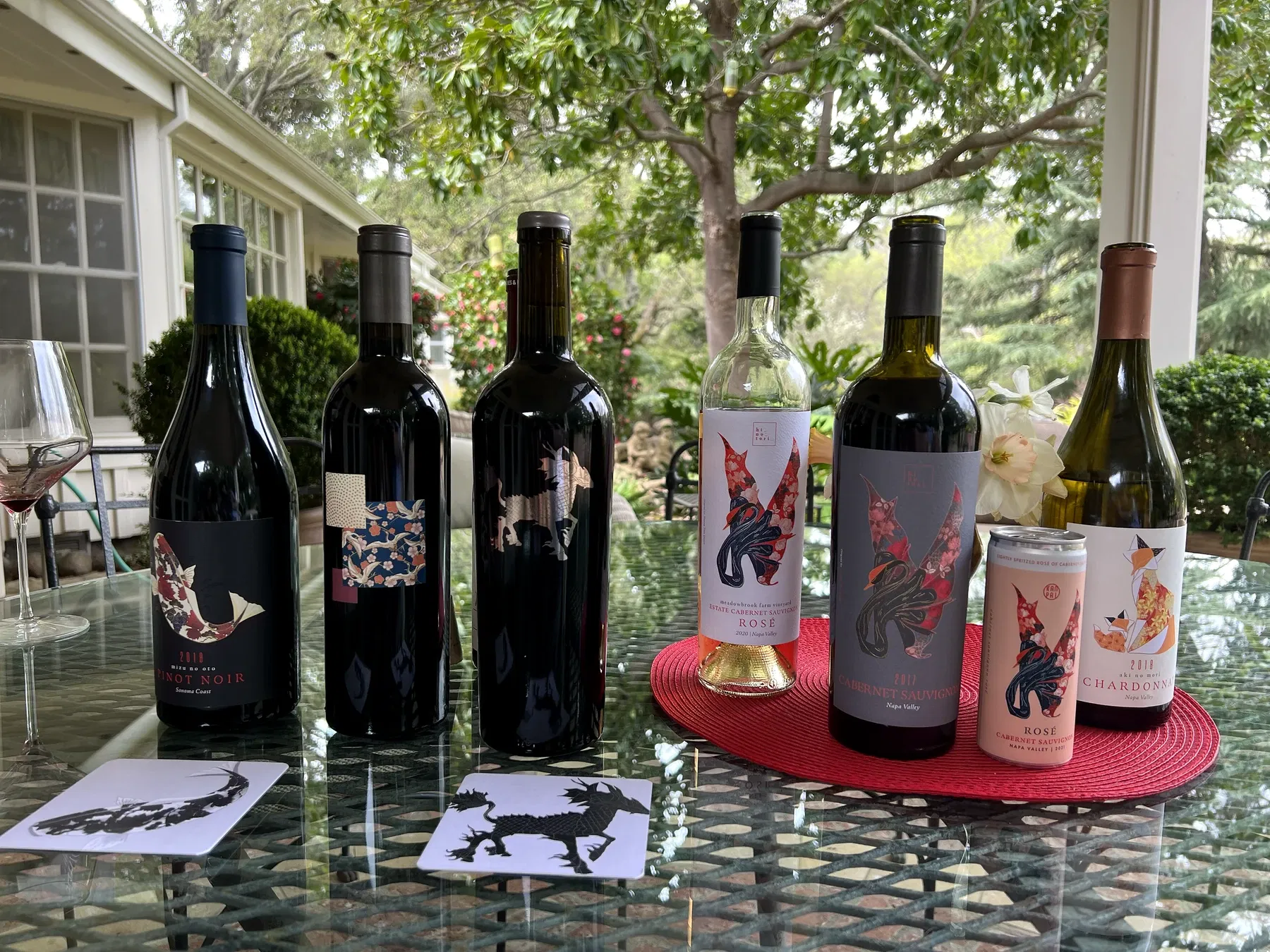
That range demonstrated the project better than a Cabernet-only flight would have. The wines moved between Sonoma Coast Pinot Noir, Coombsville Chardonnay and Meadowbrook's Oak Knoll Cabernet family. Different sites answered different food and emotional contexts, while Steve's preference for balance gave the lineup continuity.
| Wine | Name and origin | Why it matters |
|---|---|---|
| 2018 Mizu No Oto Pinot Noir | “The Sound of Water”; Doña Margarita Vineyard, Sonoma Coast | Koi imagery, perfumed red fruit, forest-floor savor and a silky, food-oriented structure |
| Hikari No Hana Red Wine | “Flowers of Light”; Napa Valley Bordeaux varieties | Cabernet Sauvignon for power, Cabernet Franc for finesse and Merlot for softness |
| Tsuchi No Koe Estate Cabernet Sauvignon | “Voice of the Land”; Meadowbrook Farm, Oak Knoll District | The single-vineyard estate statement, marked by the kirin guardian on its label |
| 2020 Hi No Tori Rosé | “Bird of Fire”; Meadowbrook Farm Cabernet Sauvignon | The wine that began Kanpai and continues to support California fire relief |
| 2018 Hi No Tori Cabernet Sauvignon | Meadowbrook Farm, Oak Knoll District | Plum and blackberry fruit with tea, cedar, tobacco and refreshing structure |
| Hi No Tori sparkling rosé can | Lightly sparkling rosé in a 250-milliliter format | A playful, portable extension of the serious estate-rosé story |
| 2018 Aki No Mori Chardonnay | “The Forest in Fall”; Berry Lane Vineyard, Coombsville | Created as a bright, saline, umami-aware partner for sushi and Asian food |
Years later, what stays with me is the coherence. The Chardonnay was fresh rather than buttery. The Pinot Noir had enough savor to belong at the table. The Cabernets carried structure without giving up energy. The rosé story felt sincere because we were tasting it on the property whose 2017 fruit created the winery.
Kanpai's labels reward attention because the visual choices carry real information. The origami phoenix on Hi No Tori is one direct example, but each bottle extends the family's vocabulary.
Mizu No Oto means “The Sound of Water.” A koi on the label connects the Pinot Noir to calm, intimate drinking. Aki No Mori means “The Forest in Fall.” Its foxes represent Azumi and her Pomeranian, Kiki, while the wine recalls the autumn colors that reminded her of Japan during Napa harvest.
Hikari No Hana means “Flowers of Light.” Cranes and plum blossoms symbolize health, renewal and good fortune. Tsuchi No Koe means “Voice of the Land.” The kirin on the estate Cabernet is a mythical guardian associated with peace, prosperity, kind leadership and bountiful harvest.
The current portfolio has expanded that world. Fuyu No Tsuki, “Winter's Moon,” is a Cabernet Sauvignon dessert wine. Aozora, “Blue Sky,” is an old-vine Zinfandel whose dragon echoes the form of ancient vines. Toki No Kawa, “Time's River,” is a Cabernet Franc whose deer represent Peter, Azumi and their child, Rio.
Those newer releases should not be confused with what I tasted during those visits. They do, however, show that Kanpai's naming system is not a one-time design exercise. It is becoming a family mythology expressed through wine.
The strongest estate tastings create context that cannot be replicated in a retail tasting room. Meadowbrook gave me all of that at once.
I could see the gardens and fruit trees behind Peter's food-first philosophy, understand why a cool Oak Knoll property leads Steve toward freshness, hold a bottle beside the origami animal it references and walk into the carriage house to encounter the railroad passion of a previous owner. The wine became one layer in a larger place.
That intimacy also changed the service rhythm. Across the visits, Craig's hosting never felt like a performance designed to impress a room. Conversation moved between wine, family, the estate and whatever object had caught our attention. The invitation itself carried value because Meadowbrook remained a home and working farm rather than a public attraction.
Years later, staying at Okaeri Calistoga felt like entering a second chapter of the same story. The family's Japanese-inspired inn uses Kanpai wine names for its rooms, pours the wines during social hour and houses a cellar beneath the property. We stayed in Aozora, named for the old-vine Zinfandel.
At Meadowbrook, “kanpai” means raising a glass with people you care about. At Okaeri, “welcome home” becomes the greeting. The two properties are distinct, yet both are built around reducing the distance between guest and host.
For a collector planning a Napa trip, pairing them would create a rare continuity. Ask Kanpai what tasting access is currently possible, then consider staying at Okaeri Calistoga to see how the family's ideas travel from vineyard to inn.
The access model requires precision because current public information and my member visits describe two different doors.
Craig hosted each of my Meadowbrook visits, and estate access was a benefit of my Kanpai membership at the time. Kanpai's current visit page directs public guests to Vintner's Collective, a downtown Napa tasting room representing small producers without conventional public hospitality spaces. That is the reliable public route today.
If your goal is to taste the wines, reserve through Vintner's Collective or contact Kanpai directly. If your goal is specifically to visit Meadowbrook Farm, explain that clearly and ask whether any estate experience is currently offered for your membership tier, allocation relationship or requested date. Do not assume that club membership automatically guarantees the appointment.
Kanpai's current club page lists four-, six- and twelve-bottle options with spring and autumn shipments, year-round wine discounts and an Okaeri lodging benefit. Those benefits and prices can change. Confirm the current terms before joining, especially if estate access is the primary reason.
If I returned, I would ask for particularly personal version Kanpai is comfortable offering rather than trying to maximize the number of wines. A walk through the gardens, time in the train room and a seated tasting with food would be ideal. The estate rewards attention more than pace.
I would also ask which Meadowbrook block supplied each estate wine and whether any current pairing uses fruit or herbs from the property. Peter's culinary perspective deserves to be tasted through food, not treated as biography.
The railroad deserves time too. During my visits, we were told that a Disney engineer helped construct it. Published histories identify prior owner Ronald Birtcher as the commissioner and connect the project to his Southern Pacific business history, but they do not name the engineer. Even without that name, the room's film-set precision is extraordinary.
Kanpai Wines is one of Napa Valley's most personal small-producer stories. It began when the 2017 fires disrupted the Chiang family's plans for Meadowbrook fruit. It found a winemaker who already understood the vineyard. It turned Peter's culinary training and Azumi's Japanese artistic language into wines that ask where, how and with whom they will be opened.
The private estate gives that philosophy a home. Meadowbrook's gardens soften the edges of Napa Cabernet country. Its orchard makes the food conversation tangible. Its historic residence carries the memory of Lenore Stearns. Its carriage house preserves Ronald Birtcher's improbable miniature railroad. The tasting table brings all of those histories back to the present through bottles whose labels look unlike anything else in the valley.
Should you seek it out? Absolutely. Taste the wines, build the relationship and ask respectfully whether a Meadowbrook visit is available as a current member benefit. If the answer is yes, take your time upstairs in the train room, then return to the garden and raise a glass. Few winery experiences make the meaning of “kanpai” feel so complete.
Kanpai means “cheers” in Japanese. For owners Peter Chiang and Azumi Kubo, the name also represents celebration, family, togetherness and sharing life with people you love.
Kanpai's estate vineyard and home, Meadowbrook Farm, is on Dry Creek Road in the Oak Knoll District of Napa Valley. The current public tasting route listed by Kanpai is Vintner's Collective in downtown Napa.
Meadowbrook is not a conventional public tasting room. My estate access came through Kanpai membership, and Craig hosted my visits. Kanpai's current visit page lists Vintner's Collective as the public tasting route. Ask Kanpai directly whether an estate visit is available as a current member benefit.
The wines can be purchased without an estate visit, and public tastings may be arranged through Vintner's Collective. My Meadowbrook visits were a Kanpai membership benefit hosted by Craig; current estate access should be confirmed directly with Kanpai.
Peter Chiang and Azumi Kubo founded Kanpai after acquiring Meadowbrook Farm in 2017. Peter brings a culinary and hospitality perspective, while Azumi shapes much of the Japanese cultural and artistic direction.
Steve Matthiasson is Kanpai's partner and winemaker. His farming and viticultural relationship with Meadowbrook began more than a decade before the Chiang family acquired the estate.
Meadowbrook combines a historic private residence, mature gardens, orchard and Oak Knoll vineyard with an elaborate model railroad hidden above the carriage house. The tasting feels like a personal invitation rather than a conventional public flight.
During my member visits, we were told that a Disney engineer helped construct the room. Published histories identify prior owner Ronald Birtcher as the commissioner and connect the project to his Southern Pacific business history, but they do not name the engineer.
The core portfolio includes Hi No Tori Cabernet Sauvignon and rosé, Aki No Mori Chardonnay, Mizu No Oto Pinot Noir, Hikari No Hana Red Wine and Tsuchi No Koe Estate Cabernet Sauvignon. Newer wines include Aozora Zinfandel, Toki No Kawa Cabernet Franc and Fuyu No Tsuki dessert wine.
Tsuchi No Koe Estate Cabernet Sauvignon is the clearest single-vineyard statement from Meadowbrook Farm. Its name means “Voice of the Land,” and its kirin label symbolizes guardianship, peace and prosperity.
Hi No Tori means “Bird of Fire.” It began as a Cabernet Sauvignon rosé after the 2017 Napa fires altered the family's plans for its grapes. Kanpai continues to donate proceeds from the wine to California fire relief.
The wines favor balance, moderate alcohol, acidity and savory detail. Steve Matthiasson's style gives the reds structure without excessive weight and keeps the Chardonnay and Pinot Noir firmly oriented toward food.
The same family is behind both. Okaeri's rooms are named after Kanpai wines, the inn pours Kanpai during social hour and its cellar extends the wine program into a Japanese-inspired Calistoga stay.
Yes for drinkers who value food-friendly, age-worthy wines, Japanese label art and access to the broader Kanpai and Okaeri world. Review current shipment sizes, discounts and benefits directly with the winery because membership terms can change.
Get the App
Take the shortlist into the En Primeur Club app for concierge access, saved places, and the next step after discovery.
Get Exclusive AccessMore from the editors