Carska

Michelin Plate
Our verdict
Carska occupies what was once the Tsar's private railway station in Białowieża, a forested UNESCO World Heritage site home to Europe's largest bison population. The dining room spans the former rail hall, with summer seating in a converted train carriage, and the menu centers on game and seasonal forage drawn from the surrounding ancient woodland.

Pearl is the En Primeur Club membership app, where members save venues, book tables and use the concierge.
Białowieża sits at the edge of one of Europe's last remaining primeval forests, a UNESCO-protected expanse of oak, hornbeam, and ash that once served as the Tsar's private hunting estate. Carska occupies the railway station built to bring him here, a piece of imperial infrastructure now repurposed as a restaurant and hotel. The building's history and the forest's ecology inform both the menu and the experience. The name translates to 'tsar', and while that nods to the building's past, the kitchen's focus remains rooted in what the forest yields today.
The dining room spans the former railway hall, a high-ceilinged space with exposed beams and industrial bone structure softened by tablecloths and low lighting. In summer, service extends to a converted train carriage on the platform. The scale is modest, the atmosphere quiet, and the clientele tends toward visitors who have come to Białowieża for the forest itself, hikers, wildlife photographers, and travelers chasing bison sightings rather than culinary itineraries. That shapes the mood: Carska functions as a practical anchor for a remote destination, not a stand-alone dining draw, and the kitchen works within that brief.
Cooking Rooted in the Estate and Seasonal Supply
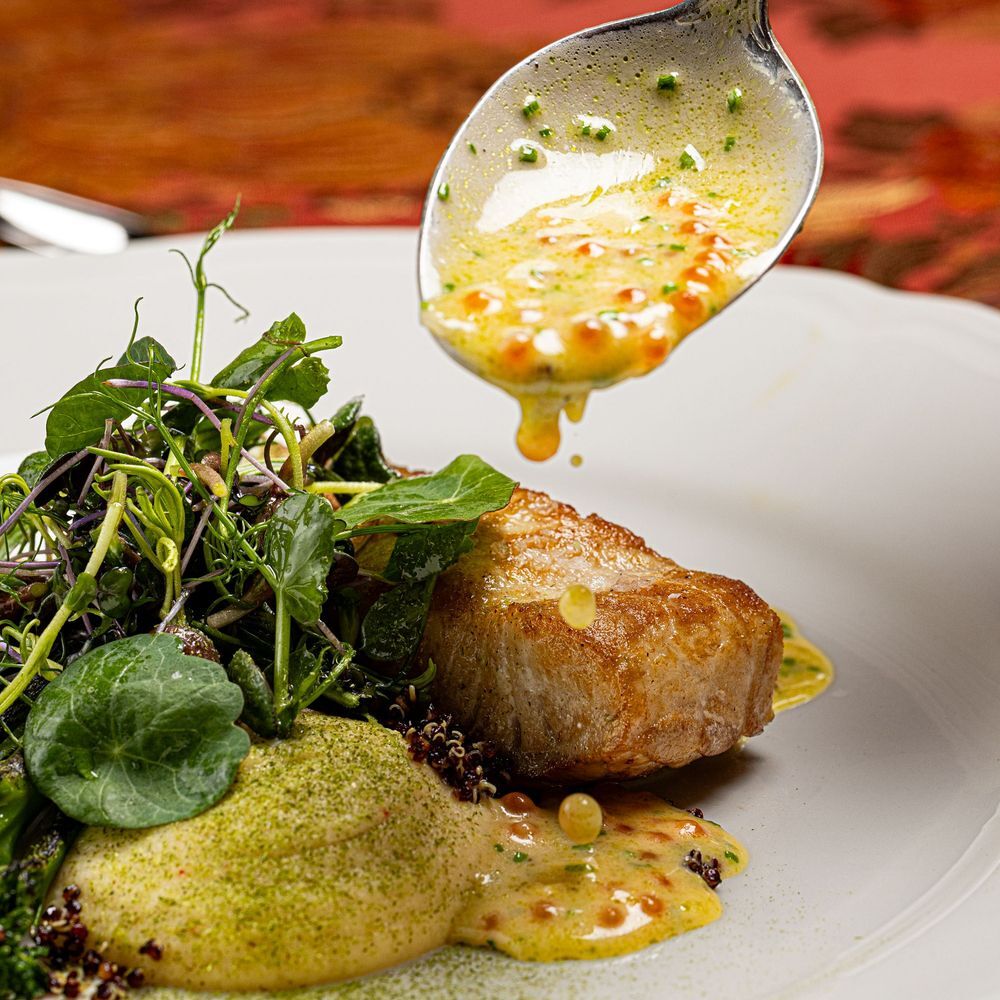
The menu builds on game and forest forage, a reflection of the surrounding landscape rather than a thematic choice. Deer, wild boar, and bison graze the forest, and the kitchen sources locally raised or harvested protein as a matter of proximity and tradition. Fried deer tenderloin appears as a recurring dish, plated with garnishes that shift according to the season, wild mushrooms in autumn, root vegetables through winter, tender greens in spring. The format is direct: protein treated simply, garnish sourced from what the forest or nearby farms are yielding, and technique that favors clarity over invention. It is cooking that expects the ingredient to carry the dish, and in a region where game is abundant and wild forage still part of everyday practice, that approach holds up.
This is not the rarified forest-to-table format seen in Nordic fine dining, where hyper-local sourcing becomes part of a chef's manifesto and plating borders on sculpture. Carska's kitchen follows traditional Polish game cookery, searing, roasting and braising dishes with restraint rather than spectacle. The cooking reads as vernacular rather than progressive, anchored in what the region has done for generations rather than what it might reinterpret. For travelers expecting innovation or tasting-menu ambition, that can feel conservative; for those interested in how a remote Polish forest community eats when it sources from its own terrain, it offers direct insight.
A Venue Shaped by Geography and Visitation Patterns
Poland's broader restaurant landscape has deepened over the past decade, with Michelin recognition arriving in Warsaw, Kraków, and Poznań, and a cohort of chefs applying modern technique to regional Polish ingredients. Carska does not sit in that tier. It operates as a regional venue in a remote location, where the draw is the building and the forest, and the food supports that context rather than competing with urban fine dining. For perspective, travelers comparing Poland's culinary destinations might pair a meal here with more technically ambitious cooking at AHAAN in Warsaw or 3 Rybki in Kraków, both of which operate at a different scale of refinement and service polish.
The venue functions well as part of a multi-day visit to the forest. Białowieża rewards slow exploration, early-morning bison walks, daylight hours spent on foot through the strict reserve, evenings that close down early. Carska fits that rhythm, offering a meal that does not demand much of the diner beyond showing up. For those building a Polish itinerary that includes both urban and rural stops, the restaurant offers a useful counterpoint to city dining: simpler, quieter, and more tightly tied to the immediate environment. For regional activities and accommodation options, see our full Białowieża experiences guide.
Frequently asked questions
What kind of setting is Carska?
You dine in a former railway hall built for the Tsar's shooting estate, now enclosed within a hotel at Stacja Towarowa 4. In summer, seating extends into a stationary train carriage. The architecture is utilitarian-historic rather than ornamental, and the surrounding UNESCO World Heritage forest provides the visual context.
What's Carska's location?
Carska is located at ul. Stacja Towarowa 4, Białowieża, Podlaskie, 17-230, POL, Bia Owieza.
What's Carska best at?
Carska focuses on estate-adjacent game. Fried deer tenderloin with seasonal garnish is a menu anchor, alongside forest forage and local wild stock. The Tsar's railway-station provenance distinguishes the venue historically, and the train-carriage dining format in warm months links the venue to the building's original function.
How Carska Białowieża compares with similar nearby venues.
| Venue | Cuisine | Awards |
|---|---|---|
| CarskaThis venue (the venue you are viewing) | Polish–Kresy–French fine dining | Michelin Plate |
Recognition history
Dated appearances from independent guides and award organizations, with the underlying list record or original source where available.
Michelin Plate
Michelin
Details
- Romantic
- Elegant
- Classic
- Cozy
- Intimate
- Date Night
- Business Dinner
- Group Dining
- Family
- Celebration
- Special Occasion
- Private Event
- Historic Building
- Design Destination
- Hotel Restaurant
- Private Dining
- Standalone
- Local Sourcing
- A La Carte
Elegant, historic interiors styled after the Tsarist era in a restored 1903 wooden railway station, with multiple small rooms offering either intimate, quiet corners or a more convivial, biesiadny (festive) atmosphere; the overall feel is nostalgic, warm, and refined rather than bustling like a typical station.