Kamba Ngaga Lodge

Fodor's Most Incredible Hotels in the World
Kamba Ngaga Lodge sits at the boundary of Odzala-Kokoua National Park in the Republic of the Congo, operating closer to a field research station than a conventional wilderness lodge. The architecture and philosophy are calibrated to forest immersion rather than resort comfort, placing it in a narrow tier of Central African properties where ecological access is the primary offering.

Pearl is the En Primeur Club membership app, where members save venues, book tables and use the concierge.
Where the Forest Sets the Terms
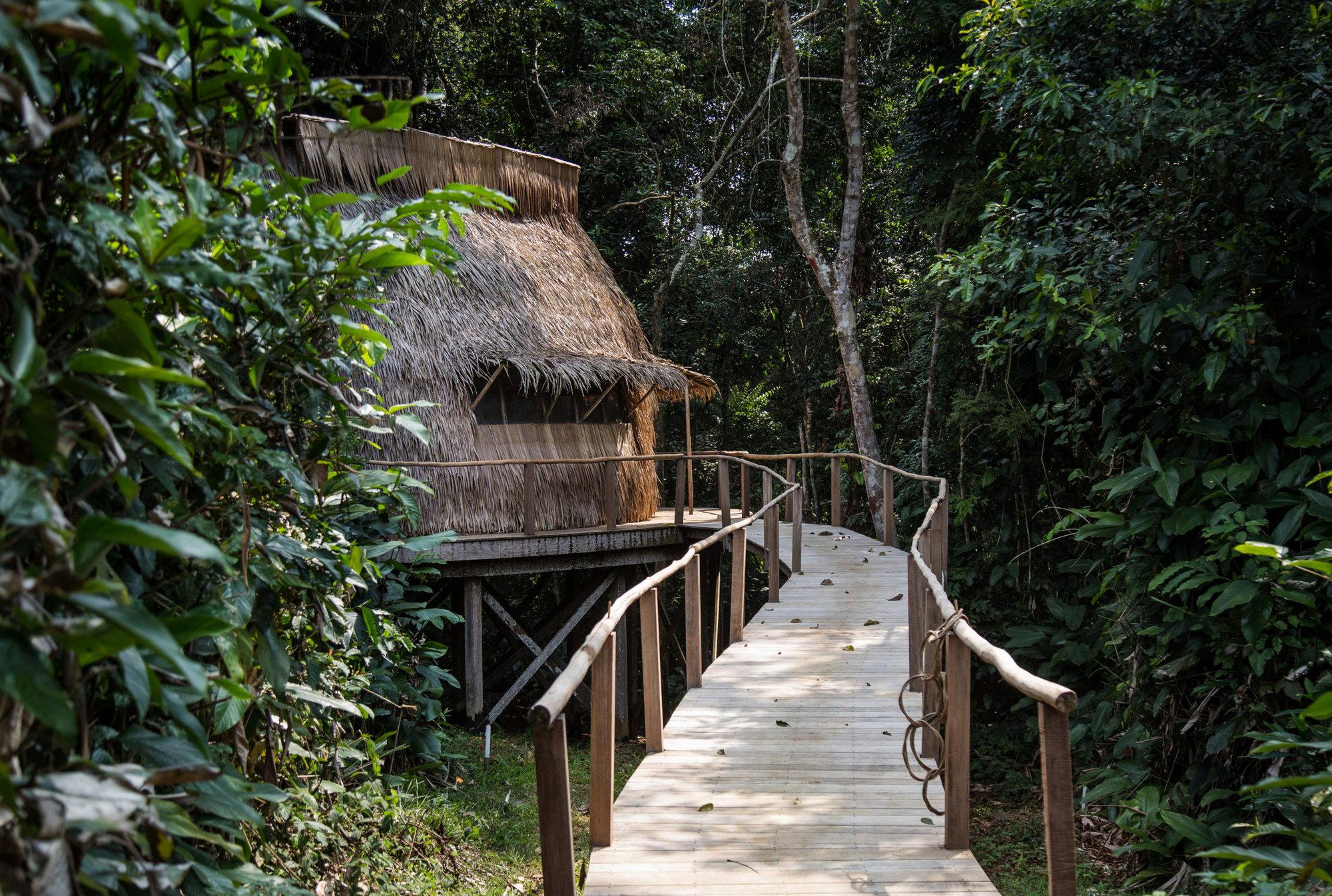
There is a category of wilderness lodge that makes no concession to the idea of a holiday. Kamba Ngaga Lodge, positioned at the edge of Odzala-Kokoua National Park in the Sangha region of the Republic of the Congo, belongs to that category. The park itself covers roughly 13,600 square kilometres of Congo Basin rainforest, one of the largest intact tropical forest ecosystems remaining on Earth. Arriving at Ngaga is not a transition from urban life to managed nature, it is an abrupt entry into a working forest, dense and indifferent to guests. The lodge reads accordingly: the structure is deliberately low-key, conceived to occupy rather than interrupt the treeline. This is design in its most restrained form, and it sets the editorial frame for everything that follows.
Architecture as Deference
The buildings at Ngaga have been described in terms that echo research infrastructure more than hospitality architecture. That framing is earned. In a region where the default for premium wilderness accommodation tends toward theatrical tented camps or refined boardwalk compounds, Ngaga takes a different position. The physical form stays close to the forest floor, using materials and a palette that absorb rather than contrast with the surrounding canopy. The effect is less resort and more outpost: functional, spare, and organised around observation rather than amenity.
This design posture is a meaningful editorial choice in the context of Central African lodge development. Properties in East Africa have long set the benchmark for luxury safari design, from stone-and-canvas heritage camps in the Maasai Mara to high-design glass-and-timber structures in the Okavango. Central Africa, by contrast, has a much smaller inventory of comparable properties, and the few that exist tend to prioritise ecological access over aesthetic ambition. Ngaga fits that pattern, but with a coherence of intent that separates it from a lodge that simply lacks design resources: the research-station aesthetic appears considered, not accidental.
For travellers whose reference points are properties like Amangiri in Canyon Point or Castello di Reschio in Lisciano Niccone, both of which embed architecture deeply into landscape logic, Ngaga occupies a recognisable position on that spectrum, even if the price tier, setting, and purpose differ considerably. The shared thread is a design philosophy that treats the surrounding environment as the primary spatial experience, with built structures acting as threshold rather than destination.
The Odzala-Kokoua Context
Odzala-Kokoua is one of Africa's oldest protected areas, gazetted initially in 1935 and expanded substantially in subsequent decades. It sits within the Congo Basin, which holds the second-largest tropical rainforest on the planet after the Amazon. The park's biodiversity profile includes western lowland gorillas, forest elephants, bongo, and a primate census that draws researchers from international conservation institutions. Ngaga Lodge's position on the park boundary is not incidental, it is the central value proposition.
Habituation programmes of this kind require years of field investment before guests can participate. The western lowland gorilla groups accessible from Ngaga represent conservation infrastructure as much as tourism infrastructure. That dual status shapes how the lodge operates and why the research-outpost framing holds: the guests and the scientists are, in a meaningful sense, using the same asset.
Positioning Within the Central African Accommodation Set
The Republic of the Congo's broader accommodation profile sits far from the luxury tier that operates across parts of East Africa and southern Africa. Kinshasa, in the neighbouring Democratic Republic of the Congo, offers branded urban hotels including the Hilton Kinshasa, while Brazzaville, the Congolese capital, anchors its premium accommodation around the Radisson Blu M'Bamou Palace Hotel. Both properties serve a business and diplomatic traveller base and operate within the conventions of international chain hospitality. Ngaga sits in an entirely different register: remote, single-purpose, and oriented entirely toward ecological access rather than urban convenience.
That separation is worth understanding before travel. The lodge is not a luxury escape with a gorilla excursion attached. It is a gorilla access operation with accommodation attached. Travellers expecting the formal service architecture of, say, Mandarin Oriental Bangkok or the refined European hotel tradition of Le Bristol Paris will find themselves recalibrating rapidly. That recalibration is part of the experience, and for the right traveller, it is the point.
Properties like Hotel Esencia in Tulum or One&Only; Mandarina in Riviera Nayarit have built their identities around nature-embedded architecture while retaining substantial amenity infrastructure. Ngaga makes fewer amenity concessions, and is candid about that. The trade-off is access to a forest ecosystem and a gorilla habituation programme that most travellers will never encounter anywhere else on the itinerary.
Planning and Access
Reaching Mbomo requires navigating a logistics chain that reflects the region's infrastructure realities. Most itineraries route through Brazzaville before connecting onward to the Odzala region, typically via chartered light aircraft to an airstrip serving the park. The journey is long and the connections are limited, which means booking requires lead time and a tolerance for the kind of travel where not everything runs on schedule. Confirmation of gorilla tracking permits and availability should be established well in advance of travel, as group access is limited and allocations fill during peak wildlife season.
For a fuller picture of what the Mbomo region offers, see our full Mbomo guide.
Side-by-Side Snapshot
| Venue | Price | Awards |
|---|---|---|
| Kamba Ngaga LodgeThis venue (the venue you are viewing) | Not listed | Fodor's Most Incredible Hotels in the World |
| Hilton Kinshasa | $200–300 | World Luxury Hotel Awards WLHA Country Winner |
| Radisson Blu M’Bamou Palace Hotel | Not listed | World Luxury Hotel Awards WLHA Regional Winner |
Recognition history
Dated appearances from independent guides and award organizations, with the underlying list record or original source where available.
Fodor's Most Incredible Hotels in the World
Fodor's
Details
- Quiet
- Scenic
- Rustic
- Intimate
- Romantic Getaway
- Wellness Retreat
- Weekend Escape
- Group Retreat
- Panoramic View
- Garden
- Terrace
- Wi Fi
- Room Service
- Concierge
Serene forest immersion with natural sounds of birds, monkeys, and insects; open-air decks and thatch-roofed bungalows foster deep connection to pristine wilderness.